
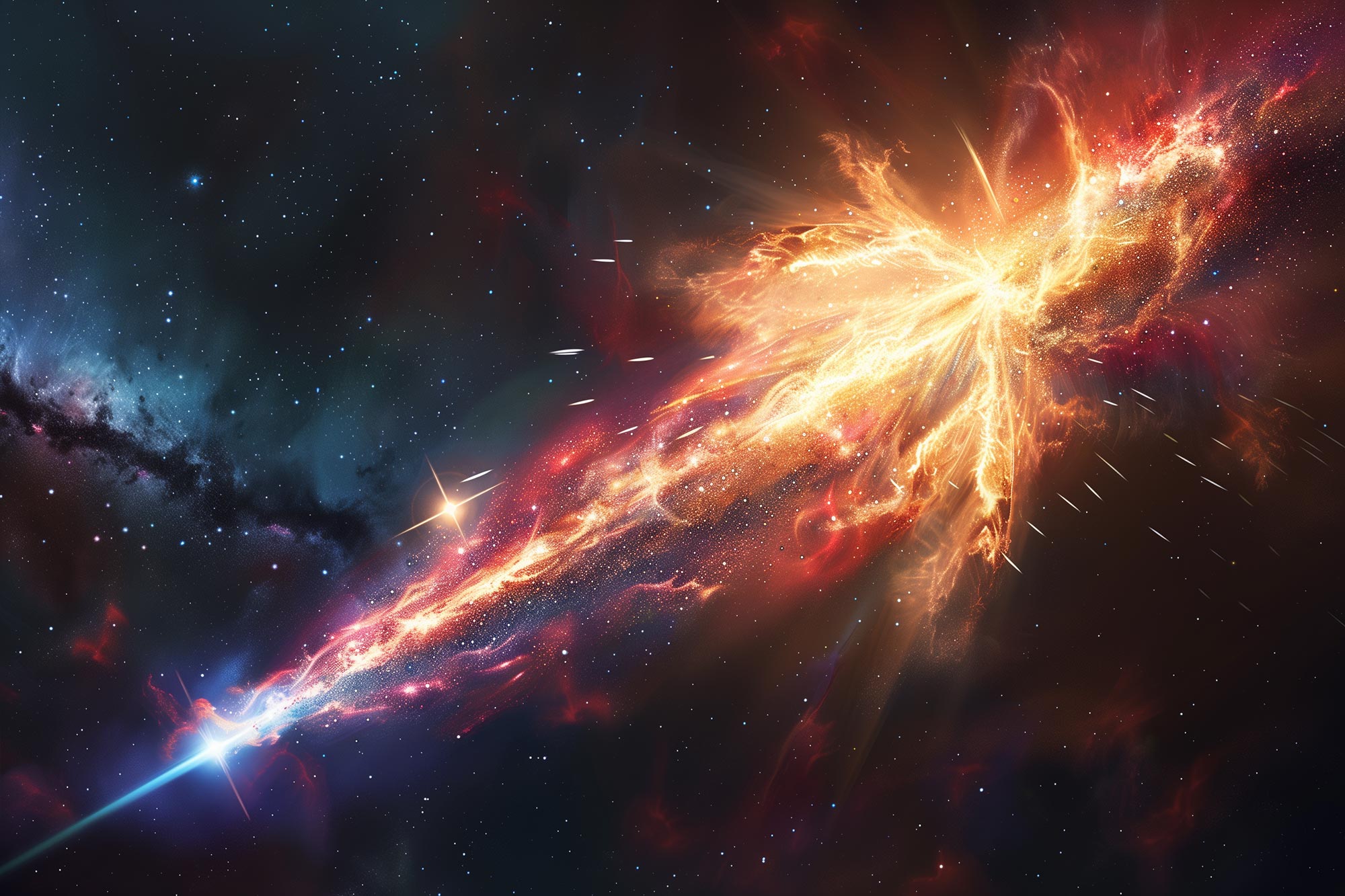
Researchers link two ancient mass extinctions to nearby supernova explosions, which may have damaged Earth’s atmosphere and triggered global biodiversity loss.
A new study suggests that at least two of Earth’s mass extinction events may have been triggered by the powerful effects of nearby supernova explosions.
Researchers from Keele University propose that these massive stellar blasts, caused by the collapse and explosion of large stars, could have severely disrupted Earth’s atmosphere. The explosions may have destroyed the ozone layer, triggered acid rain, and exposed life on Earth to dangerous levels of ultraviolet radiation from the Sun.
The team points to the Ordovician and late Devonian extinction events, which occurred around 445 million and 372 million years ago, respectively, as likely candidates influenced by such cosmic events.
The Ordovician extinction killed 60 percent of marine invertebrates at a time when life was largely confined to the sea, while the late Devonian wiped out around 70 percent of all species and led to huge changes in the kind of fish that existed in our ancient seas and lakes.
Past research has failed to identify a clear cause for either event, although they are thought to have been linked to the depletion of Earth’s ozone layer, which could have been triggered by a supernova.
New Study Backs Supernova Link
The new study, published today in Monthly Notices of the Royal Astronomical Society, found that the rate supernovae occur near to our planet is consistent with the timings of both mass extinctions.
The authors say it is a “a great illustration for how massive stars can act as both creators and destructors of life.”
That’s because supernovae are also known to spread the heavy elements that help form and support life across the universe.

Supernovae occur when massive stars reach the end of their lives, run out of fuel, cool off, and then collapse under the pressure of gravity. The explosions are the biggest humans have ever seen.
Lead author Dr Alexis Quintana, formerly from Keele University and now at the University of Alicante, said: “Supernova explosions bring heavy chemical elements into the interstellar medium, which are then used to form new stars and planets. But if a planet, including the Earth, is located too close to this kind of event, this can have devastating effects.”
Dr Nick Wright, from Keele University, added: “Supernova explosions are some of the most energetic explosions in the universe. If a massive star were to explode as a supernova close to the Earth, the results would be devastating for life on Earth. This research suggests that this may have already happened.”
Mapping Stellar Threats
The researchers came to their conclusion after carrying out a “census” of massive stars within a kiloparsec (around 3,260 light-years) of the Sun.
They were studying the distribution of these massive stars, known as OB stars, to learn more about how star clusters and galaxies form by using the Milky Way itself as a benchmark, and the rate at which these stars form in our galaxy.
This census allowed the researchers to calculate the rate at which supernovae occur within the galaxy, which is important for observations of supernovae, and the production of supernova remnants and massive stellar remnants such as black holes and neutron stars throughout the universe.
The data will also be useful for the future development of gravitational wave detectors, which are a useful tool for scientists studying the structure and origins of the universe.
As part of this, the research team calculated the supernova rate within 20 parsecs of the Sun, or approximately 65 light-years, and compared this with the approximate rate of mass extinction events on Earth that have previously been attributed to nearby supernovae.
This excludes extinction events linked to other factors such as asteroid impacts or the ice ages.
Comparing these data sets, the experts found that their research supported the theory that a supernova explosion was responsible for both the late Devonian and Ordovician extinction events – two of the five known mass extinctions in Earth’s history.
“We calculated the supernova rate close to Earth and found it to be consistent with the rate of mass extinction events on our planet that have been linked to external forces such as supernovae,” Dr Wright explained.
Astronomers believe about one or two supernovae – or possibly at a rate even lower than that – occur each century in galaxies like the Milky Way, but the good news is there are only two nearby stars which could go supernova within the next million years or so: Antares and Betelgeuse.
However, both of these are more than 500 light-years away from us and computer simulations have previously suggested a supernova at that distance from Earth likely wouldn’t affect our planet.
Reference: “A census of OB stars within 1 kpc and the star formation and core collapse supernova rates of the Milky Way” by Alexis L Quintana, Nicholas J Wright and Juan Martínez García, 18 March 2025, Monthly Notices of the Royal Astronomical Society.
DOI: 10.1093/mnras/staf083
Never miss a breakthrough: Join the SciTechDaily newsletter.
Follow us on Google and Google News.
5 Comments
🤞 for a new cleansing
Same. We need it.
Wouldn’t the loss of the semi-permanent ozone layer just result in the absorption of the UV at lower altitudes?
Or a solar micronova from our own sun seems more likely.
“Likely wouldn’t affect our planet” isn’t the same as definitely wouldn’t.