

Researchers have developed a novel metasurface-based method to generate terahertz complex vector light fields using surface waves.
A recent paper in Opto-Electronic Sciences explores the generation of terahertz complex vector light fields on a metasurface driven by surface waves.
As information and communication technologies advance—particularly with the rise of 5G and 6G networks, artificial intelligence, and the Internet of Things—there is a growing demand for on-chip optical control devices that offer high bandwidth, fast operation, low power consumption, and compact size. However, conventional optical devices often struggle with limitations such as bulkiness, low efficiency, and restricted control capabilities.
Metasurfaces are a novel class of optical devices composed of ultra-thin, subwavelength artificial structures arranged in precise patterns. These engineered surfaces enable extraordinary optical effects, including anomalous reflection and refraction, planar prisms, holographic imaging, and surface wave excitation. Recent research has explored the use of on-chip surface waves as an excitation source, leveraging metasurfaces to efficiently decouple surface waves and control wavefronts in free space, expanding possibilities for on-chip optical applications.
However, most previous studies have focused primarily on phase control. Achieving simultaneous control over phase, amplitude, and polarization remains a major challenge, yet it is essential for more flexible and advanced light field manipulation.
A Novel Method for Generating Complex Vector Beams
This paper proposes a general method for designing ultra-compact on-chip optical devices that can efficiently generate pre-designed complex wavefront vector beams (VOFs) under surface wave (SW) excitation, with experimental verification in the terahertz (THz) frequency range.
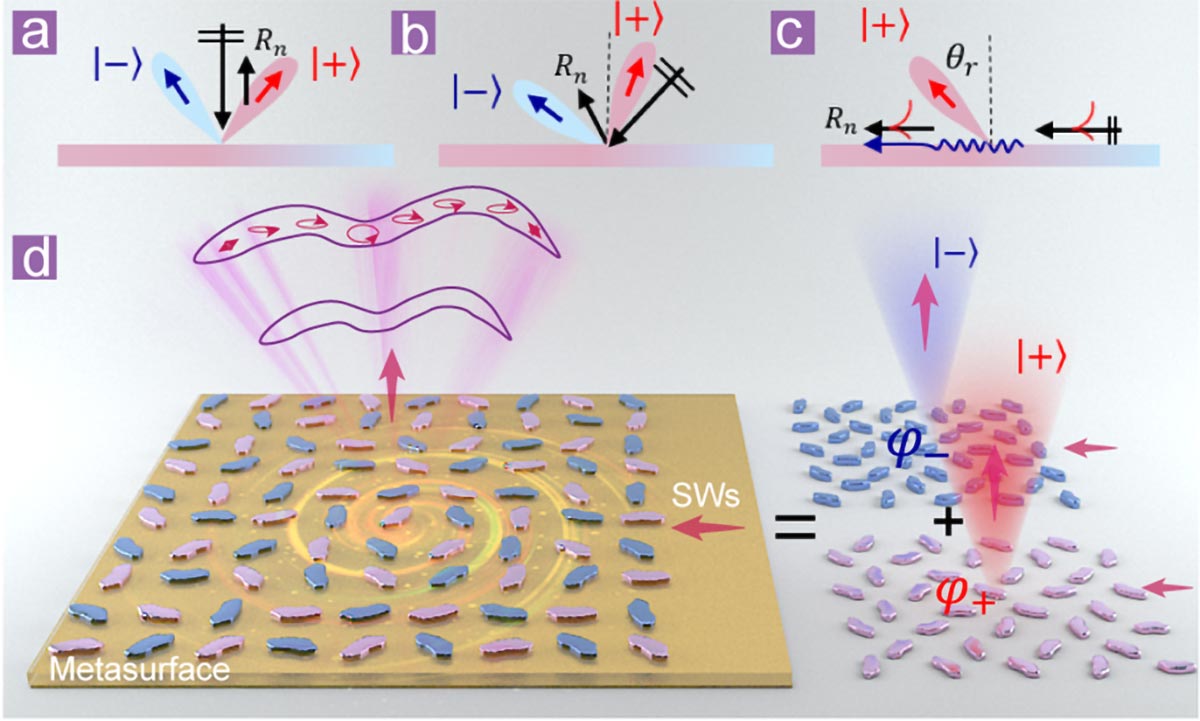
For reflective metasurface devices with linear geometric phase, when illuminated by linearly polarized light in the vertical direction, the scattered field will simultaneously contain both spin-related and spin-independent anomalous and normal modes (as shown in Fig. 1a).
As the incident angle increases, one of the anomalous modes and normal modes, after being manipulated by the metasurface, both have their reflection angles gradually increase. When the incident wave is an on-chip surface wave, the mode “surviving” in free space is a specific circularly polarized light, and both the radiation angle and polarization state of this mode can be arbitrarily controlled by precisely designing the phase gradient of the metasurface (Fig. 1b, c).
Composite Metasurfaces for Complex Vector Light Fields
Building on the above concepts, researchers have further proposed the idea of designing composite metasurfaces to radiate complex vector light fields. The traditional single “artificial atom” is expanded into a 2×2 “artificial molecule,” where the different subunits (blue and purple) have independent rotation angles and directions.
Under the illumination of surface waves, these subunits can simultaneously radiate left-handed circular polarization (LCP) and right-handed circular polarization (RCP) components. By controlling the local phase and polarization components through interference effects, specific wavefronts and polarization distributions of vector beams can be constructed on a macroscopic scale (Fig. 1d).
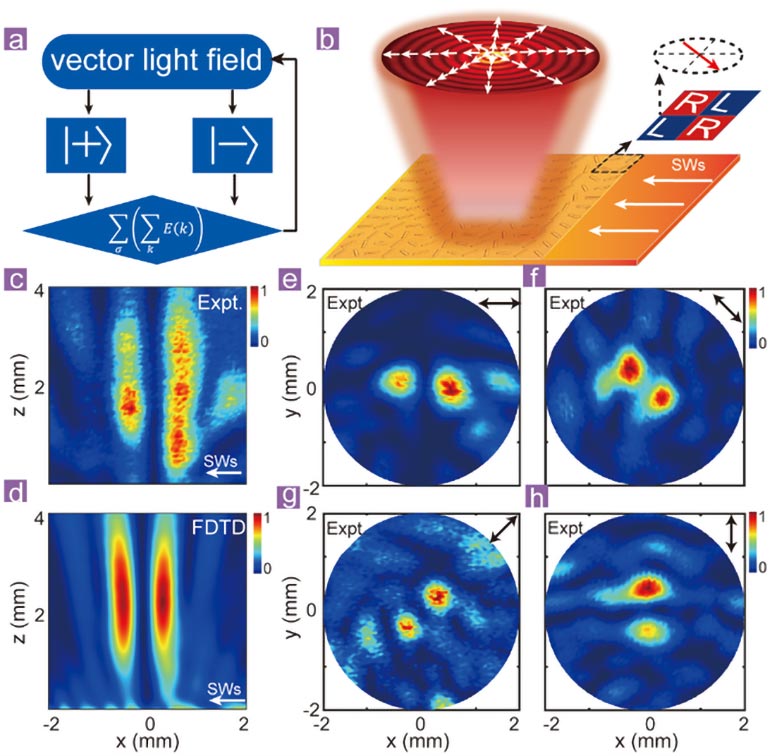
To achieve this concept, researchers have developed a universal design method that decomposes the target vector light field into a sum of different wave vectors and circular polarization basis vectors. Through the mapping relationship between the target total field and the artificial atoms, the design parameters of the composite metasurface are determined, ultimately completing the design of the prototype device (Fig. 2a).
For example, the researchers developed a terahertz device that generates a radially polarized Bessel beam under surface wave excitation. Using full-wave simulation and near-field scanning, the light field morphology was demonstrated in different planes and polarization directions, showing excellent agreement, thereby verifying the device’s outstanding performance (Fig. 2b-g). This research provides a new approach for achieving highly integrated on-chip terahertz devices, with broad application prospects in fields such as biosensing, high-speed communication, lidar, and augmented and virtual reality (AR/VR).
Reference: “Efficient generation of vectorial terahertz beams using surface-wave excited metasurfaces” by Zhuo Wang, Weikang Pan, Yu He, Zhiyan Zhu, Xiangyu Jin, Muhan Liu, Shaojie Ma, Qiong He, Shulin Sun and Lei Zhou, 15 January 2025, Opto-Electronic Science.
DOI: 10.29026/oes.2025.240024
Never miss a breakthrough: Join the SciTechDaily newsletter.
Follow us on Google and Google News.
2 Comments
For reflective metasurface devices with linear geometric phase, when illuminated by linearly polarized light in the vertical direction, the scattered field will simultaneously contain both spin-related and spin-independent anomalous and normal modes.
VERY GOOD.
Ask the researchers:
Is the spin you observed related to topological spin?
Scientific research guided by correct theories can enable researchers to think more.
A topological vortex is a concept in physics that describes the natural gravitational field or the fluid-body coupled system. A topological vortex is formed by the interaction and balance of vortex and anti-vortex field pairs, which can be set into resonance by the body motion and interaction.
Topological Vortex Theory (TVT) treats space as an ideal fluid, posits that the topological vortex gravitational field is fundamental to the structure of the universe, and emphasizes the importance of topological phase transitions in understanding mass, inertia, and energy.
According to the Topological Vortex Theory (TVT), spins create everything, spins shape the world. There are substantial distinctions between Topological Vortex Theory (TVT) and traditional physical theories. Grounded in the inviscid, incompressible, and isotropic spaces, TVT introduces the concept of topological phase transitions and employs topological principles to elucidate the formation and evolution of matter in the universe, as well as the impact of interactions between topological vortices and anti-vortices on spacetime dynamics and thermodynamics.
Within TVT, low-dimensional spacetime matter serves as the foundation for high-dimensional spacetime matter, and the hierarchical structure of matter and its interaction mechanisms challenge conventional macroscopic and microscopic interpretations. The conflict between Quantum Physics and Classical Physics can be attributed to their differing focuses: Quantum Physics emphasizes low-dimensional spacetime matter, whereas Classical Physics centers on high-dimensional spacetime matter.
Subatomic particles in the quantum world often defy the familiar rules of the physical world. The fact repeatedly suggests that the familiar rules of the physical world are pseudoscience. In the familiar rules of the physical world, two sets of cobalt-60 can form the mirror image of each other by rotating in opposite directions, and should receive the Nobel Prize for physics.
Please witness the grand performance of some so-called peer review publications (including PRL, PNAS, Nature, Science, etc.). https://scitechdaily.com/microscope-spacecrafts-most-precise-test-of-key-component-of-the-theory-of-general-relativity/#comment-854286. Some so-called academic publications (including PRL, PNAS, Nature, Science, etc.) are addicted to their own small circles and have deviated from science for a long time.
As the background of various material interactions and movements, space exhibits inviscid, absolutely incompressible and isotropic physical characteristics. It may form various forms of spacetime vortices through topological phase transitions. Hence, vortex phenomena are ubiquitous in cosmic space, from vortices of quantum particles and living cells to tornados and black holes. Stars and radioactive elements are one of the most active topological nodes in spacetime. Utilizing them is more valuable and meaningful than simulating them. Small or micro power topology intelligent batteries may be the direction of future energy research and development for human society.
Under the topological vortex architecture, science and pseudoscience are clear at a glance. Topological Vortex Theory (TVT) can play a crucial role in elucidating the foundations of physics, establishing its principles, and combating pseudoscience. Therefore, TVT has been strongly opposed and boycotted by traditional so-called peer review publications (such as PRL, PNAS, Nature, Science, etc.).
These so-called peer review publications (including PRL, PNAS, Nature, Science, etc.) mislead the direction of science and are known for their various absurdities and wonders. They collude together, reference each other, and use so-called Impact Factor (IF) or the Nobel Prize to deceive people around.
Ask the so-called peer review publications (including PRL, PNAS, Nature, Science, etc.):
1. What are your criteria for distinguishing science from pseudoscience?
2. Is your Impact Factor (IF) the standard for distinguishing science from pseudoscience?
3. Is the Nobel Prize the standard for distinguishing science from pseudoscience?
4. What is the most important aspect of academic publications?
5. Is the most important aspect of academic publications being flashy and impractical articles?
Pseudo academic publications (including PRL, PNAS, Nature, Science, etc.) are neither inclusivity nor openness, nor transparency and fairness, and have already had a serious negative impact on the progress of science and technology. Some so-called peer review publications (including PRL, PNAS, Nature, Science, etc.) are addicted to their own small circle and no longer know what science is. They hardly know what is dirty and ugly.
Publications that mislead the public under the guise of scholarship are more reprehensible than ordinary publications. The field of physics faces an ongoing challenge in maintaining scientific rigor and integrity in the face of pervasive pseudoscientific claims. Fighting against rampant pseudoscience, physics still has a long way to go.
While my comments may be lengthy, they are necessary to combat the proliferation of rampant pseudoscience and to promote the advancement of science and technology, and also is all I can do.
Appreciate the SciTechDaily for its inclusivity, openness, transparency, and fairness. If the researchers are truly interested in cosmic matter, please read: A Brief History of the Evolution of Cosmic Matter (https://scitechdaily.com/microscope-spacecrafts-most-precise-test-of-key-component-of-the-theory-of-general-relativity/#comment-873523).
Topological Vortex Theory (TVT) is based on topology and fluid dynamics, which have solid mathematical and physical foundations. Under the topological vortex architecture, science and pseudoscience are clear at a glance. Topological Vortex Theory (TVT) can play a crucial role in elucidating the foundations of physics, establishing its principles, and combating pseudoscience.
However, some individuals, some AI (https://zhuanlan.zhihu.com/p/23079945169), and some so-called peer review publications (including PRL, PNAS, Nature, Science, etc.) stubbornly believe that two sets of cobalt-60 can form the mirror image of each other by rotating in opposite directions (https://scitechdaily.com/microscope-spacecrafts-most-precise-test-of-key-component-of-the-theory-of-general-relativity/#comment-854286), and stubbornly believe that the Topological Vortex Theory (TVT) currently lacks validation. This is because they have been misled by pseudoscientific information.
Vortex phenomena are ubiquitous in cosmic space, from vortices of quantum particles and living cells to tornados and black holes. The inviscid and incompressible spaces have been widely used in engineering simulation (https://scitechdaily.com/microscope-spacecrafts-most-precise-test-of-key-component-of-the-theory-of-general-relativity/#comment-870077). These all are the most powerful verification.
Ask some so-called peer review publications (including PRL, PNAS, Nature, Science, etc.) again:
1. Does space not exist?
2. Does time not exist?
3. Does the ideal fluid not exist?
4. Do scientific experiments require time and space?
5. Do certain engineering simulations require ideal fluids?
6. If non-existent things are applied to scientific experiments and engineering simulations, and good results can be achieved. So, what is the difference between the non-existent thing and God?
Some individuals and some so-called peer review publications (including PRL, PNAS, Nature, Science, etc.) have been misleading the public with confusing concepts (https://pic2.zhimg.com/v2-4127b0b58fe8b88feb27c189fb705029_1440w.jpg?source=172ae18b), unscientific logic and reasoning, and self righteous Impact Factor (IF), hindering the progress of science and technology.
Fighting against rampant pseudoscience, physics still has a long way to go.