
Close Menu
    Facebook X (Twitter) Instagram
    SciTechDaily
    • Biology
    • Chemistry
    • Earth
    • Health
    • Physics
    • Science
    • Space
    • Technology
    Facebook X (Twitter) Pinterest YouTube RSS
    SciTechDaily
    Home»Space»Surprise Twist Suggests Stars Grow Competitively – Unprecedented High-Resolution Map of the Orion Nebula Cluster
    Space

    Surprise Twist Suggests Stars Grow Competitively – Unprecedented High-Resolution Map of the Orion Nebula Cluster

    By National Institutes of Natural SciencesMay 15, 20211 Comment3 Mins Read
    Facebook Twitter Pinterest Telegram LinkedIn WhatsApp Email Reddit
    Share
    Facebook Twitter LinkedIn Pinterest Telegram Email Reddit
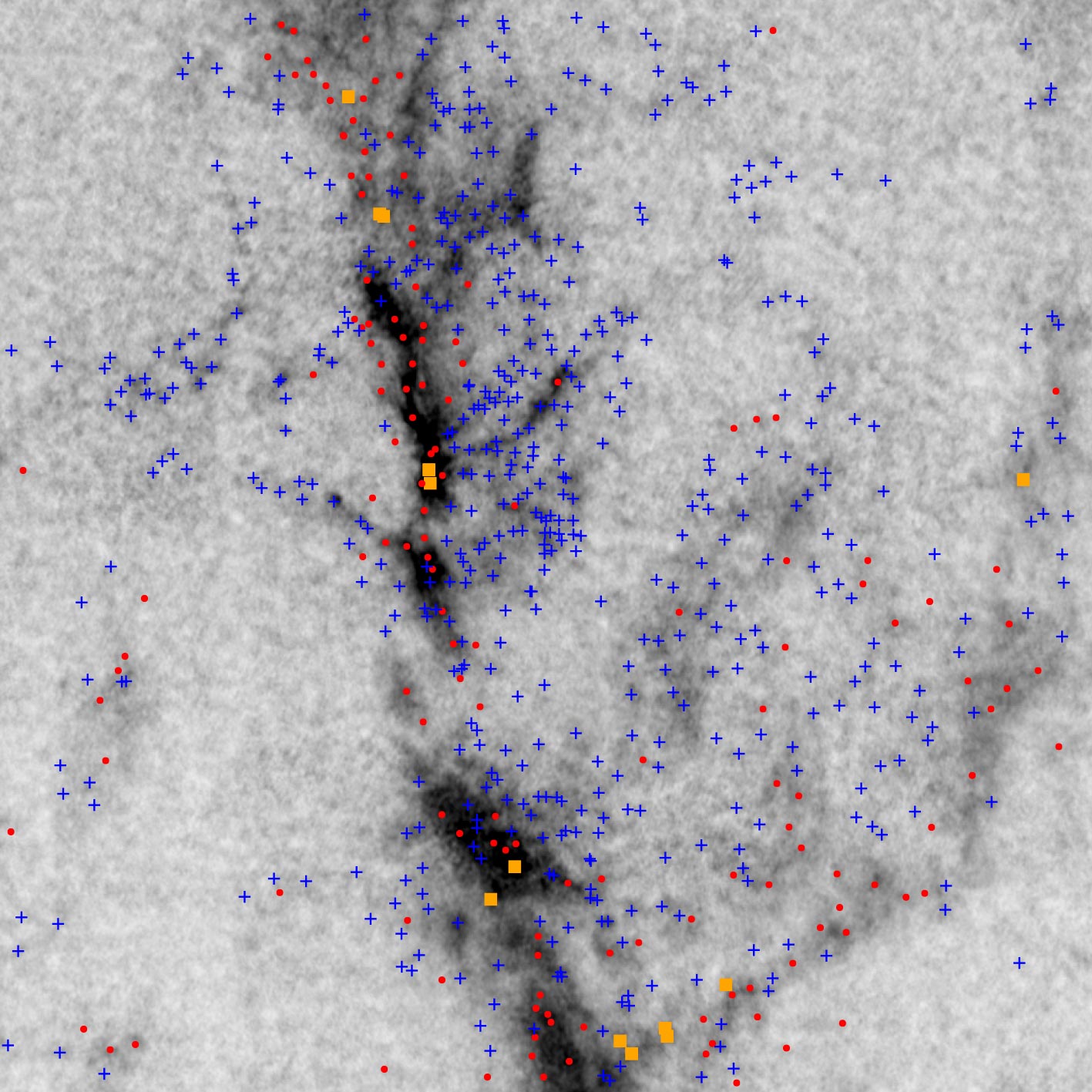
    Orion Nebula Cluster Map
    Unprecedented high-resolution map of the Orion Nebula Cluster showing newborn stars (orange squares), gravitationally collapsing gas cores (red circles), and non-collapsing gas cores (blue crosses). Credit: Takemura et al.

    Research in the Orion Nebula Cluster supports the competitive accretion model of star formation, showing that a star’s final mass depends more on gas accretion during growth than on the initial mass of its gas core.

    A survey of star formation activity in the Orion Nebula Cluster found similar mass distributions for newborn stars and dense gas cores, which may evolve into stars. Counterintuitively, this means that the amount of gas a core accretes as it develops, and not the initial mass of the core, is the key factor in deciding the final mass of the produced star.

    The Universe is populated with stars of various masses. Dense cores in clouds of interstellar gas collapse under their own gravity to form stars, but what determines the final mass of the star remains an open question. There are two competing theories. In the core-collapse model, larger stars form from larger cores. In the competitive accretion model, all cores start out about the same mass but accrete different amounts of gas from the surroundings as they grow.

    To distinguish between these two scenarios, a research team led by Hideaki Takemura at the National Astronomical Observatory of Japan created a map of the Orion Nebula Cluster where new stars are forming, based on data from the American CARMA interferometer and NAOJ’s own Nobeyama 45-m (148-ft) Radio Telescope. Thanks to the unprecedented high resolution of the map, the team was able to compare the masses of the newly formed stars and gravitationally collapsing dense cores. They found that the mass distributions are similar for the two populations. They also found many smaller cores which don’t have strong enough gravity to contract into stars.

    One would think that similar mass distributions for prestellar cores and newborn stars would favor the core-collapse model, but actually, because it is impossible for a core to impart all of its mass to a new star, this shows that continued gas inflow is an important factor, favoring the competitive accretion model.

    Now the team will expand their map using additional data from CARMA and the Nobeyama 45-m Radio Telescope to see if the results from the Orion Nebula Cluster hold true for other regions.

    Reference: “The Core Mass Function in the Orion Nebula Cluster Region: What Determines the Final Stellar Masses?” by Hideaki Takemura, Fumitaka Nakamura, Shuo Kong, Héctor G. Arce, John M. Carpenter, Volker Ossenkopf-Okada, Ralf Klessen, Patricio Sanhueza, Yoshito Shimajiri, Takashi Tsukagoshi, Ryohei Kawabe, Shun Ishii, Kazuhito Dobashi, Tomomi Shimoikura, Paul F. Goldsmith, Álvaro Sánchez-Monge, Jens Kauffmann, Thushara G. S. Pillai, Paolo Padoan, Adam Ginsberg, Rowan J. Smith, John Bally, Steve Mairs, Jaime E. Pineda, Dariusz C. Lis, Blakesley Burkhart, Peter Schilke, Hope How-Huan Chen, Andrea Isella, Rachel K. Friesen, Alyssa A. Goodman and Doyal A. Harper, 22 March 2021, The Astrophysical Journal Letters.
    DOI: 10.3847/2041-8213/abe7dd

    Funding: Japan Society for the Promotion of Science, Deutsche Forschungsgemeinschaft, Heidelberg Cluster of Excellence STRUCTURES, European Research Council, Spanish Ministry of Economy and Competitiveness, the State Agency for Research of the Spanish Ministry of Science and Innovation

    Never miss a breakthrough: Join the SciTechDaily newsletter.
    Follow us on Google and Google News.

    Astronomy Astrophysics National Institutes of Natural Sciences Stars
    Share. Facebook Twitter Pinterest LinkedIn Email Reddit

    Related Articles

    Stellar Evolution Rewritten – New Findings Upend Our Understanding of High-Mass Star Formation

    Stellar Egg Hunt: Tracing Evolution From Embryo to Baby Star

    Astronomers Discover Star Orbiting the Black Hole at Center of the Milky Way

    Ultramassive Stars of Cluster R136 Were Created from the Merger of Lighter Stars

    Examining the Accuracy of the Spectral Energy Distribution Models

    NASA Data Reveals Significant Changes in Exoplanet’s Atmosphere

    Astronomers Discover Radio Emissions From a Brown Dwarf

    Astronomers Combine Hundreds of Images of Carina Nebula to Reveal Thousands of Stars in Stellar Nursery

    Hubble Observes Rare Blue Stars in Andromeda’s Core

    1 Comment

    1. Ed Stauffer on May 16, 2021 12:41 pm

      If dark matter is in the “liquid” state there is less accretion than if it is in the “steam” state as the phase transition results in more accretion due to the transition collapse effect.

      Reply
    Leave A Reply Cancel Reply

    • Facebook
    • Twitter
    • Pinterest
    • YouTube

    Don't Miss a Discovery

    Subscribe for the Latest in Science & Tech!

    Trending News

    Largest-Ever Study Finds Medicinal Cannabis Ineffective for Anxiety, Depression, PTSD

    250-Million-Year-Old Egg Solves One of Evolution’s Biggest Mysteries

    Living With Roommates Might Be Changing Your Gut Microbiome Without You Knowing

    Century-Old Cleaning Chemical Linked to 500% Increased Risk of Parkinson’s Disease

    What if Your Memories Never Happened? Physicists Take a New Look at the Boltzmann Brain Paradox

    One of the Universe’s Largest Stars May Be Getting Ready To Explode

    Scientists Discover Enzyme That Could Supercharge Ozempic-Like Weight Loss Drugs

    Popular Sweetener Linked to DNA Damage – “It’s Something You Should Not Be Eating”

    Follow SciTechDaily
    • Facebook
    • Twitter
    • YouTube
    • Pinterest
    • Newsletter
    • RSS
    SciTech News
    • Biology News
    • Chemistry News
    • Earth News
    • Health News
    • Physics News
    • Science News
    • Space News
    • Technology News
    Recent Posts
    • Scientists Say This Overlooked Organ Could Hold the Key to Longer Life
    • Want Less Stress? Landmark Study Points to a Simple Habit
    • Scientists Reveal Eating Fruits and Vegetables May Increase Your Risk of Lung Cancer
    • AI Reveals Explosive Growth of Floating Algae Across the World’s Oceans
    • 5.5 Million Bees Discovered Living Beneath a New York Cemetery
    Copyright © 1998 - 2026 SciTechDaily. All Rights Reserved.
    • Science News
    • About
    • Contact
    • Editorial Board
    • Privacy Policy
    • Terms of Use

    Type above and press Enter to search. Press Esc to cancel.