
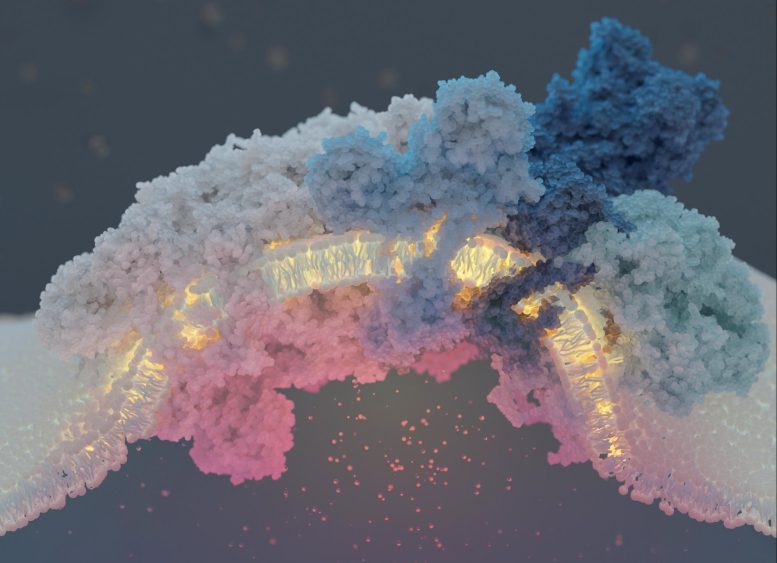
For the first time, researchers have found a complex of proteins that contains the four central components for optimized energy production. This discovery is of great importance for understanding how life has optimized basic processes in different ways, and at the same time, it lays the foundation for analyses of the development of drugs against parasitic organisms.
Every eukaryotic cell houses tiny “powerhouses” known as mitochondria, responsible for generating the all-purpose energy molecule, ATP. In order to fulfill this role, mitochondria must maintain a spatial organization of the membrane proteins that handle diverse stages in ATP formation.
During the cellular breakdown of sugars, energy is released and subsequently utilized within the mitochondria to create ATP. This process is centrally dependent on four membrane protein complexes — labeled as complex I, II, III, and IV. Collectively, these complexes create an energy gradient that is harnessed by complex V to synthesize ATP. These ATP molecules then fuel a wide array of reactions throughout the cells, a process critical to sustaining life.
It is commonly known that the respiratory complexes I, III, and IV interact with each other and form so-called respiratory supercomplexes, which optimizes the interaction between the complexes. Until now, researchers have not observed that complex II is part of the supercomplexes. In mammalian mitochondria, supercomplexes are spatially separated in the membrane from complex V, where supercomplexes reside only in membrane regions without curvature. However, there are unicellular eukaryotic organisms such as Tetrahymena thermophila whose mitochondria contain only membranes with curvature, and therefore it has been a major question where supercomplexes reside in these membrane systems.
Now an international team of researchers, with the participation of postdoc Rasmus Kock Flygaard from the Department of Molecular Biology and Genetics at Aarhus University, has answered a number of key questions regarding supercomplexes from Tetrahymena.
“For the first time ever, we have shown that complex II can also form part of a super complex, which shows an incredible optimization of the process for ATP formation,” says Rasmus Kock Flygaard. “Furthermore, with our structure, we can see that supercomplexes do not follow a simple plan for construction, but on the contrary, there is a surprising variety, which was not previously thought possible.”
Adaptation of Supercomplexes to Curved Membranes
This variation in the structure of the supercomplex is also central to the question of its existence in curved membranes, and Rasmus Kock Flygaard continues:
“The supercomplex from Tetrahymena has been rebuilt and expanded with countless proteins and extra domains, which overall give the supercomplex a curved architecture, so that it is completely adapted and developed to exist in curved membranes. This is an incredible example of how nature is able to adapt otherwise conserved protein complexes to new environments to maintain function. Now, we have investigated the membrane protein structure of a single organism and made completely new discoveries. There are so many more single-celled eukaryotic organisms that are also just waiting to be described, so that we can provide a more nuanced picture of how life has evolved and adapted.”
Reference: “Structural basis of mitochondrial membrane bending by the I–II–III2–IV2 supercomplex” by Alexander Mühleip, Rasmus Kock Flygaard, Rozbeh Baradaran, Outi Haapanen, Thomas Gruhl, Victor Tobiasson, Amandine Maréchal, Vivek Sharma and Alexey Amunts, 22 March 2023, Nature.
DOI: 10.1038/s41586-023-05817-y
Never miss a breakthrough: Join the SciTechDaily newsletter.
Follow us on Google and Google News.