
Close Menu
    Facebook X (Twitter) Instagram
    SciTechDaily
    • Biology
    • Chemistry
    • Earth
    • Health
    • Physics
    • Science
    • Space
    • Technology
    Facebook X (Twitter) Pinterest YouTube RSS
    SciTechDaily
    Home»Space»Swarm of Stars Spotted by Hubble Space Telescope
    Space

    Swarm of Stars Spotted by Hubble Space Telescope

    By Rob Garner, European Space AgencySeptember 7, 20191 Comment2 Mins Read
    Facebook Twitter Pinterest Telegram LinkedIn WhatsApp Email Reddit
    Share
    Facebook Twitter LinkedIn Pinterest Telegram Email Reddit
    Hubble Space Telescope UGC 685
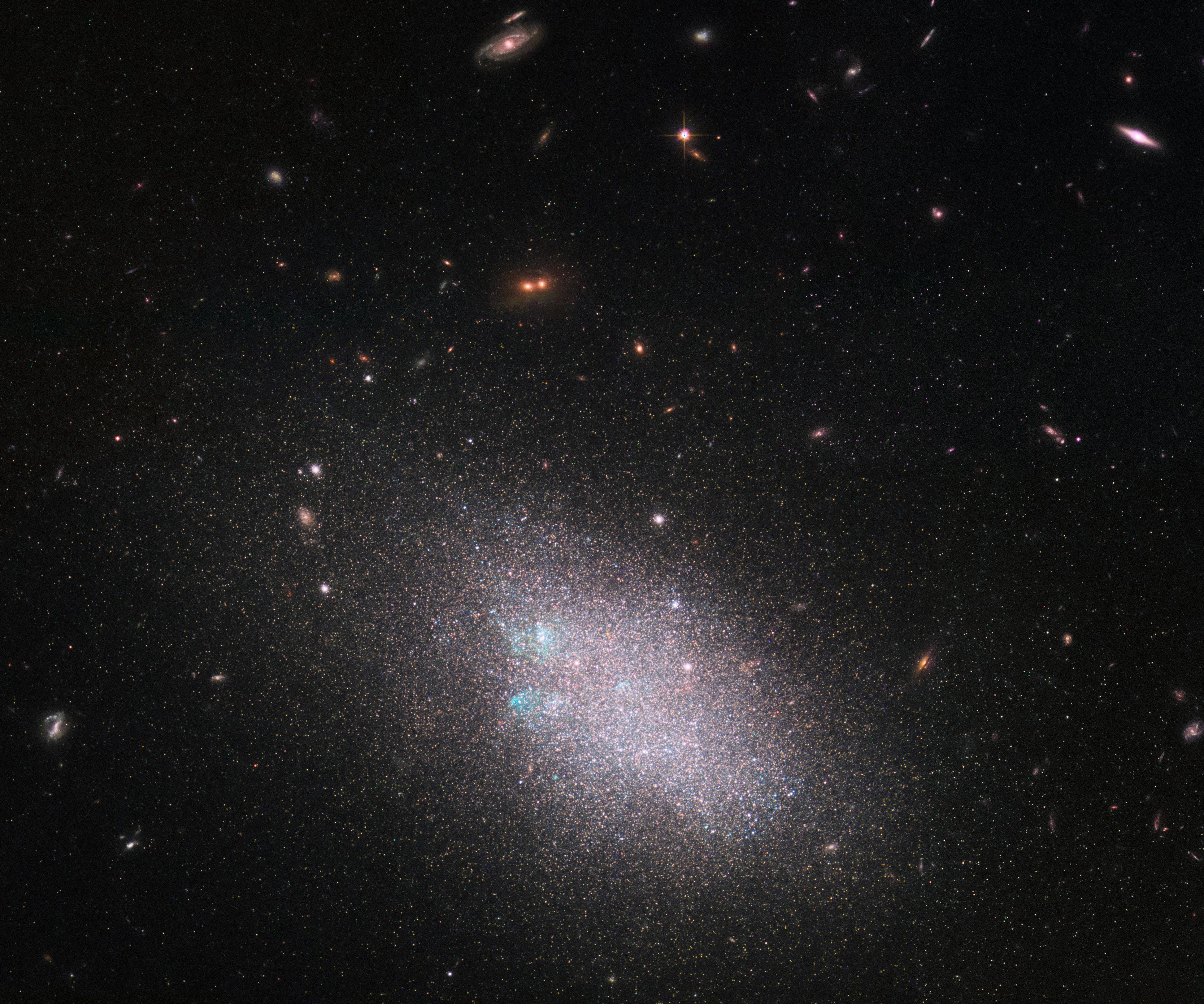
    This image from the NASA/ESA Hubble Space Telescope shows a dwarf galaxy named UGC 685. Classified as an SAm galaxy — a type of unbarred spiral galaxy — it is located about 15 million light-years from Earth. Credit: ESA/Hubble & NASA; the LEGUS team, B. Tully, D. Calzetti; Acknowledgment: Judy Schmidt (Geckzilla)

    This image from the NASA/ESA Hubble Space Telescope shows a dwarf galaxy named UGC 685. Such galaxies are small and contain just a tiny fraction of the number of stars in a galaxy like the Milky Way. Dwarf galaxies often show a hazy structure, an ill-defined shape, and an appearance somewhat akin to a swarm or cloud of stars — and UGC 685 is no exception to this. Classified as an SAm galaxy — a type of unbarred spiral galaxy — it is located about 15 million light-years from Earth.

    These data were gathered under Hubble’s LEGUS (Legacy ExtraGalactic UV Survey) program, the sharpest and most comprehensive ultraviolet survey of star-forming galaxies in the nearby universe.

    LEGUS is imaging 50 spiral and dwarf galaxies in our cosmic neighborhood in multiple colors using Hubble’s Wide Field Camera 3. The survey is picking apart the structures of these galaxies and resolving their constituent stars, clusters, groups and other stellar associations. Star formation plays a huge role in shaping its host galaxy. By exploring these targets in detail via both new observations and archival Hubble data, LEGUS will shed light on how stars form and cluster together, how these clusters evolve, how a star’s formation affects its surroundings, and how stars explode at the end of their lives.

    Never miss a breakthrough: Join the SciTechDaily newsletter.
    Follow us on Google and Google News.

    Astronomy European Space Agency Hubble Space Telescope NASA
    Share. Facebook Twitter Pinterest LinkedIn Email Reddit

    Related Articles

    Hubble’s Newest Discovery Isn’t a Star, It’s a Window Into the Dark Universe

    This Nearby Galaxy Shows How Frozen Clouds Ignite Into Stars

    This Chaotic Spiral Galaxy Is Still Recovering From a Cosmic Collision

    This Strange Spiral Galaxy Is Hiding a Massive Black Hole

    Hubble Zooms In on a Galaxy That Maps the Universe’s Expansion

    Hubble Captures a Dazzling Spiral Galaxy Alive With Birth and Destruction

    Hubble Spots a Glowing “Ring of Fire” in a Distant Spiral Galaxy

    Dust, Light & Ancient Collisions: The Sombrero Galaxy Like You’ve Never Seen It

    Star Formation in Motion: Hubble Reveals Spiraling Stars and Sculpted Nebulae

    1 Comment

    1. Mike Kaplan on September 8, 2019 5:52 pm

      How many stars in this cloud?
      I was just wondering what is a dwarf galaxy verses a full one
      Thanks

      Reply
    Leave A Reply Cancel Reply

    • Facebook
    • Twitter
    • Pinterest
    • YouTube

    Don't Miss a Discovery

    Subscribe for the Latest in Science & Tech!

    Trending News

    Scientists Finally Uncover How a “Forever Chemical” Causes Birth Defects

    Scientists Uncover the Earliest Brain Changes That May Predict Alzheimer’s Decades Before Symptoms

    Surprising New Study Challenges a Century-Old Theory of Habit Formation

    Scientists Turn Seawater Into Drinking Water Without Toxic Brine

    Vitamin D Drug Shows Surprising Promise Against One of the Deadliest Cancers

    NASA’s X-59 Sonic Boom Killer Is Ready for Its Biggest Test Yet

    The Best Exercise Combination for Longevity, According to a 30-Year Study

    Popular Weight-Loss Drug Found To Slow Biological Aging in Landmark Human Trial

    Follow SciTechDaily
    • Facebook
    • Twitter
    • YouTube
    • Pinterest
    • Newsletter
    • RSS
    SciTech News
    • Biology News
    • Chemistry News
    • Earth News
    • Health News
    • Physics News
    • Science News
    • Space News
    • Technology News
    Recent Posts
    • AI Reveals Simple Ways To Make Your Meals Healthier and Cheaper
    • Scientists Discover Key Alzheimer’s “Tipping Point” That May Decide Who Gets Dementia
    • Record-Breaking Black Hole Wind Blasts Through Space at 30% the Speed of Light
    • Interstellar Comet 3I/ATLAS Reveals Strange Chemistry Beyond Our Solar System
    • A Newly Found Cellular Shift May Explain Why Aging Leads to Disease
    Copyright © 1998 - 2026 SciTechDaily. All Rights Reserved.
    • Science News
    • About
    • Contact
    • Editorial Board
    • Privacy Policy
    • Terms of Use

    Type above and press Enter to search. Press Esc to cancel.