
Close Menu
    Facebook X (Twitter) Instagram
    SciTechDaily
    • Biology
    • Chemistry
    • Earth
    • Health
    • Physics
    • Science
    • Space
    • Technology
    Facebook X (Twitter) Pinterest YouTube RSS
    SciTechDaily
    Home»Technology»Swarms of Microrobots Quickly Clean Up Radioactive Waste [Video]
    Technology

    Swarms of Microrobots Quickly Clean Up Radioactive Waste [Video]

    By American Chemical SocietyOctober 30, 2019No Comments3 Mins Read
    Facebook Twitter Pinterest Telegram LinkedIn WhatsApp Email Reddit
    Share
    Facebook Twitter LinkedIn Pinterest Telegram Email Reddit
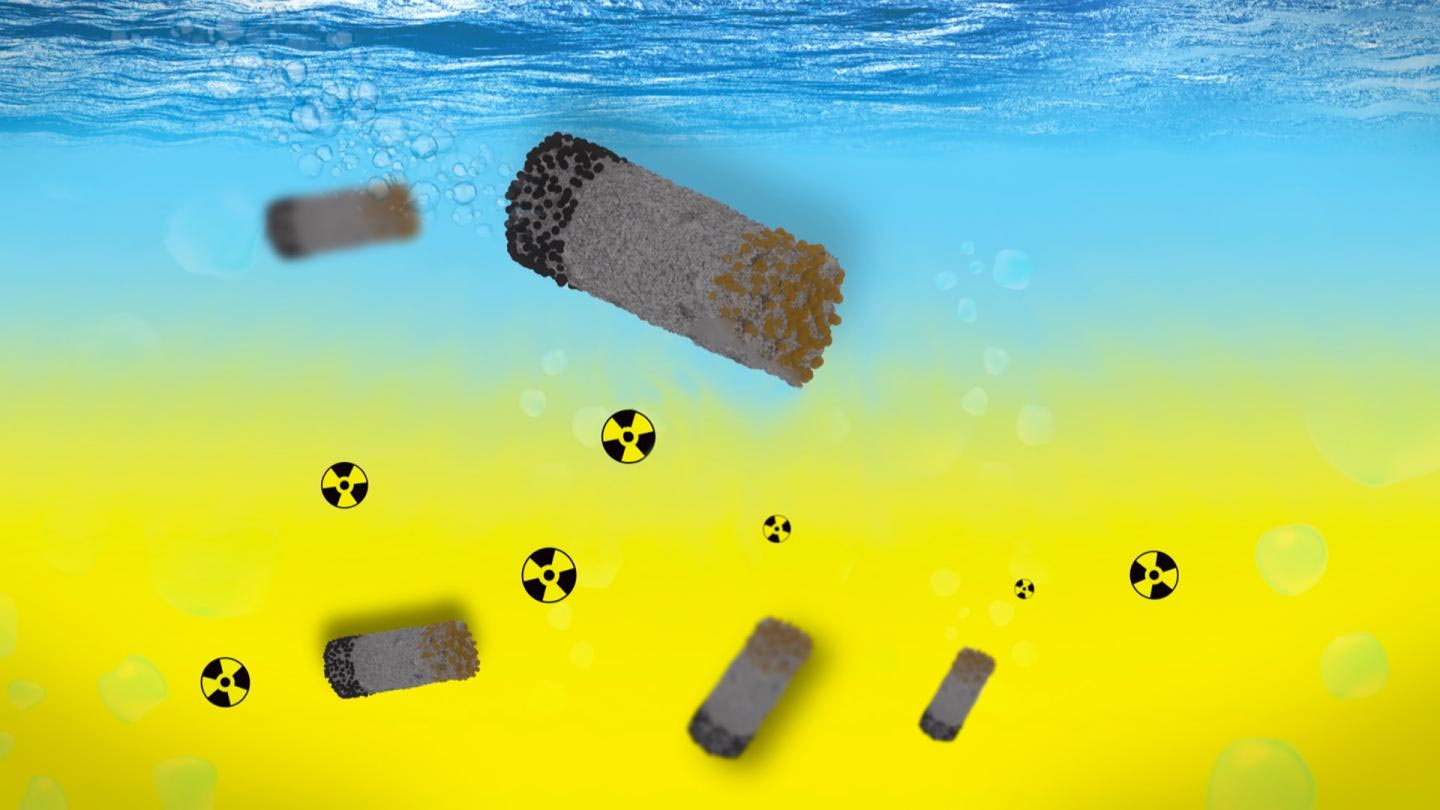
    Microrobots Clean up Radioactive Waste
    Tiny, self-propelled robots could someday be used to clean up radioactive waste. Credit: American Chemical Society

    According to some experts, nuclear power holds great promise for meeting the world’s growing energy demands without generating greenhouse gases. But scientists need to find a way to remove radioactive isotopes, both from wastewater generated by nuclear power plants and from the environment in case of a spill. Now, researchers reporting in ACS Nano have developed tiny, self-propelled robots that remove radioactive uranium from simulated wastewater. Watch a video of the microrobots in action:


    Researchers reporting in ACS Nano have developed tiny, self-propelled robots that remove radioactive uranium from simulated wastewater. ACS Headline Science shows the microbots in action.

    The accidental release of radioactive waste, such as what occurred in the Chernobyl and Fukushima nuclear plant disasters, poses large threats to the environment, humans, and wildlife. Scientists have developed materials to capture, separate, remove and recover radioactive uranium from water, but the materials have limitations. One of the most promising recent approaches is the use of metal-organic frameworks (MOFs) — compounds that can trap specific substances, including radioactive uranium, within their porous structures. Martin Pumera and colleagues wanted to add a micromotor to a rod-shaped MOF called ZIF-8 to see if it could quickly clean up radioactive waste.

    To make their self-propelled microrobots, the researchers designed ZIF-8 rods with diameters about 1/15 that of a human hair. The researchers added iron atoms and iron oxide nanoparticles to stabilize the structures and make them magnetic, respectively. Catalytic platinum nanoparticles placed at one end of each rod converted hydrogen peroxide “fuel” in the water into oxygen bubbles, which propelled the microrobots at a speed of about 60 times their own length per second. In simulated radioactive wastewater, the microrobots removed 96% of the uranium in an hour. The team collected the uranium-loaded rods with a magnet and stripped off the uranium, allowing the tiny robots to be recycled. The self-propelled microrobots could someday help in the management and remediation of radioactive waste, the researchers say.

    Reference: “Radioactive Uranium Preconcentration via Self-Propelled Autonomous Microrobots Based on Metal–Organic Frameworks” by Yulong Ying, Amir Masoud Pourrahimi, Zdeněk Sofer, Stanislava Matějková and Martin Pumera, 8 October 2019, ACS Nano.
    DOI: 10.1021/acsnano.9b04960

    The authors acknowledge funding from the Advanced Functional Nanorobots program, the Czech Science Foundation, the Ministry of Education, Youth and Sports of the Czech Republic, and the Neuron Benevolent Fund for Support of Science.

    Never miss a breakthrough: Join the SciTechDaily newsletter.
    Follow us on Google and Google News.

    American Chemical Society Energy Environment Nanotechnology Nuclear Robotics
    Share. Facebook Twitter Pinterest LinkedIn Email Reddit

    Related Articles

    Microrobots Swarm the Seas, Capturing Microplastics and Bacteria [Video]

    Mind-Controlled Robots: New Graphene Sensors Are Turning Science Fiction Into Reality

    MXene Nanomaterial Offers Flexible and Stretchable High-Capacity Energy Storage

    Bacteria-Sized Metallic Robots Take On Microplastics – And Win by Breaking Them Down

    Ultralow-Temperature Supercapacitors Using Porous Carbon Aerogel – Could Power Mars & Polar Missions

    Backpack Makes Loads Feel Lighter and Powers Electronics by Harvesting Energy From Walking

    Using Lasers to Create Miniature Robots From Bubbles [Video]

    Anode-Free Zinc Battery Could Someday Provide Large Scale Storage of Renewable Energy

    ‘Flapping Wings’ Powered by the Sun – Could Be Used for Solar Energy Harvesting

    Leave A Reply Cancel Reply

    • Facebook
    • Twitter
    • Pinterest
    • YouTube

    Don't Miss a Discovery

    Subscribe for the Latest in Science & Tech!

    Trending News

    Breakthrough Bowel Cancer Trial Leaves Patients Cancer-Free for Nearly 3 Years

    Natural Compound Shows Powerful Potential Against Rheumatoid Arthritis

    100,000-Year-Old Neanderthal Fossils in Poland Reveal Unexpected Genetic Connections

    Simple “Gut Reset” May Prevent Weight Gain After Ozempic or Wegovy

    2.8 Days to Disaster: Scientists Warn Low Earth Orbit Could Suddenly Collapse

    Common Food Compound Shows Surprising Power Against Superbugs

    5 Simple Ways To Remember More and Forget Less

    The Atomic Gap That Could Cost the Semiconductor Industry Billions

    Follow SciTechDaily
    • Facebook
    • Twitter
    • YouTube
    • Pinterest
    • Newsletter
    • RSS
    SciTech News
    • Biology News
    • Chemistry News
    • Earth News
    • Health News
    • Physics News
    • Science News
    • Space News
    • Technology News
    Recent Posts
    • After 37 Years, the World’s Longest-Running Soil Warming Experiment Uncovers a Startling Climate Secret
    • NASA Satellite Captures First-Ever High-Res View of Massive Pacific Tsunami
    • ADHD Isn’t Just a Deficit: Study Reveals Powerful Hidden Strengths
    • Scientists Uncover “Astonishing” Hidden Property of Light
    • Scientists Discover Stem Cells That Could Regrow Teeth and Bone
    Copyright © 1998 - 2026 SciTechDaily. All Rights Reserved.
    • Science News
    • About
    • Contact
    • Editorial Board
    • Privacy Policy
    • Terms of Use

    Type above and press Enter to search. Press Esc to cancel.