
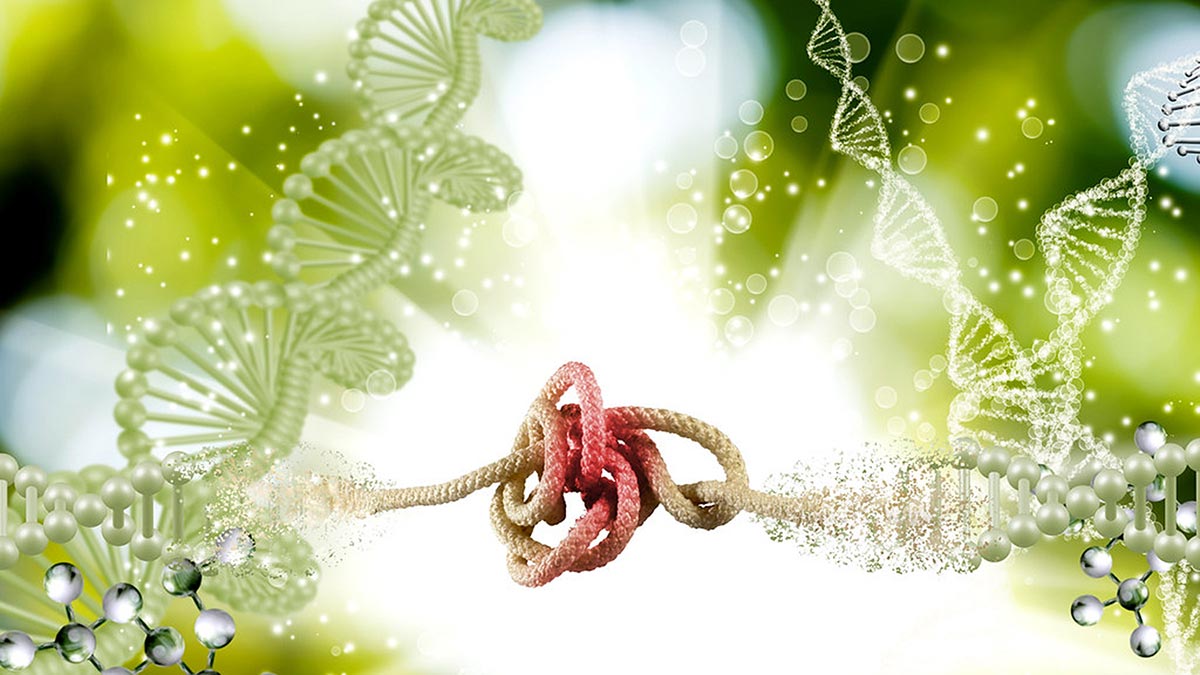
Researchers from the Milner Centre for Evolution have identified evolutionary hotspots in DNA where mutations are more likely.
Tangles in unwound DNA can create mutational hotspots in the genomes of bacteria, according to a new study by the Milner Centre for Evolution at the University of Bath.
The study authors say these findings will help us in the future to predict the evolution of bacteria and viruses over time, which could aid vaccine design and better understanding of antibiotic resistance.
More Than Natural Selection at Work
While most evolution is shaped by natural selection, where only those individuals who are adapted for their environment are able to survive and pass on their genes, a new study published in Nature Communications shows that evolution is also influenced by tangles in the DNA strands.
A team of scientists, led by the University of Bath in collaboration with the University of Birmingham, looked at the evolution of two strains of the soil bacteria Pseudomonas fluorescens (SBW25 and Pf0-1).
When the scientists removed a gene that enables the bacteria to swim, both strains of the bacteria quickly evolved the ability to swim again, but using quite different routes.
One of the strains (called SBW25), always mutated the same part of a particular gene to regain mobility.
However, the other strain (called Pf0-1) mutated different places in different genes each time the scientists repeated the experiment.
Hairpin Structures Behind Hotspots
To understand why one strain evolved predictably and the other was unpredictable, they compared the DNA sequences of the two strains. They found that in the SBW25 strain, which mutated in a predictable way, there was a region where the DNA strand looped back on itself forming a hairpin-shaped tangle.
These tangles can disrupt the cell machinery, called DNA polymerase, which copies the gene during cell division, and so makes mutations more likely to happen.
When the team removed the hairpin structure using six silent mutations (without changing the sequence of the protein produced), this abolished the mutational hotspot and the bacteria started evolving in a much wider variety of ways to get back its swimming ability.
Dr. Tiffany Taylor, from the Milner Centre for Evolution, said: “DNA normally forms a double helix structure, but when the DNA is copied, the strands are briefly separated.
“We’ve found there are hotspots in the DNA where the sequence causes the separated strands of DNA to get twisted back on themselves – a bit like when you pull apart the strands of a rope – this results in a tangle.
“When the DNA polymerase enzyme runs along the strand to copy the gene, it bumps into the tangle and can skip, causing a mutation.
Creating or Abolishing Mutation Hotspots
“Our experiments show that we were able to create or remove mutational hotspots in the genome by altering the sequence to cause or prevent the hairpin tangle.
“This shows that while natural selection is still the most important factor in evolution, there are other factors at play too.
“If we knew where the potential mutational hotspots in bacteria or viruses were, it might help us to predict how these microbes could mutate under selective pressure.”
Mutational hotspots have already been found in cancer cells, and the researchers plan to search for them across a range of bacterial species, including important pathogens.
This information can help scientists better understand how bacteria and viruses evolve, which can help in developing vaccines against new variants of diseases. It can also make it easier to predict how microbes might develop resistance to antibiotics.
Silent Mutations, Big Surprises
Dr. James Horton, who has recently completed his PhD at the Milner Centre for Evolution, said: “Like many exciting discoveries, this was found by accident. The mutations we were looking at were so-called silent because they don’t change the resulting protein sequence, so initially we didn’t think they were particularly important.
“However our findings fundamentally challenge our understanding of the role that silent mutations play in adaptation.”
Reference: “A mutational hotspot that determines highly repeatable evolution can be built and broken by silent genetic changes” by James S. Horton, Louise M. Flanagan, Robert W. Jackson, Nicholas K. Priest and Tiffany B. Taylor, 19 October 2021, Nature Communications.
DOI: 10.1038/s41467-021-26286-9
Never miss a breakthrough: Join the SciTechDaily newsletter.
Follow us on Google and Google News.