

Recent discoveries offer deeper insight into the movement of tectonic plates.
New research has found that variations in rock composition within oceanic plates, caused by ancient tectonic processes, can significantly affect the path and speed of these plates as they sink into Earth’s mantle.
At depths between 410 and 660 kilometers lies the mantle transition zone (MTZ), a key boundary layer that regulates the movement of material into the planet’s deeper interior. When subducting plates, those that dive beneath others, encounter large concentrations of basalt within the MTZ, their descent can slow down or even stall, rather than continuing smoothly into the lower mantle. While basalt-rich regions in the MTZ have been observed before, their origins have remained uncertain until now.
Uncovering the Origins of Basalt Reservoirs
An international team of seismologists led by the University of Southampton (and now at the Woods Hole Oceanographic Institution) has provided evidence of an extremely thick MTZ, which can only be explained by a large basaltic rock composition, suggesting that, in certain regions, entire oceanic slabs—approximately 100 kilometers thick—can possess significant basaltic material.
The findings, published in the journal Nature, provide a greater understanding of plate subduction, which recycles surface materials and volatile elements deep into the Earth’s interior, sustaining long-term climate stability, atmospheric balance, and the habitability of our planet over billions of years.
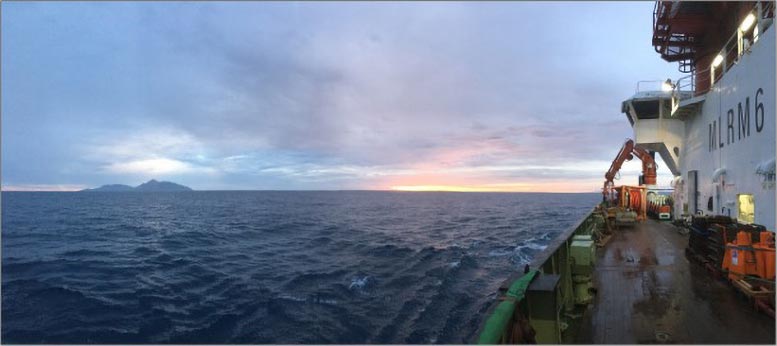
This groundbreaking research is part of the VoiLA (Volatiles in the Lesser Antilles) project, in which the team deployed 34 seismometers on the ocean floor beneath the Lesser Antilles.
“This is the first large scale ocean bottom seismic experiment conducted at an Atlantic subduction zone,” said Dr. Catherine Rychert, formerly an Associate Professor at the University of Southampton and currently at the Woods Hole Oceanographic Institution. “We were very surprised to find an unexpected and exceptionally thick—approximately 330 kilometers—mantle transition zone beneath the Antilles, which makes it one of the thickest transition zones observed worldwide. Although the Caribbean is well-known for its sunshine and beaches, it now has a new claim to fame in the world of plate tectonics.”
Tectonic ‘Memory’ and Mantle Convection
“It’s wild to think that in some ways tectonic plates have a ‘memory’ and that affects the way the plates drive mantle convection and mix material back into the Earth,” said Dr. Nick Harmon, formerly an Associate Professor at the University of Southampton and currently at the Woods Hole Oceanographic Institution.
“It’s wild to think that in some ways tectonic plates have a ‘memory’ and that affects the way the plates drive mantle convection and mix material back into the Earth,” said Dr. Nick Harmon, formerly an Associate Professor at the University of Southampton and currently at the Woods Hole Oceanographic Institution.
Lead author, Dr. Xusong Yang, a former visiting scholar at the University of Southampton and currently at the University of Miami, emphasized, “We cannot overlook the inherited compositional heterogeneity of subducting oceanic slabs. It may greatly influence their ultimate fate in Earth’s deep interior.”
Reference: “Seismic imaging of a basaltic Lesser Antilles slab from ancient tectonics” by Xusong Yang, Yujiang Xie, Catherine A. Rychert, Nicholas Harmon, Saskia Goes, Andreas Rietbrock, Lloyd Lynch and Members of the VoiLA Working Group, 9 April 2025, Nature.
DOI: 10.1038/s41586-025-08754-0
Dr. Kate Rychert and Dr. Nick Harmon, formerly of the University of Southampton, Professor Saskia Goes from Imperial College London, and Professor Andreas Reitbrock from Karlsruhe Institute of Technology, led the experiment. The experiment was funded by NERC (Natural Environment Research Council, UK) and the ERC (European Research Council).
Never miss a breakthrough: Join the SciTechDaily newsletter.
Follow us on Google and Google News.