
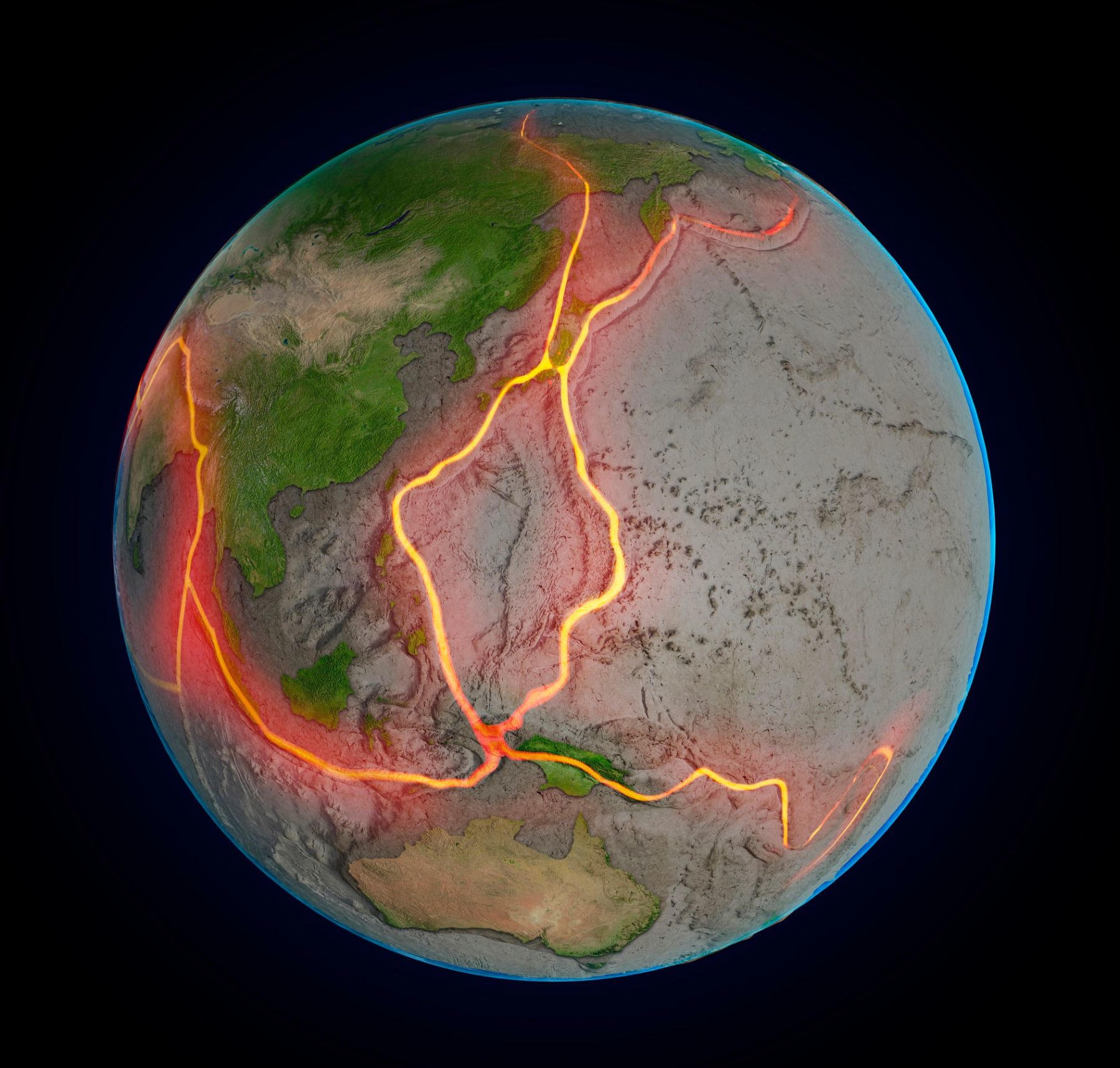
Tibetan uplift was mainly caused by post-collisional mantle dynamics, not ongoing India-Asia convergence. The study challenges long-held tectonic models.
The India-Asia continental collision and the rise of the Tibetan Plateau have traditionally been explained by continuous convergence throughout the Cenozoic, based on two main assumptions: that the India-Asia collision is ongoing and that the Indian continent has been steadily underthrusting beneath the Tibetan hinterland.
A new study challenges those assumptions through a comprehensive analysis of geological, geophysical, and geochemical data. It focuses on the timing of syn-collisional processes, the extent of their spatial effects, and the structural and compositional differences between syn-collisional and post-collisional features. The findings reveal that the India-Asia collisional orogeny was brief, occurring in the Early Cenozoic, and did not involve significant underthrusting of the Indian continent beneath the Tibetan interior.
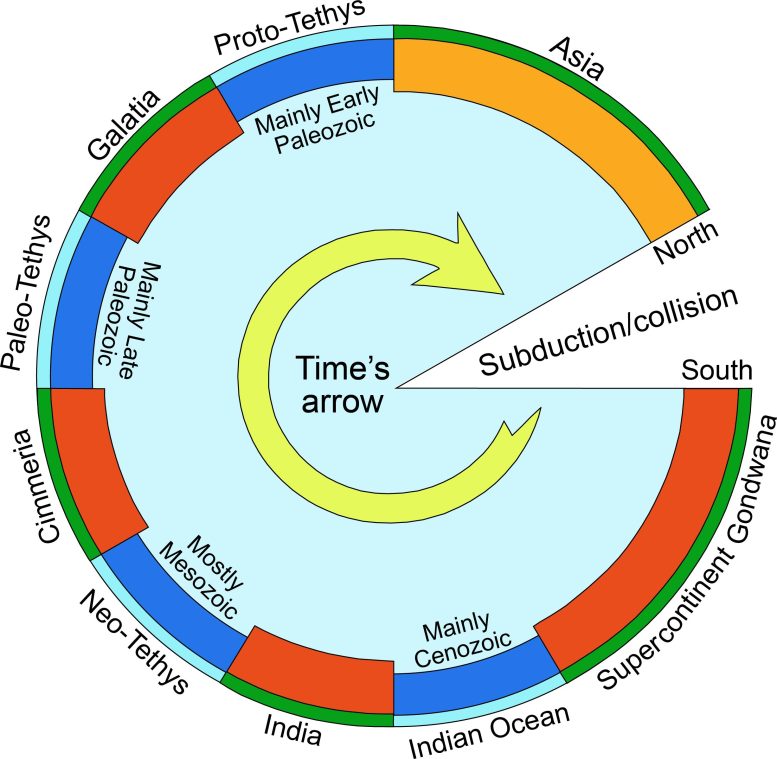
Instead, the uplift of the Tibetan Plateau was primarily driven by mantle dynamics that followed the collision, taking place in the Late Cenozoic. The study emphasizes that the Tibetan Plateau is not a uniform structure formed by a single collisional process but a complex mosaic of terranes that accreted northward from the Early Paleozoic to the Mesozoic.
These terranes and their sutures were reactivated during the short-lived Early Cenozoic collision, rather than being shaped by a continuous collision over the entire Cenozoic. The most pronounced effects of the India-Asia collision are found in the Himalayan and Gangdese orogens.
Dismantling traditional tectonic paradigms
Inspection of key findings in the literature dismantles the traditional paradigms based on the two generic assumptions. Seismic tomography and helium isotope data constrain subduction of the Indian continent to depths of 200–300 km mainly beneath the Yarlung-Zangpo Suture that marks the southernmost margin of the Tibetan Plateau.
Paleomagnetic discrepancies regarding the width of Greater India are resolved by emphasizing the cover-basement decoupling during soft collision and shallow subduction, limiting its underthrusting to short distances of ≤300 km. This reconciles geological shortening estimates with exaggerated paleomagnetic-derived convergence distances. A critical examination of petrological, structural, and geochronological data partitions the formation of the Himalayan orogen into two stages.
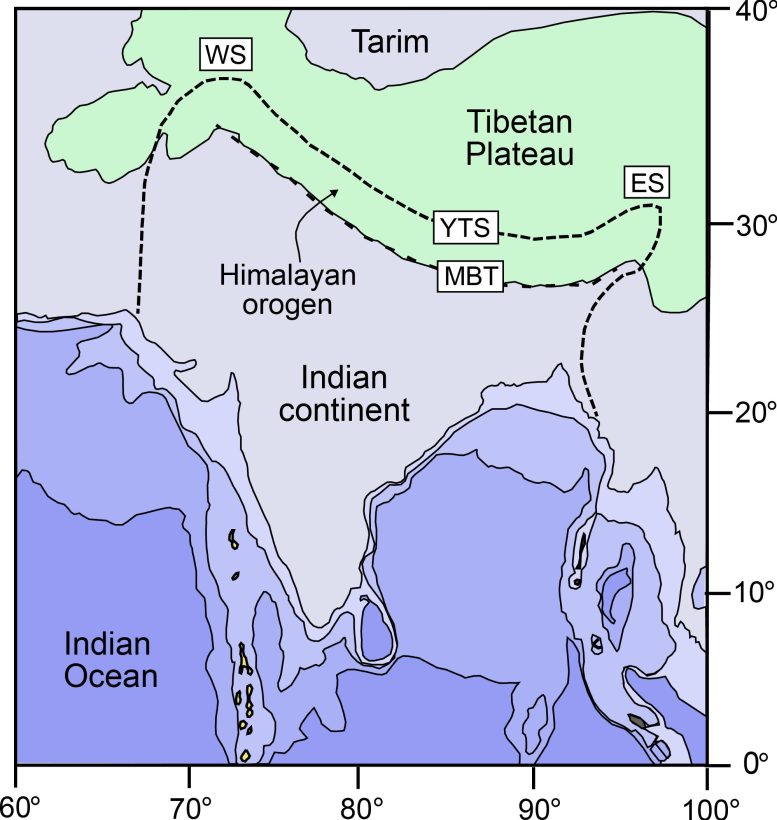
The first is the continental suturing from soft collision through hard collision to deep subduction, leading to crustal shortening through slice thrusting mainly at 55–45 Ma in the Early Cenozoic. The second is the post-collisional reworking due to upwelling of the asthenospheric mantle induced by foundering of the lithospheric mantle, resulting in crustal anatexis, emplacement of leucogranites and metamorphic core complexes, and domical uplift mainly at 30–10 Ma in the Late Cenozoic.
The Himalaya-Tibet tectonic collage has behaved in an intracontinental setting in the Late Cenozoic when it uplifted due to the asthenospheric upwelling in response to the lithospheric foundering.
Reinterpreting tectonic processes and models
This study demonstrates that the two generic assumptions for the India-Asia collision do not stand any more under close scrutiny and thus are essentially specious in previous studies. It has great bearing on the evolution of the Himalaya-Tibet tectonic collage in the Cenozoic. It casts doubt on the tectonic interpretation of paleomagnetic and seismic data with respect to the continental convergence and underthrusting between India and Asia.
Many of geological and geochemical observations were interpreted under the two assumptions, overlooking a series of differences in temporal sequence, dynamic regime, and geothermal gradient between the syn-collisional and post-collisional processes.
Therefore, it is necessary to examine the rationality of geodynamic models for the processes, mechanisms, and effects of the India-Asia collision and plateau uplift through prioritizing of the post-collisional processes over the syn-collisional effects. As such, this study offers transformative insights into the nature of continental tectonics at precedingly converged plate margins globally.
Reference: “A revisit to continental collision between India and Asia” by Yong-Fei Zheng, 1 March 2025, Earth-Science Reviews.
DOI: 10.1016/j.earscirev.2025.105087
Never miss a breakthrough: Join the SciTechDaily newsletter.
Follow us on Google and Google News.
1 Comment
If the writers are reading: check the precession of the moon