
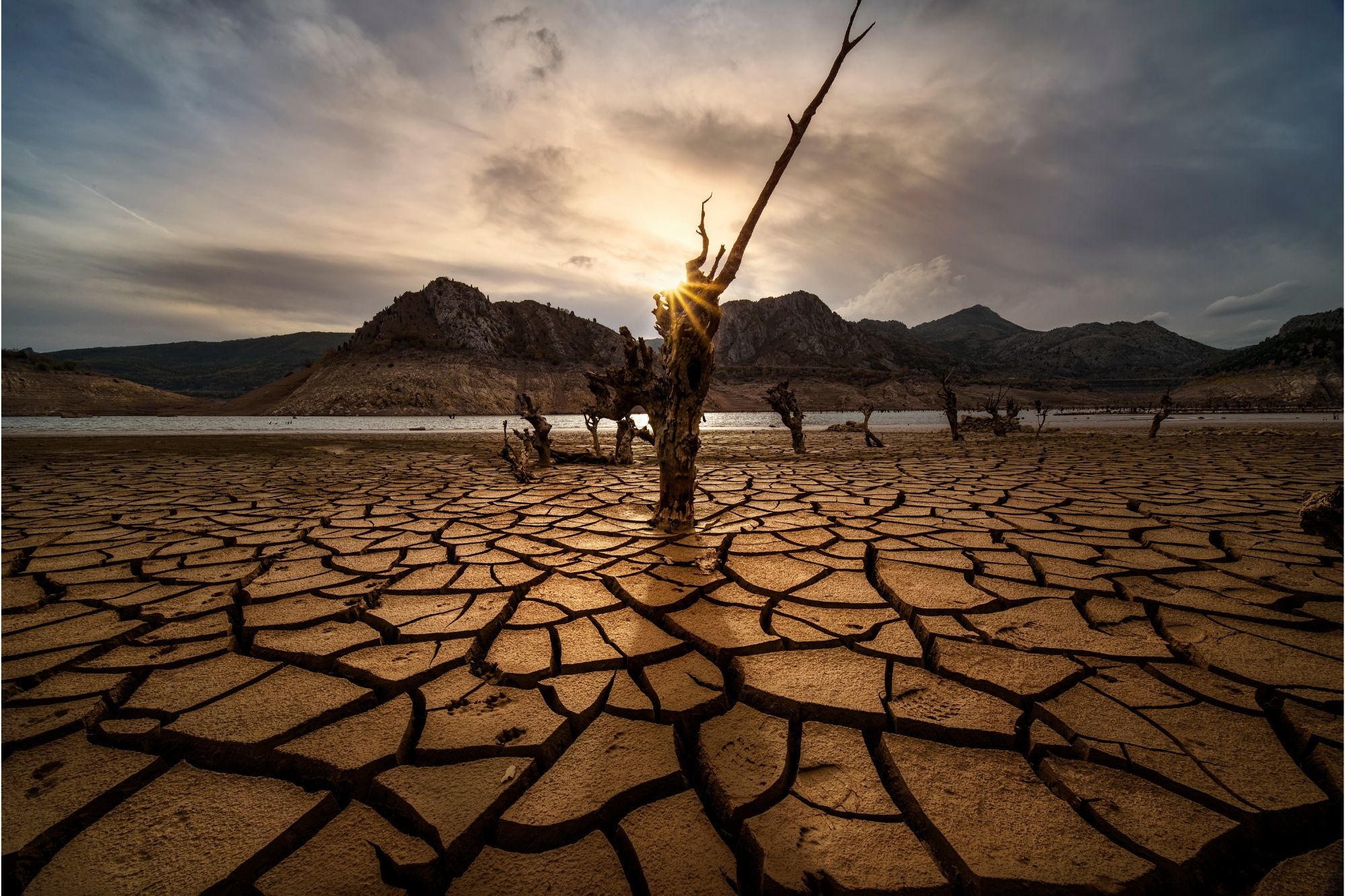
As the climate warms, the atmosphere’s increasing demand for evaporation is surpassing the rate at which precipitation is rising.
Hot air can carry more moisture than cool air. That’s why your hair still dries quickly after a steamy shower. It’s also the reason tropical regions experience heavy rainfall and desert soils lose water so easily.
Now, scientists have discovered that this basic principle is having a powerful global impact. A new study published in Nature reveals that the atmosphere’s increasing demand for water is making droughts significantly worse, even in places where rainfall hasn’t changed. Over the past 40 years, this growing “thirst” has made droughts about 40 percent more severe worldwide.
“Drought is based on the difference between water supply (from precipitation) and atmospheric water demand. Including the latter reveals substantial increases in drought as the atmosphere warms,” said co-author Chris Funk, director of the Climate Hazards Center at UC Santa Barbara.
The hidden force behind worsening droughts
Most people think droughts happen simply because it stops raining. But scientists have found another powerful force at play. As the air gets warmer, it increases what’s known as atmospheric evaporative demand, or AED.
Think of AED as a giant sponge in the sky. As it heats up, it pulls more and more moisture from the land below, drying out soil, draining rivers, and stressing plants, often faster than that moisture can be replaced.
It’s not clear whether a warmer atmosphere will make droughts more or less intense, frequent, and widespread. “As the atmosphere warms, air at a constant relative humidity will hold more water vapor, so rainfall may increase,” Funk explained. “But at the same time, atmospheric evaporative demand is also expected to increase. So which is increasing more quickly?”
Funk joined an international team of scientists to examine the role AED is playing in exacerbating droughts around the world.
A new way to measure drought’s growing danger
Scientists knew AED was important, but few studies had carefully measured its global impact using real-world observations, making it harder to predict and prepare for droughts. This new study used a set of high-resolution data covering more than a century, and applied advanced methods to track how AED has increased and how much worse it has made droughts.
“We face a big challenge,” explained lead author Solomon Gebrechorkos, a hydro-climatologist at University of Oxford. “There’s no direct way to measure how ‘thirsty’ the atmosphere is over time. So, we used high-resolution climate data, identified through a comprehensive global evaluation, and applied the most advanced models for atmospheric evaporative demand — models that account for multiple climate variables, not just temperature.”
The team compared water supply, based on precipitation, and atmospheric evaporative demand using multiple world-class datasets. They then looked at changes in the standardized data, evaluating these changes over time. “This allowed us to compare wet and dry regions using a common framework,” Funk explained. The authors then identified statistically significant increases in drought.
They found that AED has increased faster than precipitation rates, suggesting an alarming tendency towards drier conditions. “I find these results very concerning, but perhaps not terribly surprising,” Funk said. “Most of us are familiar with how air temperatures are increasing rapidly, but most people may not realize the connections between this warming and the desiccating influence of the atmosphere.” In warm areas, raising the temperature by just a couple degrees can dramatically increase the atmosphere’s ability to draw moisture from crops, rangelands, and forests, he added.
Understanding drought in a warming world
This study reinforces past work showing that droughts will become more intense in a warming world. This has implications for global food and water security, which may in turn amplify political instability and conflict. Easier to see are more direct links between increased AED and wildfire. A thirsty atmosphere desiccates plants, which contributes to larger wildfires.
Looking into the future, this study underscores the importance of early warning systems, drought risk management, and effective anticipatory actions. Predicting droughts, and increased atmospheric demand, can trigger effective interventions. For example, farmers might use micro-irrigation or water-retentive soil treatments to offset increased AED. “To counter increasing drought trends, we need to anticipate and manage the extreme events that lead to concerning increases in drought risk,” Funk said.
Researchers are also interested in uncovering how evaporation and atmospheric demand interact with water supplies, not just rainfall patterns. Scientists will need to study how farmers, cities, and ecosystems can adapt to a world where the atmosphere constantly demands more moisture.
Reference: “Warming accelerates global drought severity” by Solomon H. Gebrechorkos, Justin Sheffield, Sergio M. Vicente-Serrano, Chris Funk, Diego G. Miralles, Jian Peng, Ellen Dyer, Joshua Talib, Hylke E. Beck, Michael B. Singer and Simon J. Dadson, 4 June 2025, Nature.
DOI: 10.1038/s41586-025-09047-2
Never miss a breakthrough: Join the SciTechDaily newsletter.
Follow us on Google and Google News.
14 Comments
“In warm areas, raising the temperature by just a couple degrees can dramatically increase the atmosphere’s ability to draw moisture from crops, rangelands, and forests, he added.”
First off, what is being referred to is the Clausius-Clapeyron relationship, which predicts that for each rise of 1 deg C in temperature, the atmosphere can hold about 7% more moisture. It is an upper-bound limited by the availability of water vapor. In arid regions, there is little evapotranspiration occurring because there is sparse rainfall and the plants have evolved to minimize transpiration. Therefore, while the atmosphere may become ‘more thirsty,’ there is little ability to slake that ‘thirst.’
Secondly, the authors make the situation sound worse than it is. They make their claim based on an increase in average global temperatures. However, most of the global warming is happening at night and in the Winter, when temperatures are much cooler and evapotranspiration is minimal for the region. By using the average, rather than integrating the evapotranspiration over the year (24/7), it biases the estimate to the high side for atmospheric evaporative demand, or AED. .
They remark, “A thirsty atmosphere desiccates plants, which contributes to larger wildfires.” They fail to acknowledge that there is a lower limit on how dry senescent vegetation can get. That can be achieved in a matter of hours for things like grasses, and days for fuel with larger volumes, even in cooler temperatures that prevailed in the past. Once again, they exaggerate the role of warming.
Buried in the middle of the article is probably the most important statement: “It’s not clear whether a warmer atmosphere will make droughts more or less intense, frequent, and widespread.” This is basically a plea for money to study the issue.
For another take on this article, here is a link to the opinion of a professional meteorologist:
https://climaterealism.com/2025/06/the-new-york-times-big-lie-about-the-atmosphere-being-thirstier/
Ah well, where I live, the place has dried out considerably in the last 30 years. Merely a personal observation. And summer and winter temperatures have changed. Merely an empirical observation by numerous people.
The cattle and farmers seem to agree as well.
While the honest professionals acknowledge that they don’t really have the answers, you are convinced that YOU do based on anecdotal evidence that you have subjectively assimilated. That isn’t how science works.
Merely personal observations and those of others during the last 30years. Make of those personal experiences what you will and try not to be rude/sarcastic: that is unscientific, although I have indeed worked with scientists happy to use sarcasm to denigrate other scientists.
I asked MS’s LLM, Copilot, if there was any evidence of increasing droughts in NZ. It basically said that while there was statistically significant evidence of warming that is comparable to the level of average global warming, there was no evidence for the Otago Plains having a decrease in precipitation over the last few decades. Copilot did not indicate if the diurnal low and high were changing equally. The rest of the country has a sufficient water excess to not be of much concern. The Otago Plains did, however, show a slight decline in relative and absolute humidity (<4% per decade), which is in line with this article. It is evidenced in a springtime shift of water stress to a couple weeks earlier, which requires orchardists to irrigate a little sooner than previously. The climate models are raising an alarm, but there is little empirical evidence to support that alarm. That is the problem with depending on subjective impressions.
What do you suggest as an effective way to deal with people making claims that make it abundantly clear that they don't know what they are talking about? If one explains what is wrong, assuming they even understand the explanation, other readers may latch onto what they say. It is imperative that their lack of credibility and accuracy be made very clear to prevent the spread of misinformation. It may be embarrassing to ask questions for which they have no answers, but I'm unaware of a more efficient way to make it clear that they are not reliable sources. There is a reason that humans employ sarcasm, even scientists. 'Snowflakes' may be offended, but that is better than them having an unwarranted influence over others.
‘What do you suggest as an effective way to deal with people making claims that make it abundantly clear that they don’t know what they are talking about?’
1) Shoot them. That is illegal, and they would be inclined to shoot back first if they could.
2) Don’t vote for them if they are inclined to stand for ” high” office in the community. Equally impossible answer, given the recent results of elections in the world’s greatest democracy.
3) Mock them, as do some of the better cartoonists of the world.
4) Ironical or “Black” humour, although in some ways that is an admission of one’s defeat.
5) In these columns at least, be polite to what one might consider outrageous claims and ideas; and note that outrageous ideas may well lead to technical developments that are useful. Steam engines once seemed an outrageous idea, particularly those that ran on steel railway lines at 30mph.
6) Be patient and explain the issue, even if repeatedly. That won’t work in many cases either, as H sap seems to enjoy dwelling in ignorance and bigotry. But sarcasm/mockery will simply alienate one’s readers.
How is #3 any different from what I did?
It is exactly the same. Cartoons are more often than not used to comment critically and simply about the stupidities of political decisions, so that field is a bit restricted and rarely used between scientists. Goya, Zac and Lowe were some of the more vicious of their day, and certainly were justified in how they treated their very unpleasant victims.
I would suggest that #6 could be more practical from the point of view of persuasion in these commentaries, albeit it can be frustrating
Having said all that, I don’t live in NZ, which is a pity in many ways. However, the mountain some km away from where I live commonly used to get snow that remained on the summit for several days during winters 30-40 years ago. Now, that is rare and and such snow as is deposited has melted by late afternoon. That is an observation recognised locally by many people of my vintage. Of itself, that is no proof of Anthropogenic Global Warming; it merely indicates warmer airflows are crossing the mountain’s summit. Likewise, up-country farmers are having to provide winter feed for cattle, and the fields tend towards brown with formerly live trees in the paddocks. Those trees died in the early 1990s. So, empirically, local changes to climate caused by “whatever”. As for the glacier across which I used to work to walk having become a lake, that is also an indicator of a warming; again merely an empirical personal observation that the average zero degree isotherm of the 1890s ain’t quite where it used to be.
Add those personal observations to other similar observations around the globe and yes, things are getting warmer. The cause? You know the rest of my argument as to the possibility based on our rapid post-1945 world wide population growth and concomitant growth of energy use from our burning hydrocarbons. The devil is in the detail behind the modelling, but it is likely to be an irreversible social experiment that tests that modelling, and such a social experiment could well have dangerous social results. What I see of H sap’s approach to resolving dangerous social experiments does not convince me that H sap is capable of resolving the matter to the benefit of all.
My apologies for mistakenly assuming you lived in NZ. I made references to NZ in the past and you never corrected me.
I agree that the burgeoning global population, along with albedo changes resulting from land use changes and urbanization are resulting in both warming and biasing the measurements.
The Devil is in the details, and the Fallen Angels who are the Devil’s assistants make different models based on different assumptions.
Ah well; Fallen Angels have to make a living like any other being…………….All the best.
Human-caused global warming and its resultant increasing number and intensity of climate-change-induced extreme weather events rightfully continue to stir up alarm (perhaps even for many of those people who still claim to distrust climate science). Nevertheless, to date there clearly has been pathetically little or no political courage/will to properly act on the scientific cause-and-effect of them.
There’s a continuance of polluting the natural environment with a business as usual attitude. Societally, we still discharge out of elevated exhaust pipes, smokestacks and, quite consequentially, from sky-high jet engines like it’s all absorbed into the natural environment without repercussion. Out of sight, out of mind.
Obstacles to environmental progress were quite formidable pre-pandemic. But Covid-19 not only stalled most projects being undertaken, it added greatly to the already busy landfills and burning centers with disposed masks and other non-degradable biohazard-protective single-use materials.
Also, increasingly problematic is the very large and growing populace who are too overworked, worried and rightfully angry about food and housing unaffordability for themselves or their families — all while on insufficient income — to criticize the fossil fuel industry, etcetera, for environmental damage their policies cause/allow, particularly when not immediately observable.
Then there are the majority of “conservatives” who remain quite willing to pollute and warm the planet most liberally. And it must be convenient for the very-profitable mega polluters.
Notably, there’s a belief generally shared by too many institutional ‘Christians’ that to defend the natural environment from the planet’s greatest polluters, notably the fossil fuel industry, is to go against God’s will and is therefore inherently evil.
More than just conservatives recklessly willing to pollute the planet most liberally, the anti-natural-environment ‘Christian’ mentality also largely has to do with The Bible (supposedly) not mentioning anything construable as global warming or climate change.
“Human-caused global warming and its resultant increasing number and intensity of climate-change-induced extreme weather events rightfully continue to stir up alarm …)”
https://co2coalition.org/wp-content/uploads/2025/06/Lindzen-Happer-GHGs-and-Fossil-Fuels-Climate-Physics-2025-06-07.pdf
How do you explain these senior physicists, with impeccable credentials, arguing against your claim?