
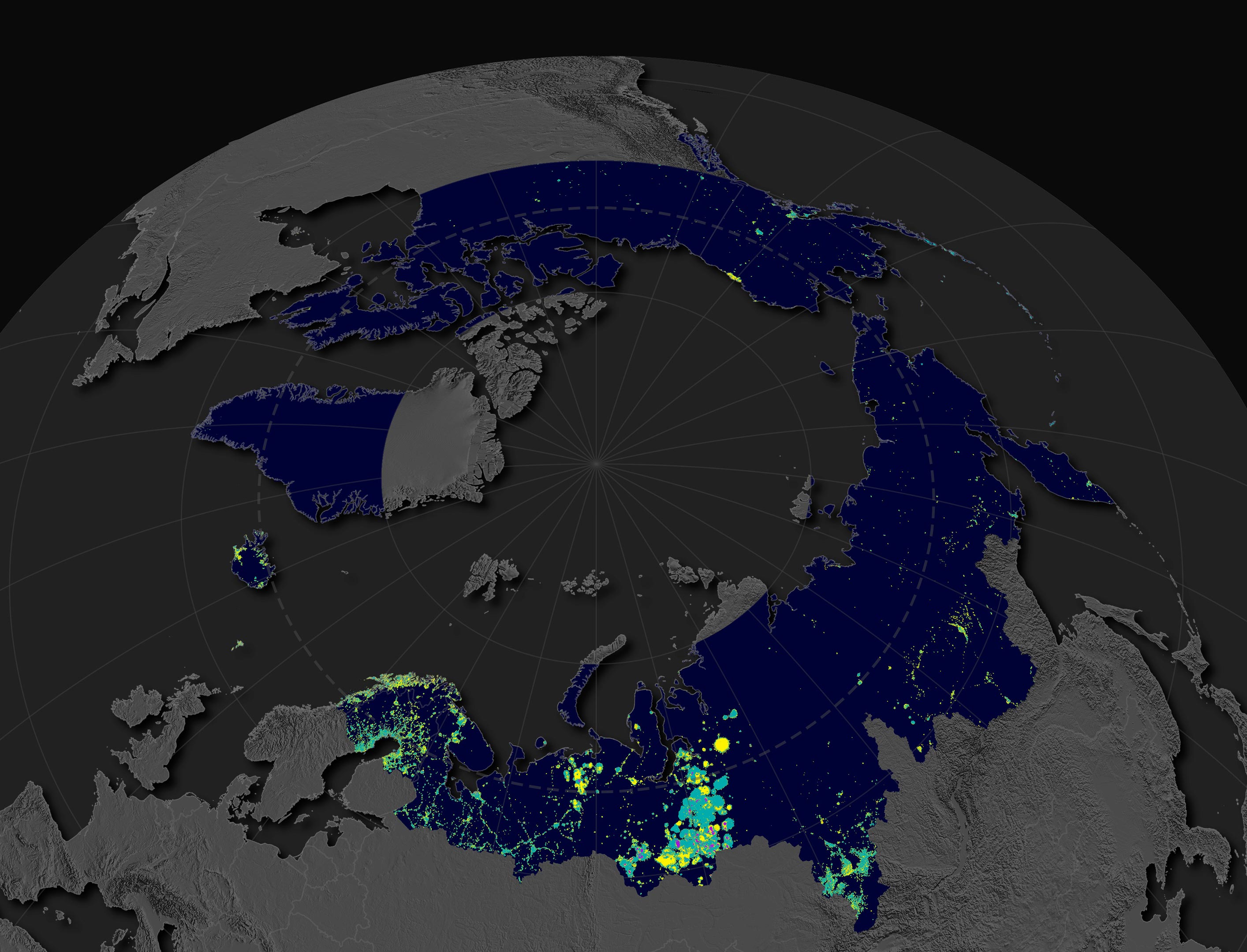
The Arctic has seen an increase in human activity, particularly in oil and gas extraction areas, leading to a significant rise in nighttime light as captured by satellite observations.
From 1992 to 2013, the Arctic became 5% brighter each year, with industrial activities accounting for most of the artificial light.
Nighttime Observations Reveal Human Presence
The Arctic’s cold, harsh climate and long, dark winters have historically limited human activity in the region. However, as the Arctic warms about four times faster than the global average, increased transportation and development have followed. To track these changes, scientists are studying the far northern latitudes after dark.
At night, vast stretches of land and ocean fall into darkness, making human activities easier to detect from space. Satellites capture light from buildings, roads, and industrial sites, revealing patterns of human settlement and development across the Arctic.
Using nighttime satellite data, an international team of researchers found that between 1992 and 2013, the Arctic became 5% brighter per year, culminating in about 605,000 square kilometers (234,000 square miles) that had transformed from dark to lit.
Industrial Development Drives Increase in Lights
“Only 15% of the lit-up areas of the Arctic during the study period contained human settlements like homes or apartment buildings, which tells us that most of the artificial light is due to industrial activities rather than urban or residential development,” said Zhuosen Wang, a member of the research team and a scientist at NASA’s Goddard Space Flight Center. The industrial development includes extractive industries, such as drilling for oil and gas and mining.
The map above shows a pan-Arctic view of nighttime lights and places where the intensity of artificial lights has increased (yellow), decreased (purple), or stayed the same (green). The team used nighttime satellite observations from the U.S. Defense Meteorological Satellite Program (DMSP).
Geographic Distribution of Nighttime Lights
Regions of oil and gas extraction in northern Russia, the U.S. state of Alaska, and the European Arctic were hotspots for artificial light, they found, whereas the Canadian Arctic largely remained dark. The Russian Arctic had the largest increases in lit area (439,048 square kilometers) during the study period, especially in Khanty-Mansi (114,426 square kilometers) and Yamal Nenets (107,837 square kilometers).
The Case of Khanty-Mansi and Arctic Oil Fields
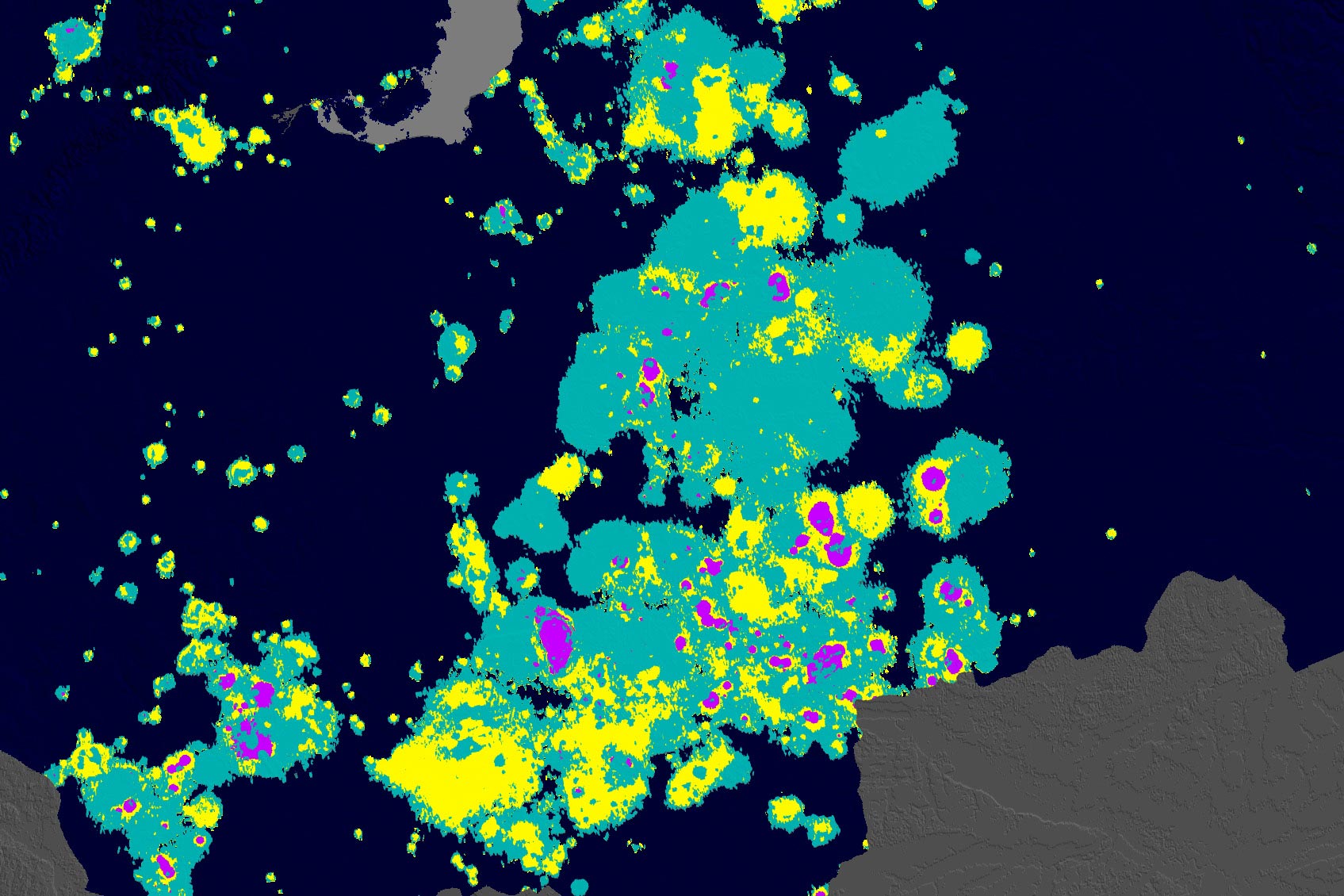
The detailed map above shows Russia’s Khanty-Mansi region, a vast, swampy area in the western Siberian Plain. The region is home to the Samotlor, one of the largest oil fields in the world, which saw the greatest expansion of nighttime lights during the study period.
Although Khanty-Mansi experienced significant expansion of human activity, there were also some declines in lit-up area. “Extractive industries follow lifecycle phases of expansion and contraction,” Wang said, “which is why we see reductions in artificial lights in some places reliant on oil, gas, or mining, without significant human settlement and economic diversification.”
In 2013, the total lit area in oil and gas extracting regions in the Russian Arctic—spanning the Khanty-Mansi, Yamal-Nenets, and Nenets regions—was 339,000 square kilometers (131,000 square miles), almost the size of Germany. The total lit area of the European Arctic was 159,000 square kilometers, whereas the North American Arctic was 49,000 square kilometers. The research team also identified mines used for extracting other minerals, such as the Red Dog Mine in remote Alaska, which was the second largest source of zinc in the world as of 2018.

Mapping the Future of Arctic Night Lights
Wang leads NASA’s Black Marble team, which produces images and composites of nighttime lights across the planet. The team uses data from the VIIRS (Visible Infrared Imaging Radiometer Suite) instrument on the NASA-NOAA Suomi-NPP (Suomi National Polar-orbiting Partnership) satellite, NOAA-20, and NOAA-21 satellites, which are higher resolution and more recent than the DMSP data used in this study. But VIIRS often picks up dim light from sources like the aurora borealis and moonlight on snow. The Black Marble team is working to correct for such natural sources of light so they can update their analysis of artificial light in the Arctic.
“By providing real-time, high-resolution insights, we will be able to better identify changes in industrial activity,” said Miguel Román, the Deputy Director for Atmospheres at Goddard. “These analyses can help ensure responsible resource management and protect the ecosystems vital to both local and global stability.”
NASA Earth Observatory images by Wanmei Liang, using data from Akandil, C., et al. (2024).
Never miss a breakthrough: Join the SciTechDaily newsletter.
Follow us on Google and Google News.
4 Comments
Greenhouse gases and oil drilling should be halted and banned forever or it could cause more of the ice to shrink and we can’t have gases to continue otherwise it’ll get worse. Also, pollution in the Arctic should be cleared away to keep the Polar environment clean and healthy for all wildlife. Save the Arctic, save the Polar bears and make a safe heaven for all the Arctic animals for a healthy living.
Yeah I agree but nobody cares they don’t see it so it’s not a concern for them “people in general” it’s sad thing to see polar bears are drowning from having to swim further and further distances to hunt and forge. It’s happening and nobody is going to do anything because there’s way to much money being made by these planet rapping sloth’s who can only care about there new car or their 2 or 3 homes the size of which my whole family 14 people in a double wide trailer lived in. I can go on and on but anyway save the planet before it’s too late. Save the artic!
YES GENTLEMAN,
IT IS VERY SAD THAT OUR GREENHOUSE GASES & OIL DRILLING SITUATION IS OVER. THE TOP.
I DON’T UNDERSTAND WHY THEY
DON’T REALIZE THAT THEY ARE DESTROYING OUR FUTURE FOR THE WONDERFUL ANIMALS & OUR FUTURE CHILDREN.
Waaaahhh!