
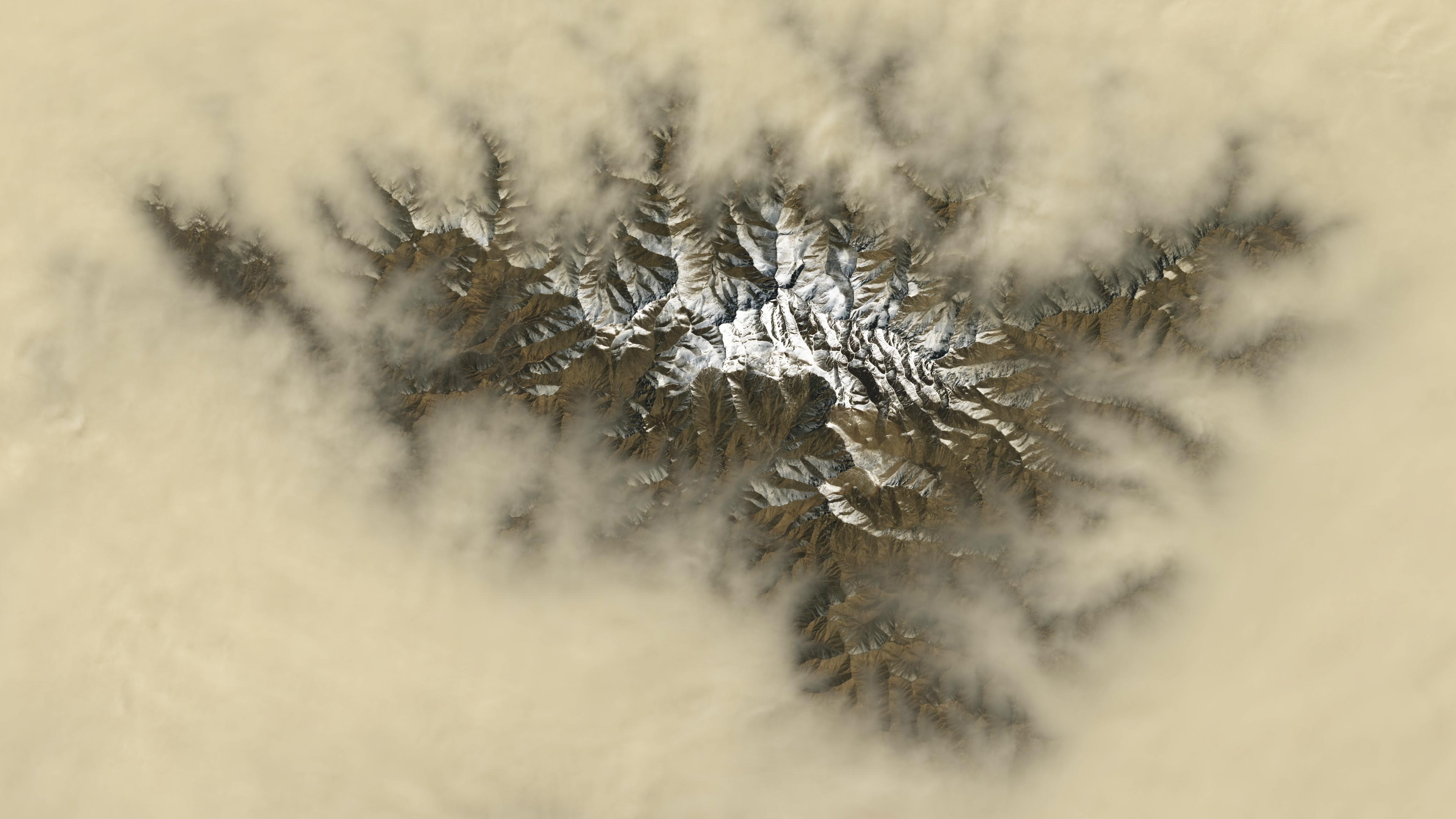
In China’s Tarim Basin, spring brings fierce dust storms fueled by dry landscapes and shifting winds.
NASA satellites captured stunning images of dust plumes rising and curling through mountain valleys, with data revealing how sun-driven convection helps lift particles into the air. Scientists are tracking long-term changes in these storms, which are not just local events—they have global impacts on air quality and climate.
Spring Dust Storms Intensify in the Tarim Basin
Spring is the peak season for dust storms in China’s Tarim Basin, especially in the southern part of this dry, barren lowland. During this time of year, shifting wind patterns bring strong winds and storm systems from the northwest. In early spring, the ground in this region is particularly dry and sparsely vegetated. Each morning, sunlight rapidly heats the exposed land, triggering convection by afternoon that can lift dust into the air.
NASA Satellites Capture Striking Dust Imagery
The image below shows a large dust storm sweeping across the basin on March 27, 2025. It was captured at 12:23 p.m. local time (04:23 UTC) by the MODIS (Moderate Resolution Imaging Spectroradiometer) instrument on NASA’s Terra satellite. In the image on top of this page, a closer view from the same day – taken about an hour later by the OLI (Operational Land Imager) on Landsat 8 – reveals a break in the dust layer over the southern basin. Through that gap, part of the Tekilik Shan is visible – a subrange of the Kunlun Mountains, where snow-covered peaks rise more than 4,000 meters (13,000 feet) above sea level.

Terrain Shapes Dust Plumes in Surprising Ways
The shapes of the fingerlike dust protrusions appear to reflect the underlying terrain. The protrusions line up with underlying valleys, which help control the flow of airborne dust. Dust may have been “self-lofting” over the course of the day. This can occur as the Sun heats recently mobilized near-surface dust, fueling pockets of convection that help lift dust particles higher into the atmosphere, explained Ralph Kahn, an atmospheric scientist at the Laboratory for Atmospheric and Space Physics at the University of Colorado Boulder and scientist emeritus at NASA’s Goddard Space Flight Center.
Supporting this interpretation, geostationary observations from Japan’s Himawari-9 satellite show dust creeping upward into the Tekilik Shan in hourly increments throughout the day before eventually obscuring the view of the mountains in the late afternoon. A similar process occurred on other days during the late-March outbreak of dust, including March 28 and 29.
Long-Term Decline in Dust Levels Observed
Since the early 2000s, researchers have observed a 1.5 percent decrease in the amount of atmospheric dust detected by MODIS sensors in this region each year. “The trend was likely linked to shifts in the spring—March, April, and May,” not in other seasons, said Hongbin Yu, a research scientist at NASA Goddard. The change is likely related to changes in wind speed or shear, vegetation cover, or soil moisture, he added.
The Takla Makan Desert is one of the driest, most barren expanses on Earth. Flanked by mountain ranges on three sides and parched by the resulting rain shadow, parts of the Tarim Basin receive no more than 10 millimeters (0.4 inches) of rain per year.
Dust Storms Pose Health and Climate Risks
Dust storms can lead to public health problems in populated areas downwind by transporting small particles, bacteria, and viruses that infiltrate human respiratory systems. Dust storms can also affect Earth’s climate by scattering and absorbing incoming solar radiation and changing the properties of clouds.
NASA Earth Observatory images by Michala Garrison, using MODIS data from NASA EOSDIS LANCE and GIBS/Worldview and Landsat data from the U.S. Geological Survey.
Never miss a breakthrough: Join the SciTechDaily newsletter.
Follow us on Google and Google News.