
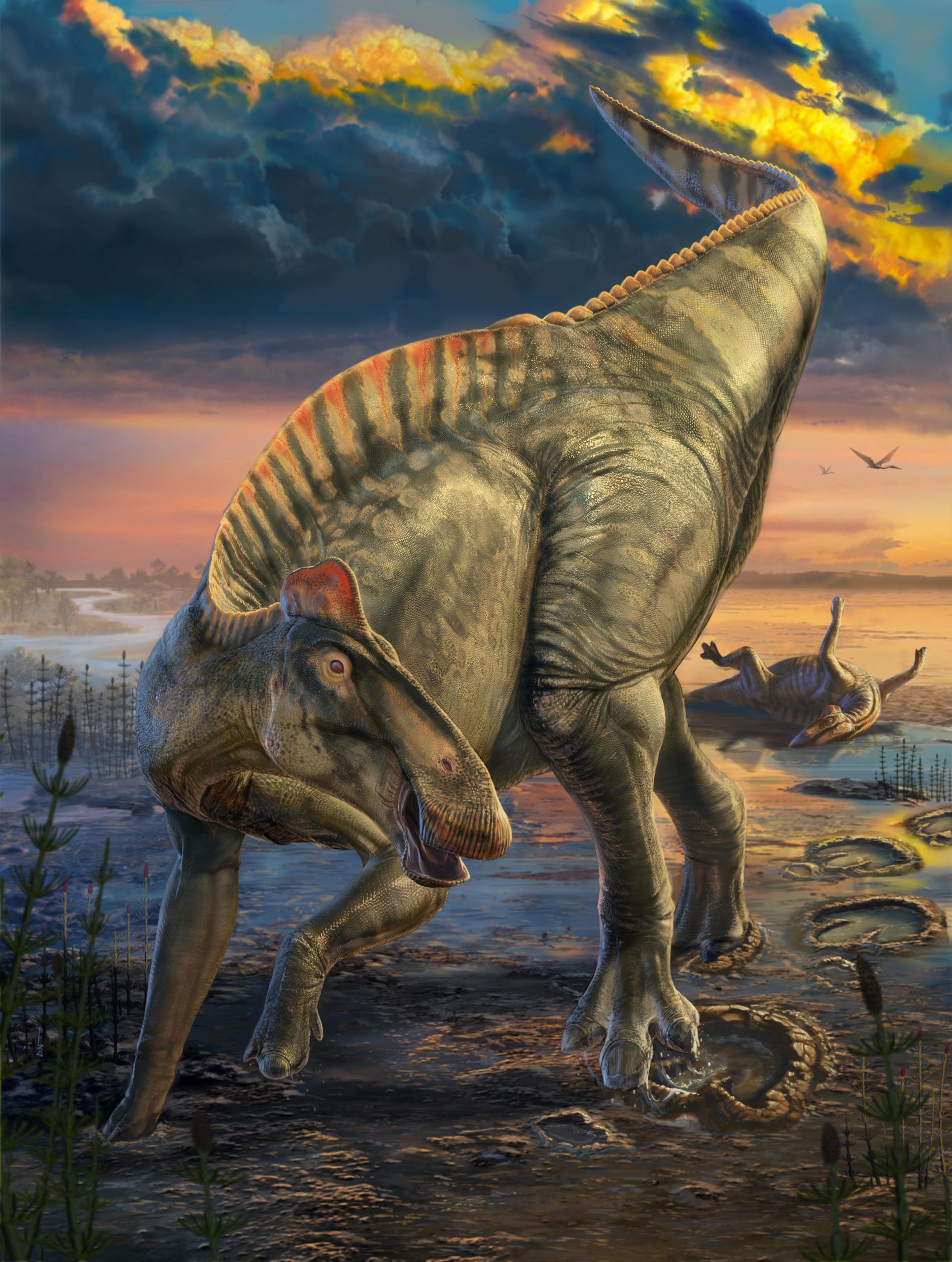
Paleontologists at the University of Chicago have revealed fossilized duck-billed dinosaur specimens from Wyoming that were carefully prepared in the Fossil Lab. These fossils preserve soft tissue and external features in remarkable detail, allowing scientists to reconstruct how this large dinosaur appeared in life.
In a new study recently published in Science, researchers from the University of Chicago detail the processes that occurred about 66 million years ago to preserve the bodies of the duck-billed dinosaur Edmontosaurus annectens as “mummies,” complete with skin texture, scales, and hoof impressions.
The preservation, known as clay templating, occurred when a paper-thin clay coating (less than 1/100th of an inch thick) formed over the animal’s outer surface after burial, capturing intricate details of its external anatomy.
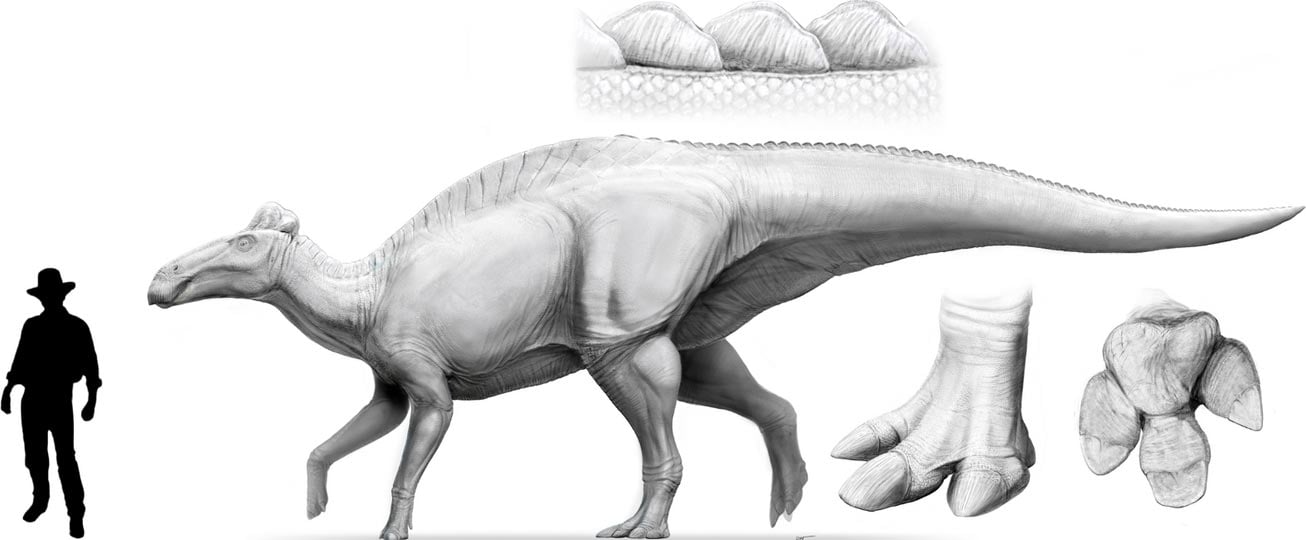
Using advanced imaging methods, the team reconstructed the dinosaur’s full appearance in life, revealing a tall neck and trunk crest, a line of spikes along its tail, and hoof coverings around its toes. When combined with fossilized footprints, these reconstructions offer the most accurate depiction yet of how this large herbivore would have looked.
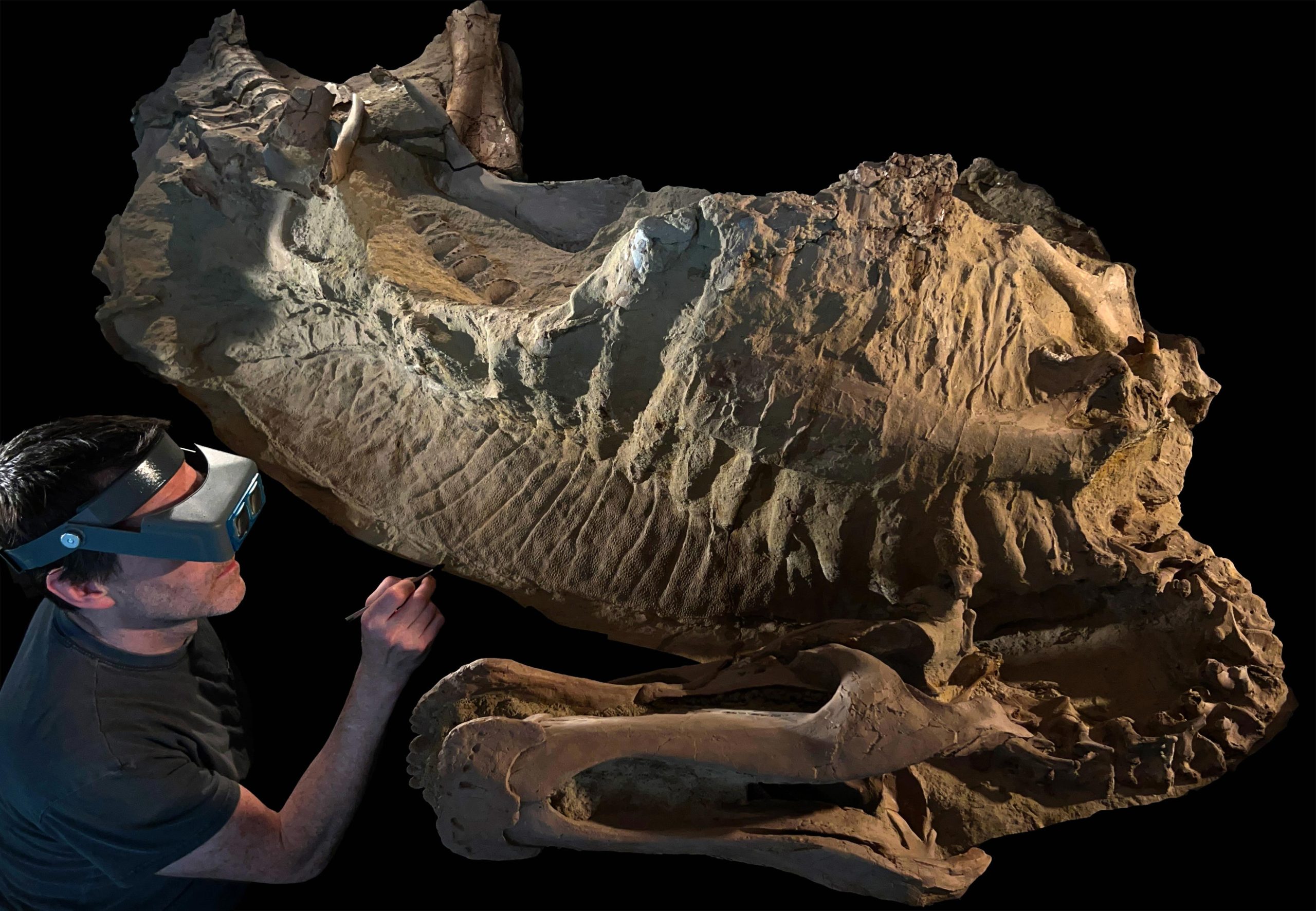
“It’s the first time we’ve had a complete, fleshed-out view of a large dinosaur that we can really feel confident about,” said senior author Paul Sereno, PhD, Professor of Organismal Biology and Anatomy at UChicago. “The badlands in Wyoming where the finds were made is a unique ‘mummy zone’ that has more surprises in store from fossils collected over years of visits by teams of university undergrads.”
From field puzzle to full profile
Through historical photographs and site mapping, Sereno’s team rediscovered the original locations in east-central Wyoming where several well-known dinosaur mummies were unearthed in the early 1900s. These efforts revealed a concentrated “mummy zone” within layers of ancient river sand. At this site, they uncovered two new Edmontosaurus specimens—a late juvenile and a young adult—both showing extensive areas of preserved external skin.
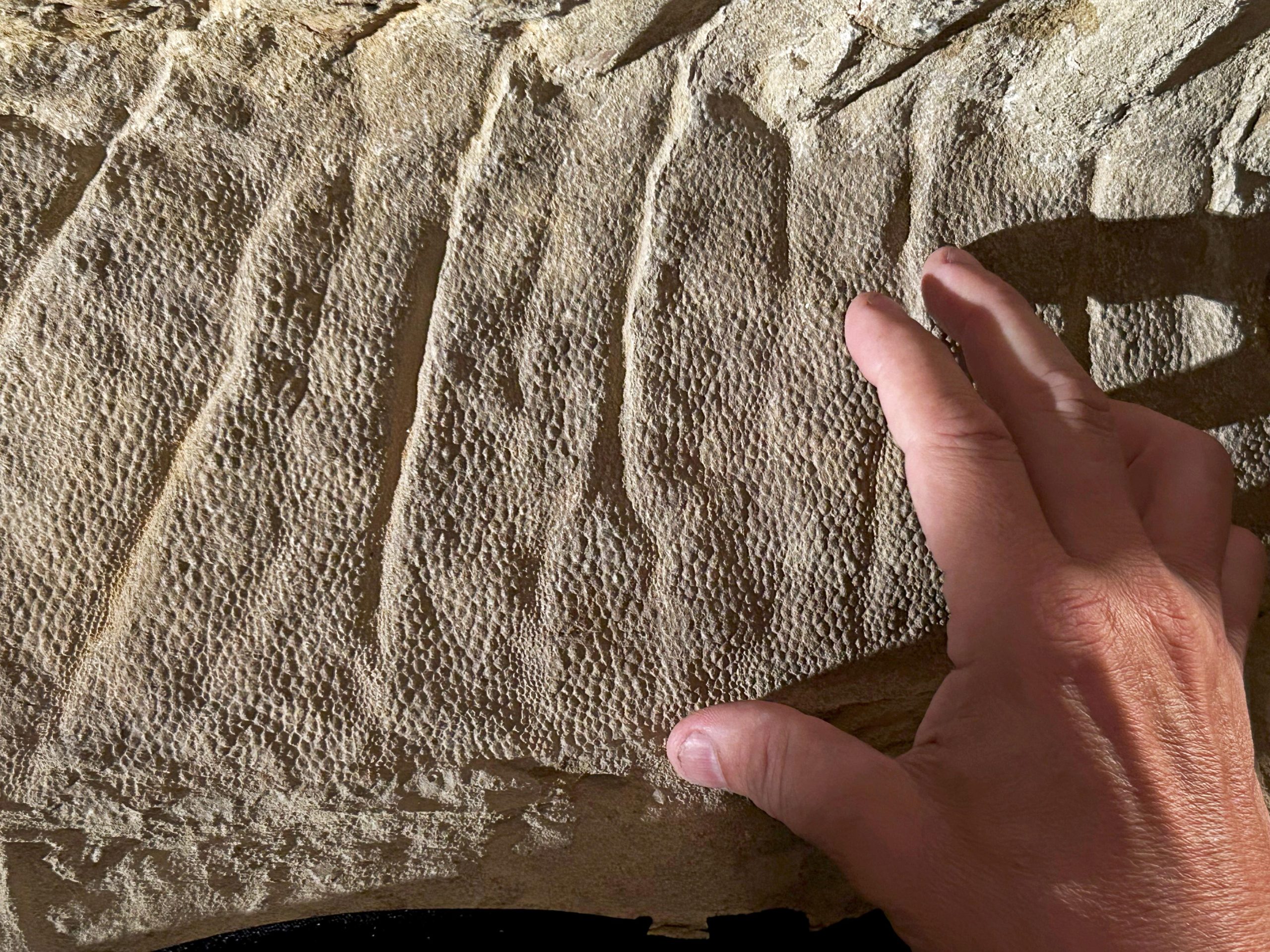
Sereno clarified that these “dinosaur mummies” differ completely from Egyptian-style human mummies, as no organic material remains. In both the newly described fossils and earlier examples from the same area, the preserved skin, spikes, and hooves consist of an ultra-thin clay coating that formed soon after burial.
“This is a mask, a template, a clay layer so thin you could blow it away,” Sereno said. “It was attracted to the outside of the carcass in a fluke event of preservation.”
Some 66 million years ago, just before the great extinction, the duck-billed dinosaur Edmontosaurus annectens walks in the soft mud of a coastline passing the sun-dried a carcass of another individual and leaving a set of footprints — before spotting its nemesis, the great predator Tyrannosaurus rex, and turning to run. Floodwaters would bury carcasses of the duckbill preserving its fleshy surface detail as a clay mask over skeletons of its fossilized bones in a small area located today in the badlands of east-central Wyoming. Credit: Artwork by Dani Navarro; storyboard by Jonathan Metzker; animation by Davide la Torre
The research team employed a wide range of analytical techniques—including hospital and micro-CT scans, X-ray spectroscopy, thin-section microscopy, and clay composition tests—to uncover how this exceptional preservation took place.
The evidence indicates that after the sun-dried carcasses were abruptly buried by a flash flood, a natural biofilm on their surfaces electrostatically drew fine clay particles from surrounding sediment. These particles formed a wafer-thin three-dimensional layer that recorded the animal’s external surface. Over time, the organic tissue decayed, while the skeleton beneath fossilized.
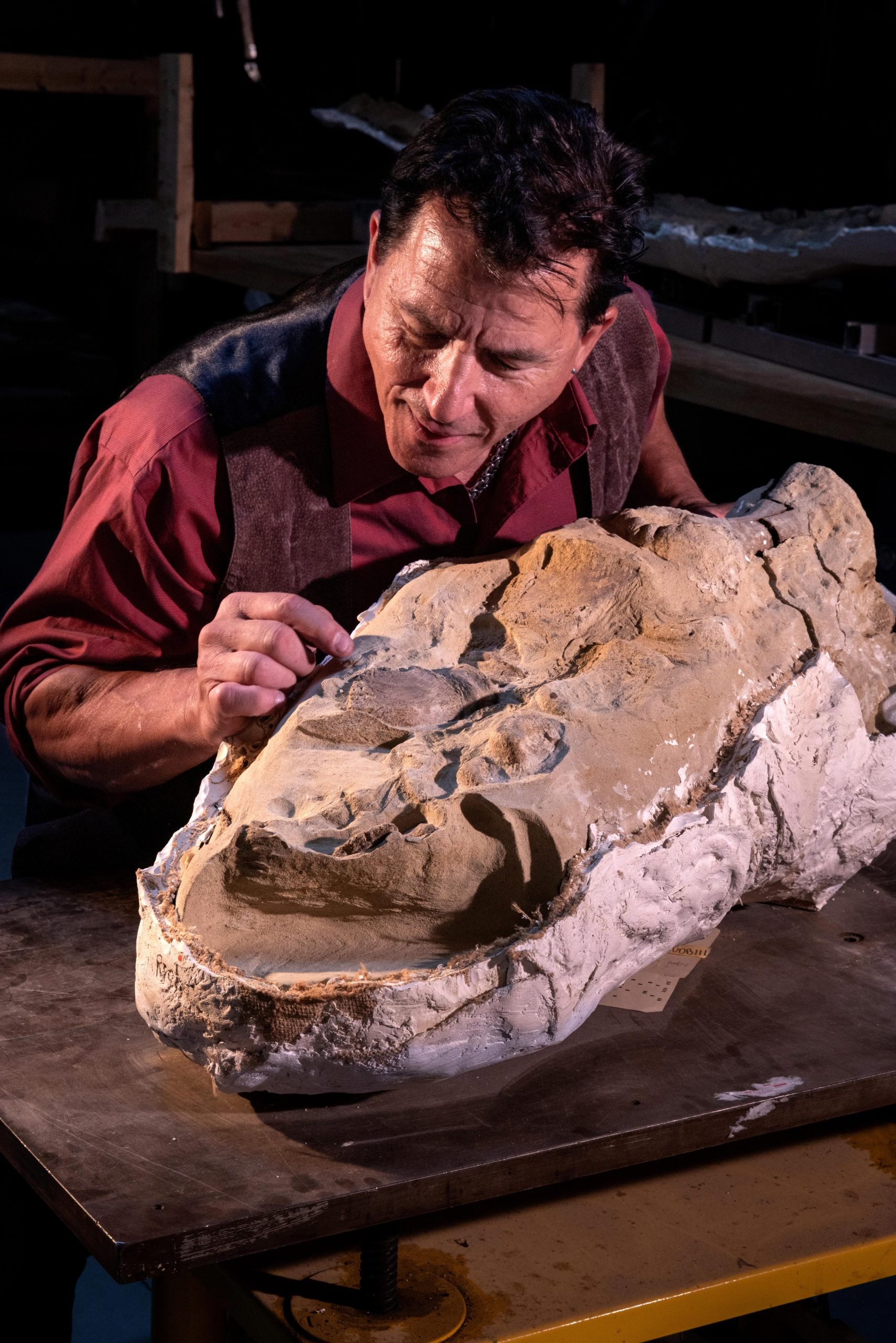
Preparing such delicate fossils demanded extraordinary precision. Fossil Lab manager and study co-author Tyler Keillor led the painstaking work to expose the fragile clay surface, which often required many hours of careful cleaning. Additional research led by postdoctoral scholar Evan Saitta incorporated 3D surface imaging, CT scans, and footprint comparisons to analyze the sediment inside and around the fossils and match the dinosaur’s hooves to its tracks. Digital artists collaborated with the scientists to visualize the reconstructed animal in motion—walking through soft mud near the close of the dinosaur age.
“I believe it’s worth taking the time to assemble a dream team in order to generate science that can be appreciated by the general public,” Sereno said. “We’ve never been able to look at the appearance of a large prehistoric reptile like this — and just in time for Halloween.”
Crests, spikes, and scales
Working with the two new mummies, the researchers reconstructed a complete, fleshy profile of Edmontosaurus annectens.
“The two specimens complemented each other beautifully,” Sereno said. “For the first time, we could see the whole profile rather than scattered patches.”
They identified a continuous midline feature that began as a fleshy crest along the neck and trunk and transitioned over the hips into a single row of spikes running down the tail — each spike positioned over a single vertebra and fitted to each other.
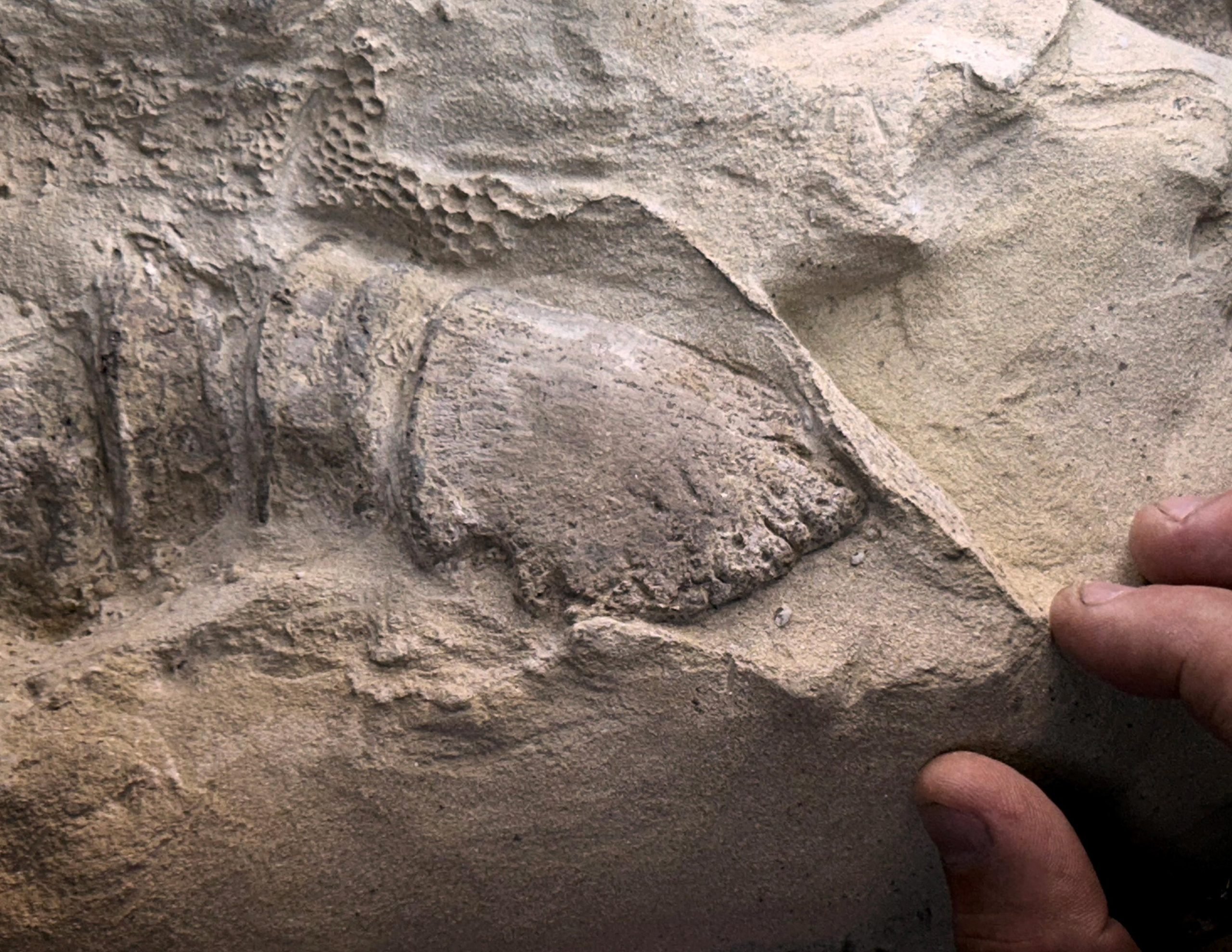
The lower body and tail had the largest polygonal scales, although most were tiny pebble-like scales just 1–4 millimeters across, surprisingly small for a dinosaur growing to over 40 feet in length. Wrinkles preserved over the ribcage suggest the skin of this duckbill was thin.
A hoofed dinosaur
The hind feet of the larger mummy held the biggest surprise: hooves. The tip of each of the three hind toes were encased in a wedge-shaped hoof with a flat bottom like that of a horse. The team used CT scans of the mummy’s feet and 3D images of the best-preserved duckbill footprint from the same time period, fitting the former into the latter. Using information from both sources, they accurately reconstructed the appearance of the hind foot. Unlike the forefoot that touches the ground only with its hooves, the hind feet have a fleshy heel pad behind the hooves.
Drone footage of the “mummy zone” in east-central Wyoming, where a half a dozen dinosaur mummies have been discovered including the two new mummies of the duck-billed dinosaur Edmontosaurus annectens. Credit: University of Chicago Fossil Lab
“There are so many amazing ‘firsts’ preserved in these duck-billed mummies — the earliest hooves documented in a land vertebrate, the first confirmed hooved reptile, and the first hooved four-legged animal with different forelimb and hindlimb posture,” Sereno said.
Shaping the future of the field
Beyond the anatomical revelations, the study offers a toolkit for future research on dinosaur soft anatomy: new preparation methods, a clear lexicon for soft structures and scales, an imaging workflow from fossil to a flesh model, and a recipe for generating a dinosaur mummy. More than standalone discoveries, the team’s mummy research offers a new model for dinosaur mummification involving clay templating to test on future finds.
The authors also point to what comes next: targeted searches for similarly preserved specimens in the same Wyoming strata and elsewhere; biomechanical models that now have reliable external boundaries; and companion analyses that probe when and where clay templating takes hold.
“This may be the single best paper I’ve released,” Sereno said. “From field to lab to 3D reconstructions along with a suite of useful terms defined, it’s a tour de force, and it tells a coherent story about how these remarkable fossils come to be and what we can learn from them.”
Reference: “Duck-billed dinosaur fleshy midline and hooves reveal terrestrial clay-template “mummification”” by Paul C. Sereno, Evan T. Saitta, Daniel Vidal, Nathan Myhrvold, María Ciudad Real, Stephanie L. Baumgart, Lauren L. Bop, Tyler M. Keillor, Marcus Eriksen and Kraig Derstler, 23 October 2025, Science.
DOI: 10.1126/science.adw3536
Never miss a breakthrough: Join the SciTechDaily newsletter.
Follow us on Google and Google News.
1 Comment
When I sometimes wish to time travel back in time..NOT THIS FAR BACK. A time filled with so many frightening things…