
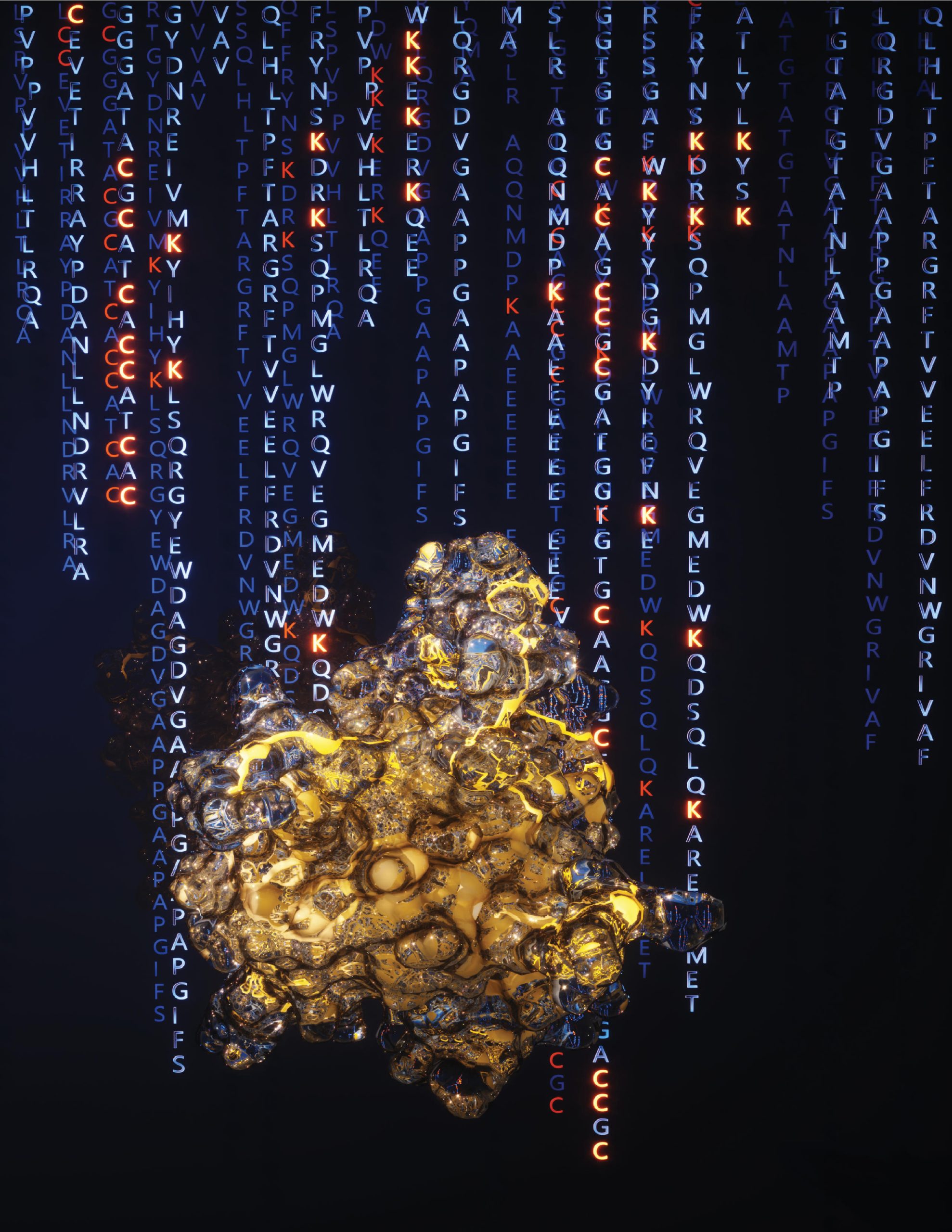
In a study published in Nature Nanotechnology, scientists from Delft University of Technology introduced a new technique to identify proteins.
Proteins carry out essential functions in our cells, while playing a crucial role in diseases like cancer and COVID-19 infection. The researchers identify proteins by reading out the fingerprint, and comparing the fingerprint to patterns from a database.
Using this new technology, the researchers can identify individual, intact, full-length proteins, preserving all its information. This can shed light on the mechanisms behind many different diseases and allows earlier diagnosis.
Incomplete IKEA project
“The study of proteins within cells has been a hot topic for decades, and has made huge advancements, allowing researchers to get a much better idea on what kind of proteins there are, and what function they carry out”, says Mike Filius, first author of the paper.
Currently, scientists use a method called mass spectrometry to identify proteins. The most common mass spectrometry approach is the ‘bottom-up’ approach, in which full-length proteins are cut into smaller fragments, called peptides, which are then measured by the mass spectrometer.
Based on the data from these small fragments, a computer reconstructs the protein.
Filius: “This is a bit similar to your typical IKEA project, where you’re always left with some spare parts you’re not really sure how to fit in. But in the case of proteins, these spare parts may actually contain very valuable information, for example about whether or not such a protein has a harmful structure that causes a disease.”
The protein fingerprint
“In order to identify a protein, you don’t need to know all of the amino acids; the building blocks of any protein. Instead, you try to obtain sufficient information so that you can identify the protein using a database as a reference, similar to how the police may find a suspect’s identity through a fingerprint,” Filius explains.
“In earlier work, we have shown that every protein has a unique fingerprint, just like the human analog. We realized that we only need to know the location of a few out of all the amino acids of a protein to generate a unique fingerprint from which we can identify the protein,” Raman van Wee, PhD candidate who was involved in the research, adds.
Finding proteins in a haystack
“We can detect these amino acids through molecules that light up under a microscope and are attached to small pieces of DNA that bind very specifically to a certain amino acid,” Van Wee explains.
This way, the team can very quickly determine the location of the amino acid with great precision.
“Since the sensitivity of this new technique, called FRET X, is higher than that of conventional methods like mass spectrometry, we can detect much lower concentrations of proteins in a mixture of many other biomolecules and require only a tiny amount of sample,” Filius says.
This is important, because that puts the measurement of patient samples in case of disease within reach.
“In our paper, we show that we can detect small amounts of proteins that are characteristic of Parkinson’s disease, or of COVID-19 infection,” Filius continues. “While there are other approaches being explored to identify proteins, ours focuses on identifying intact and individual proteins in a complex mixture. We can look for a needle in a haystack,” Van Wee adds.
Towards early-stage disease diagnosis
Though promising, the research requires substantial development still, which the Chirlmin Joo Lab is looking forward to working on. The research group has talked with several stakeholders in clinical labs and the biopharmaceutical industry and learned that they are really excited about the groundbreaking potential that the technology has.
They are also working on launching a start-up to develop FRET X into a platform for highly sensitive protein detection. This platform can diagnose diseases at the earliest stages, improving the efficacy of potential treatment.
“This breakthrough technique cracks the code of proteins and opens up exciting possibilities for earlier disease detection”, says Chirlmin Joo, supervisor of the project. This was possible with remarkable collaborative spirit. “We want to thank all people from our lab that were involved, as well as our external collaborators including the labs of Martin Pabst from the Department of Biotechnology, Dick de Ridder (Wageningen University), and Geert-Jan Boons (Utrecht University),” Filius concludes.
Reference: “Full-length single-molecule protein fingerprinting” by Mike Filius, Raman van Wee, Carlos de Lannoy, Ilja Westerlaken, Zeshi Li, Sung Hyun Kim, Cecilia de Agrela Pinto, Yunfei Wu, Geert-Jan Boons, Martin Pabst, Dick de Ridder and Chirlmin Joo, 13 February 2024, Nature Nanotechnology.
DOI: 10.1038/s41565-023-01598-7
Never miss a breakthrough: Join the SciTechDaily newsletter.
Follow us on Google and Google News.