
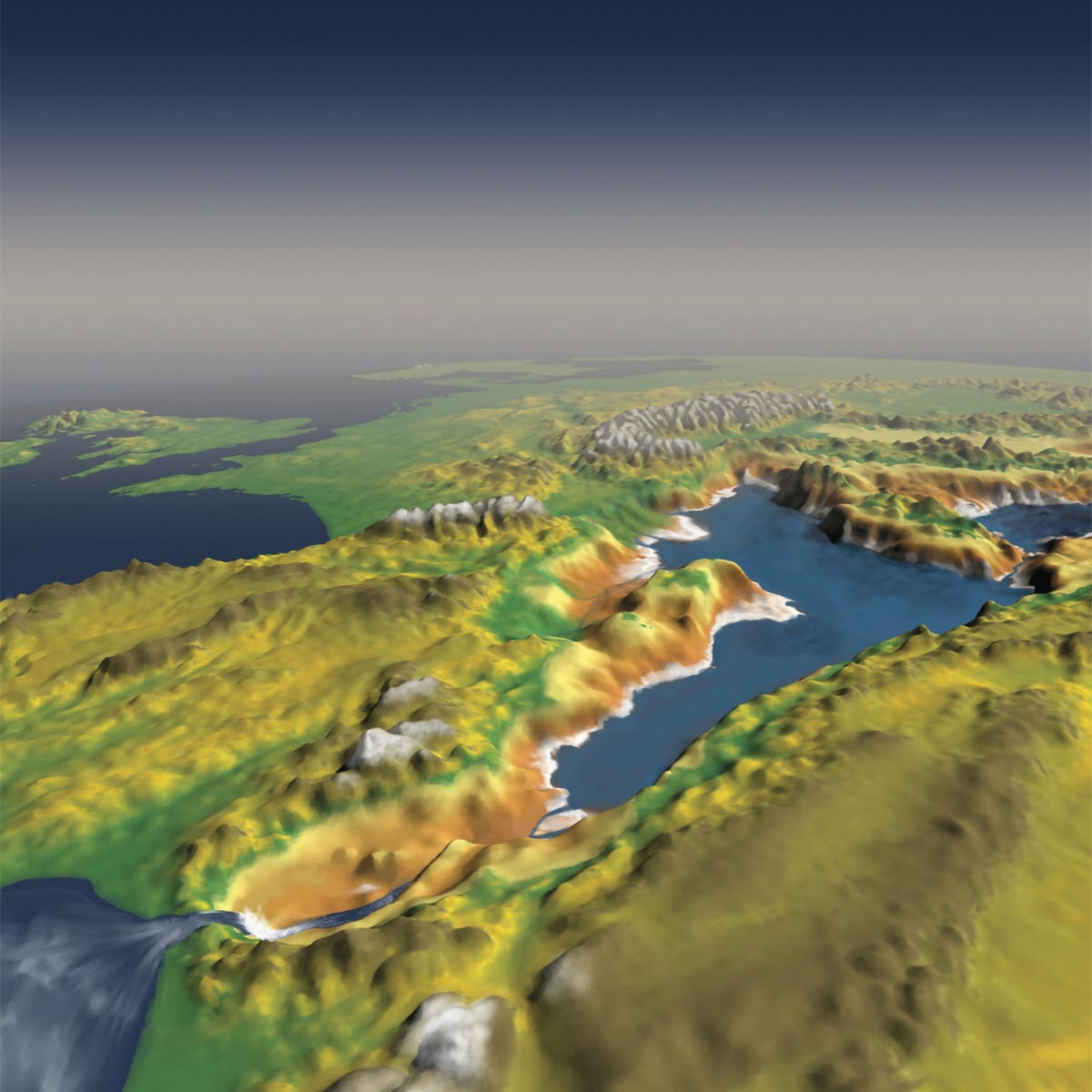
Recent studies reveal that the Messinian Salinity Crisis led to the Mediterranean Sea becoming a vast salt basin through a two-phase evaporation process, causing massive sea-level drops and widespread environmental impacts, including volcanic eruptions and global climate changes.
The Mediterranean Sea underwent a dramatic transformation during the Messinian Salinity Crisis, a major geological event that turned it into a massive salt basin between 5.97 and 5.33 million years ago.[1]
For years, scientists puzzled over how a million cubic kilometers of salt could accumulate in such a short time. Recent analysis of chlorine isotopes[2] from Mediterranean seabed salt has finally revealed the process, which unfolded in two distinct phases.
The first phase, lasting about 35,000 years, saw salt deposition limited to the eastern Mediterranean. This was triggered by a restriction in water flow from the Mediterranean to the Atlantic, leaving the basin brine-filled but stable.
In the second phase, salt accumulation expanded to the entire Mediterranean, driven by an intense, rapid evaporative event lasting less than 10,000 years. During this period, sea levels dropped dramatically—by 1.7 to 2.1 kilometers in the eastern Mediterranean and approximately 0.85 kilometers in the west. This led to a loss of up to 70% of the Mediterranean Basin’s water volume.
Impact on the Mediterranean and Beyond
This spectacular fall in sea level is thought to have had consequences for both terrestrial fauna and the Mediterranean landscape – triggering localized volcanic eruptions due to unloading of Earth’s crust, as well as generating global climatic effects due to the huge depression caused by the sea level drawdown.
These results, published today (November 18) in Nature Communications, provide a better understanding of past extreme geological phenomena, the evolution of the Mediterranean region, and successive global repercussions.
Notes
- This exceptional event covered the floor of the Mediterranean Sea with a layer of salt up to 3 km thick. Understanding the causes, consequences, and environmental changes undergone by the Mediterranean region in response to the Messinian Salinity Crisis is a challenge that has mobilized the scientific community for decades.
- Analysis of the two stable chlorine isotopes (³⁷Cl and ³⁵Cl) made it possible to estimate the rate of salt accumulation and detect the drop in sea level.
Reference: “Chlorine isotopes constrain a major drawdown of the Mediterranean Sea during the Messinian Salinity Crisis” by G. Aloisi, J. Moneron, L. Guibourdenche, A. Camerlenghi, I. Gavrieli, G. Bardoux, P. Agrinier, R. Ebner and Z. Gvirtzman, 18 November 2024, Nature Communications.
DOI: 10.1038/s41467-024-53781-6
This work was supported by the European Union and the CNRS.
Never miss a breakthrough: Join the SciTechDaily newsletter.
Follow us on Google and Google News.
4 Comments
This article is a little misleading as the Messinian Salinity event was recognised at least 50 years ago (as referenced herein Ksu et al 1973). The recent studies simply refine the observation by suggesting 2 phases of development
As above comment; and all that sea-water having evaporated during 45 000 years, where was it rained on subsequently?
Not refering to any other sources, but wasn’t this event caused by an event that basically blocked off the straits of Gibraltar , for a considerable time, whether that was tectonic,? Ice Flow?
Resulting in the Drying up of the Mediterranean. For an epic period of time.
Thet was right around the time ancient monkeys/apes migrated to Africa from south east Europe. Setting the stage for hominim development.