
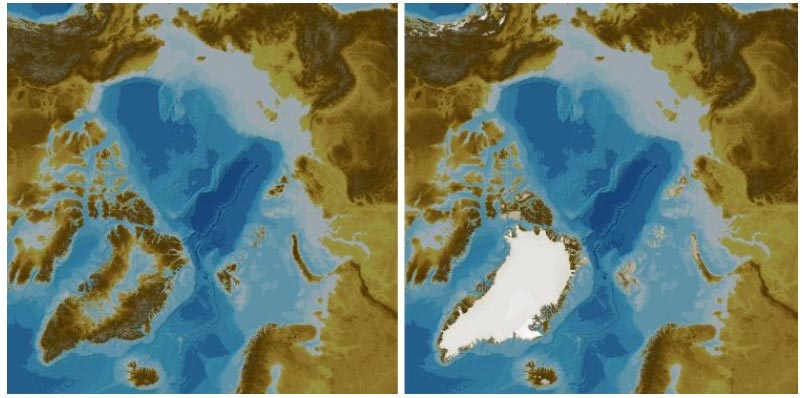
An international team of researchers has published the most detailed submarine map of the Arctic Ocean. The study, which counts on the participation of the experts Miquel Canals, José Luis Casamor, and David Amblàs, from the Consolidated Research Group on Marine Geosciences of the University of Barcelona, has been published in Nature’s journal Scientific Data.
The map is the 4.0 version of the International Bathymetric Chart of the Arctic Ocean (IBCAO), an initiative that was created in 1997 in Saint Petersburg (Russia) in order to map the depths of the Arctic floors. Published in digital format, the new chart expands up to 19.6% the submarine surface mapped in previous versions.
“The 4.0 IBCAO map is this year’s contribution to the Nippon Foundation-GEBCO Seabed 2030, whose objective is to map all seas and oceans in the world by 2030,” notes Martin Jakobsson, professor at the Stockholm University (Sweden), who led the scientific team with experts from fifteen countries, together with Larry Mayer, from the University of New Hampshire (United States).
The new bathymetric chart of the Arctic Ocean
With a strategic position, the Arctic is a mythic ocean in the story of the great geographical explorations to discover the secrets of the polar regions. The northernmost ocean of the planet -also the smallest and shallowest one- plays a decisive role in the regulation of the planet’s climate and it is the most sensitive polar region to the effects of global warming. According to some predictions, the progressive loss of the marine ice layers could open the navigation to some areas which were inaccessible so far, such as the Northwest Passage, the legendary marine route pursued by many 19th-century expeditions, which joins the boreal Pacific and Atlantic oceans.
“The potential difficulty for the current science campaigns in the Arctic is the access to places which are permanently covered by marine ice, and the short-lived duration of the navigation period. However, global warming made these inaccessible areas easier to reach now”, notes Professor Miquel Canals, head of the Consolidated Research Group on Marine Sciences of the UB.
Since 2018, the team of the UB has contributed to the 4.0 IBCAO map with data mainly obtained through the multibeam bathymetry in oceanographic campaigns in the Arctic, especially in the western area in the Barents Sea, “a volunteering collaboration to benefit science and knowledge”, as Miquel Canals states. In its different editions, the IBCAO maps received thousands of downloads over the years and are widely used by governments, companies, and researchers with scientific interests and activities in the Arctic.
The new cartography has a volume with a higher and better resolution data than the previous versions, and it includes marine regions which were unknown to date. “This results from the efforts made by an international cooperation, which counts on the participation of many institutions and researchers who provided their scientific data to reach a common objective: discovering the depths of the Arctic Ocean”, notes Canals, professor at the Department of Earth and Ocean Dynamics at the Faculty of Earth Sciences of the UB.
Multibeam probes and nuclear submarine under the Arctic ice
In order to carry out the IBCAO 4.0 map, the team used the same technology used in the submarine study in other regions of the ocean. “The compounds of the new map -mainly the most recent ones- were obtained through the most advanced multibeam bathymetry systems that exist. These data come from oceanographic vessels, ice breakers, and nuclear submarines, the only ones to map those areas under the iced sea, impossible to reach with other ships”, notes Canals.
“Regarding the data processing and fusion -with a new Mallat algorithm-, new techniques were added, and provided an excellent result”, adds the expert.
Ocean currents, climate regulation and stability of ocean floors
In general, a better and larger cartography helps to broaden the knowledge on the geological and glacial evolution of such a sensitive region like the Arctic. Therefore, the new bathymetric map identifies a great variety of the shape of the relief with glacial origins, “some at large scales -from hundreds to thousands of meters in length-, that show the direction of the movement of the ice on the ocean floors, which helps to reconstruct the geological processes of the recent past in arctic latitudes”.
Bathymetrical data are relevant in other fields of polar science, such as the study of the path of ocean currents -and therefore, the distribution of the heat-, the sea-ice decline, the effect of inflowing warm waters on tidewater glaciers, and the stability of marine-based ice streams and outlet glaciers grounded on the seabed.
One of the most spectacular formations in the Arctic ocean floors is the Lomonosov Ridge, a geological element with more than 1,600 kilometers (1,000 miles) of length “which connects Northern Greenland and Siberia and crosses the ocean leaving deep basins in both sides,” notes canals. “The most recent cartography studies carried out with ice breakers, revealed the presence of thresholds that influence the exchange of water between both basins, and anchoring marks in ice platforms on the ridge,” he adds.
The IBCAO 4.0 bathymetric chart also reveals the detailed map of the Greenland fiords, and provides data of interest for the development of predictive models on the behavior of the ice sheet -currently undergoing a rapid recession- which covers the island and on the sea level rise worldwide.
The challenge of mapping marine floors worldwide
To date, researchers have mapped about the fifth part of the ocean floors worldwide. Knowing the submarine relief of the global ocean is essential to manage and protect the marine and coastal ecosystems, as stated in one of the objectives of the UN Sustainable Development Goals (SDG), approved by the General Assembly in 2015.
Within the frame of the international effort to study the Arctic marine floors, the Consolidated Research Group on Marine Geosciences of the UB is one of the teams that take part in the Nippon Foundation-GEBCO Seabed 2030, the most ambitious global project to complete a great task in marine geosciences: high-resolution submarine bathymetry in all oceans worldwide.
Reference: “The International Bathymetric Chart of the Arctic Ocean Version 4.0” by Martin Jakobsson, Larry A. Mayer, Caroline Bringensparr, Carlos F. Castro, Rezwan Mohammad, Paul Johnson, Tomer Ketter, Daniela Accettella, David Amblas, Lu An, Jan Erik Arndt, Miquel Canals, José Luis Casamor, Nolwenn Chauché, Bernard Coakley, Seth Danielson, Maurizio Demarte, Mary-Lynn Dickson, Boris Dorschel, Julian A. Dowdeswell, Simon Dreutter, Alice C. Fremand, Dana Gallant, John K. Hall, Laura Hehemann, Hanne Hodnesdal, Jongkuk Hong, Roberta Ivaldi, Emily Kane, Ingo Klaucke, Diana W. Krawczyk, Yngve Kristoffersen, Boele R. Kuipers, Romain Millan, Giuseppe Masetti, Mathieu Morlighem, Riko Noormets, Megan M. Prescott, Michele Rebesco, Eric Rignot, Igor Semiletov, Alex J. Tate, Paola Travaglini, Isabella Velicogna, Pauline Weatherall, Wilhelm Weinrebe, Joshua K. Willis, Michael Wood, Yulia Zarayskaya, Tao Zhang, Mark Zimmermann and Karl B. Zinglersen, 9 July 2020, Scientific Data.
DOI: 10.1038/s41597-020-0520-9
Never miss a breakthrough: Join the SciTechDaily newsletter.
Follow us on Google and Google News.