
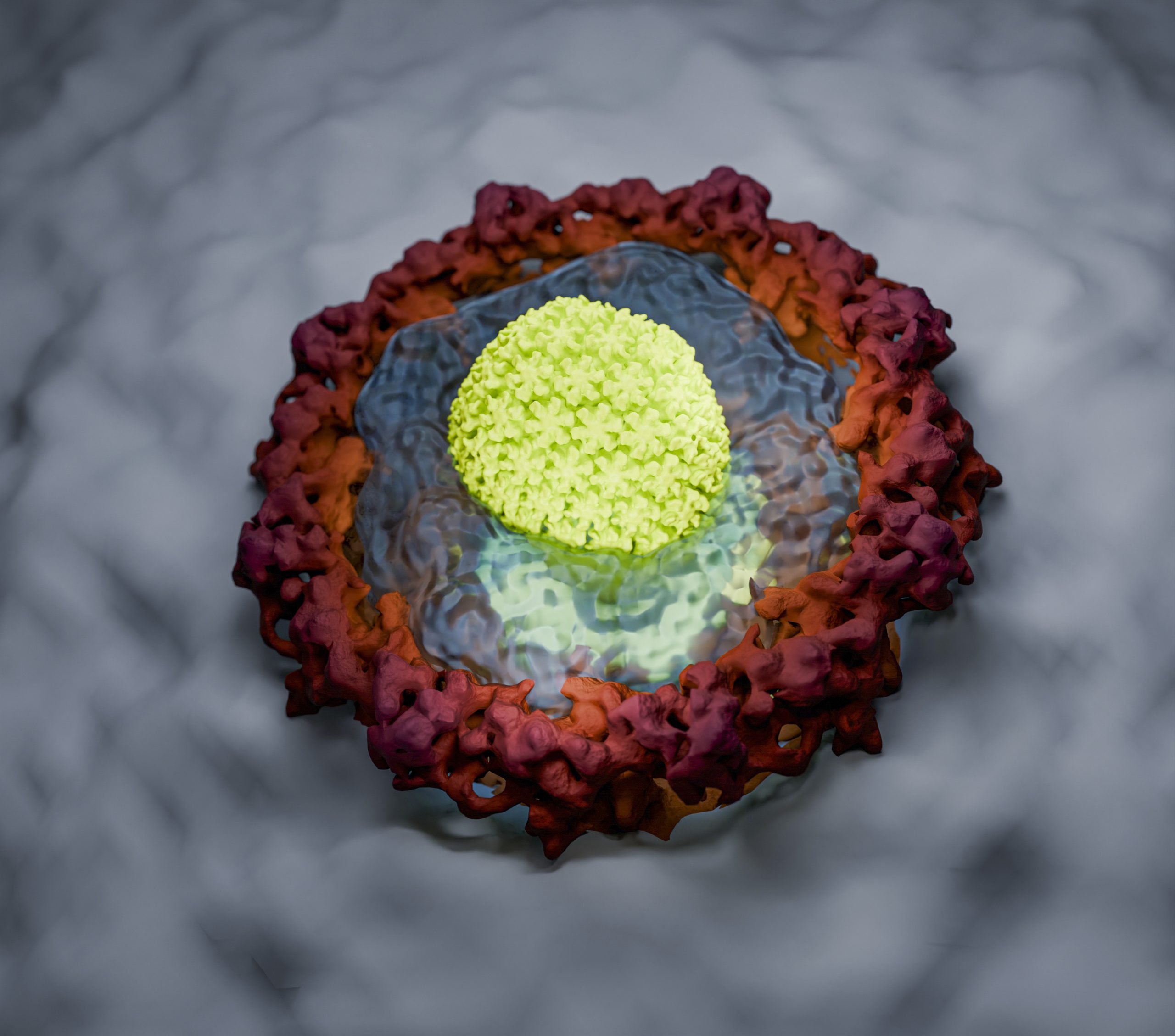
The virus’s capsid functions as a molecular transporter.
Every year, approximately one million people globally contract HIV, the virus responsible for AIDS. For the virus to multiply and propagate the infection, it must transport its genetic information into the nucleus of a cell and incorporate it into the cell’s chromosome.
Research teams led by Dirk Görlich at the Max Planck Institute for Multidisciplinary Science and Thomas Schwartz at the Massachusetts Institute of Technology (MIT) have now discovered that its capsid has evolved into a molecular transporter. As such, it can directly breach a crucial barrier, which normally protects the cell nucleus against viral invaders. This way of smuggling keeps the viral genome invisible to anti-viral sensors in the cytoplasm.
Forty years after the human immunodeficiency virus (HIV) was discovered as the cause of AIDS, we have therapies that effectively keep the pathogen under control, but there is still no cure. The virus infects certain immune cells and hijacks their genetic program in order to multiply and replicate its own genetic material. The infected cells then produce the next generation of viruses until they are finally destroyed. The immunodeficiency symptoms of AIDS result from the massive loss of immune cells that normally fight viruses and other pathogens.
To use the host cell’s resources, HIV must smuggle its genetic material through cellular defense lines into the cell nucleus. The nucleus, however, is closely guarded. Its nuclear envelope prevents unwanted proteins or harmful viruses from entering the nucleus and macromolecules from an uncontrolled escape. Yet, selected proteins can pass because the barrier is not hermetically sealed.
Thousands of tiny nuclear pores in the nuclear envelope provide a passageway. They control these transport processes with the help of importins and exportins – molecular transporters that capture cargoes with valid molecular “passcodes” and deliver them through the nuclear pore channel. A ‘smart’ material turns these pores into one of nature’s most efficient sorting and transport machines.
“Smart” sorting in the nuclear pore
This “smart” material, called FG phase, is jelly-like and impenetrable for most macromolecules. It fills and blocks the nuclear pore channel. Importins and exportins, however, can pass through because their surfaces are optimized for sliding through an FG phase.
The cell’s border control in the FG phase happens extremely fast – within milliseconds. Likewise, its transport capacity is enormous: a single nuclear pore can transfer up to 1,000 transporters per second through its channel. Even with such a high traffic density, the barrier of nuclear pores remains intact and keeps suppressing unwanted border crossings. HIV, however, subverts this control.
Smuggled genetic material
“HIV packages its genome into a capsid. Recent evidence suggests that the genome stays inside the capsid until it reaches the nucleus, and thus also when passing the nuclear pore. But there is a size problem,” Thomas Schwartz of MIT explains. The central pore channel is 40 to 60 nanometers wide. The capsid has a width of about 60 nanometers and could just squeeze through the pore.
However, a normal cellular cargo would still be covered by a transporter layer that adds at least another ten nanometers. The HIV capsid would then be 70 nanometers wide – too big for a nuclear pore. “Nevertheless, cryo-electron tomography has shown that the HIV capsid gets into the nuclear pore. But how this happens has been so far a mystery in HIV infection,” says Max Planck Director Görlich.
Camouflage as a molecular transporter
Together with Schwartz, he has now discovered how the virus overcomes its size problem, namely by a sophisticated molecular adaptation. “The HIV capsid has evolved into a transporter with an importin-like surface. This way, it can slide through the FG phase of the nuclear pore. The HIV capsid can thus enter the nuclear pore without helping transporters and bypass the protective mechanism that otherwise prevents viruses from invading the cell nucleus,” the biochemist explains.
His team has succeeded in reproducing FG phases in the laboratory. “Under the microscope, FG phases appear as micrometer-sized spheres that completely exclude normal proteins, but virtually suck up the HIV capsid with its enclosed contents,” reports Liran Fu, one of the first authors of the study now published in the journal Nature. “Similarly, the capsid is sucked up into the nuclear pore channel. This happens even after all cellular transporters have been removed.”
In one respect the HIV capsid differs fundamentally from previously studied transporters that pass nuclear pores: It encapsulates its cargo completely and thus conceals its genomic payload from anti-viral sensors in the cytoplasm. Employing this trick, the viral genetic material can be smuggled through the cellular virus defense system without being recognized and destroyed. “This makes it another class of molecular transporters alongside importins and exportins,” Görlich emphasizes.
There are still many unanswered questions, such as where and how the capsid disintegrates to release its contents. However, the observation that the capsid is an importin-like transporter might one day be exploited for better AIDS therapies.
Reference: “HIV-1 capsids enter the FG phase of nuclear pores like a transport receptor” by Liran Fu, Erika N. Weiskopf, Onno Akkermans, Nicholas A. Swanson, Shiya Cheng, Thomas U. Schwartz and Dirk Görlich, 24 January 2024, Nature.
DOI: 10.1038/s41586-023-06966-w
Never miss a breakthrough: Join the SciTechDaily newsletter.
Follow us on Google and Google News.