
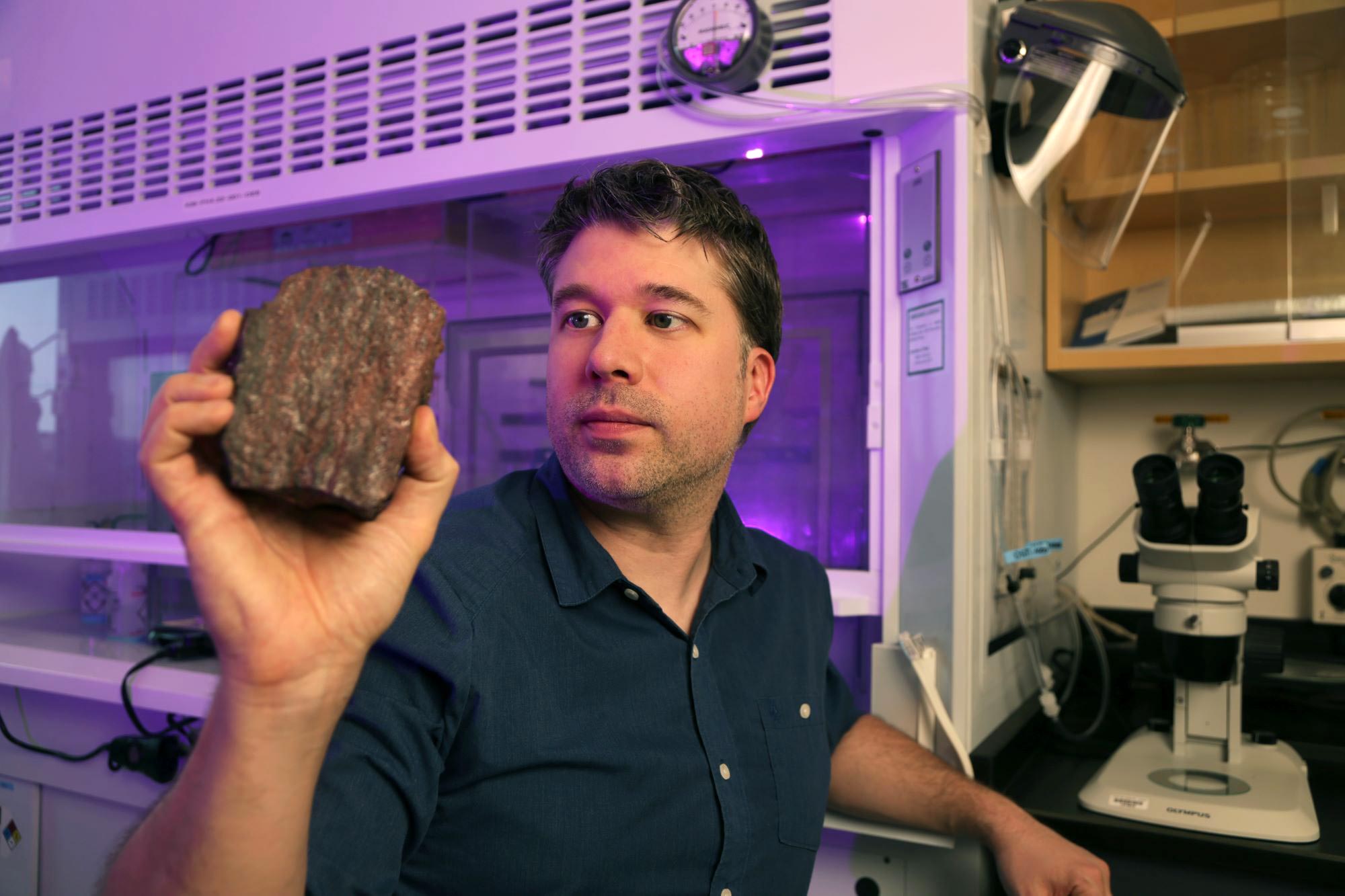
Researchers explore carbon in 3.9-billion-year-old Canadian rocks.
Scientists have revealed that graphite in the ancient Saglek-Hebron iron formations of Nunatsiavut, once thought to indicate the earliest life on Earth, likely has abiotic origins.
Early Life on Earth
The isotopic composition of carbon in iron formations from the Saglek-Hebron Complex in Nunatsiavut (northern Labrador) has been seen as evidence of the earliest traces of life on Earth. But a new study by the University of Ottawa, Carleton University, and University College London suggests otherwise.
The study shows that the petrographic, geochemical, and spectroscopic features in the graphite (the crystalline form of carbon) found in the Saglek-Hebron chemical sedimentary rocks are in fact “abiotic,” that is, nonliving physical or chemical aspects of an environment or devoid of life.
The Abiotic Nature of Graphite
This enhances our understanding of how early biomass transformed on Earth, emphasizing the interaction between non-biological processes and ancient life remnants. Studying graphitic materials is key to decoding carbon cycling on the early Earth.
This study is crucial to the search for ancient life on Earth and potentially on neighboring planets.
New Methods in Geochemical Analysis
Researchers used micro-Raman spectroscopy and revisited the isotopic signatures in these rocks. Their findings show that graphite may come from liquid substances containing carbon, hydrogen and oxygen, probably originating from the breakdown of old organic materials.
“Our study focuses on chemical sedimentary rocks found in the Saglek-Hebron. These rocks, among the oldest on Earth, dating back 3.9 billion years, are created through oceanic precipitation. They include banded iron formations that may have been formed by the activity of bacteria,” explains co-author Jonathan O’Neil, an associate professor in the Department of Earth and Environmental Sciences at uOttawa.
Rethinking Geological Signatures
“They are ideal for studying ancient biological processes. Our study challenges the previous interpretation that the carbon isotopic composition of these rocks is indicative of a biological origin, but their spectroscopic properties rather suggesting abiotic characteristics. This prompts us to reconsider the processes responsible for isotopic signatures and how they could be linked to the action of micro-organisms,” O’Neil adds.
Research over the past year has focused on samples collected in Nunatsiavut during a field campaign in 2016. Petrological characterization was carried out in Ottawa and spectroscopic analysis of graphitic carbon was carried out in London, U.K.
The Origins of Graphitic Carbon
“Graphitic carbon from chemical sedimentary rock samples has been studied in three sedimentary rock samples that are nearly 3.9 billion years old. Spectroscopic analysis of this graphitic carbon suggests that it was formed from metamorphic fluids (at temperatures of over 500oC), rather than by processes involving bacterial action,” says O’Neil.
The research shows that graphite in rocks may have formed without organic life, possibly through a carbon-extraction process. The degree of crystallization of the graphite correlates with the rocks’ metamorphism, indicating that metamorphism affects the preservation and change of carbon-based materials.
Reference: “Abiotic synthesis of graphitic carbons in the Eoarchean Saglek-Hebron metasedimentary rocks” by Zixiao Guo, Dominic Papineau, Jonathan O’Neil, Hanika Rizo, Zhong-Qiang Chen, Xincheng Qiu and Zhenbing She, 6 July 2024, Nature Communications.
DOI: 10.1038/s41467-024-50134-1
Never miss a breakthrough: Join the SciTechDaily newsletter.
Follow us on Google and Google News.
3 Comments
Prove this rock is as old as you say!
Use the scientific method, not he said ore uniformitarian ancient age garbage.
Sam there is nothing wrong with what the gentleman said, or wrote.
Even if he used the latest geochemical techniques for age dating, the number will never be exact. I am sure there are fossils in the rock, they just don’t know what to look for. NASA has the same problem, they don’t know what to look for either when it comes to looking at the highly fossiliferous Moon Rocks!
I just finished looking at the rock being held in the Professors hand. I count no less than 7 or 8 fossils laying on the surface of the outcrop sample. How embarrassing! Do universities even look at rocks anymore?