
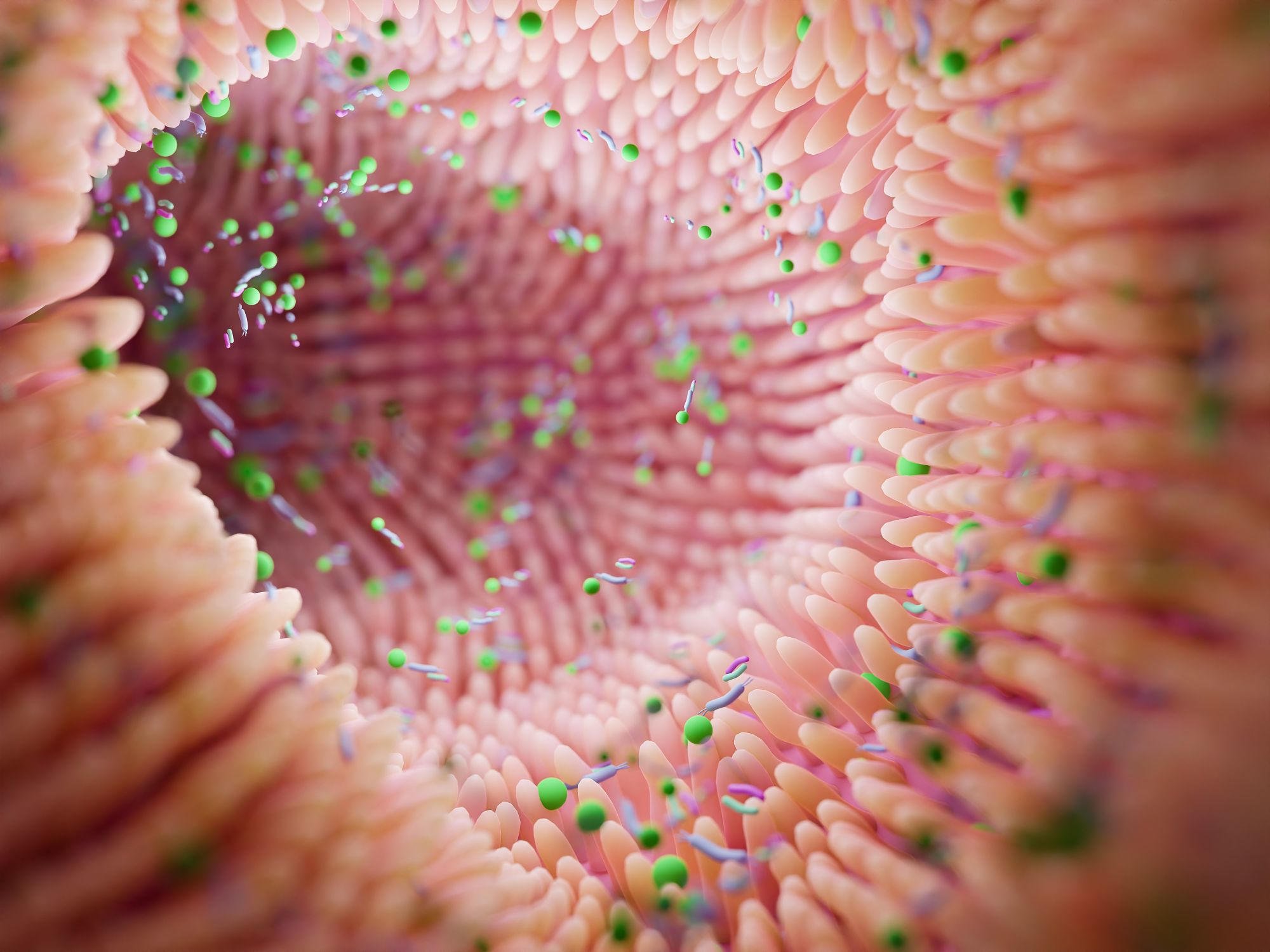
Researchers have discovered several new antibiotic candidates by mining gut microbiome data, with one matching the effectiveness of established antibiotics.
There are approximately 100 trillion microbes in the average human gut, many of which are constantly competing for limited resources.
“It’s such a harsh environment,” says César de la Fuente, Presidential Assistant Professor in Bioengineering and in Chemical and Biomolecular Engineering within the School of Engineering and Applied Science, in Psychiatry and Microbiology within the Perelman School of Medicine, and in Chemistry within the School of Arts & Sciences. “You have all these bacteria coexisting, but also fighting each other. Such an environment may foster innovation.”
In this hostile environment, where bacteria are forced to develop tools to fight against one another, de la Fuente’s lab sees potential for new antibiotics to fight drug-resistant infections.
Advancements in Antibiotic Discovery
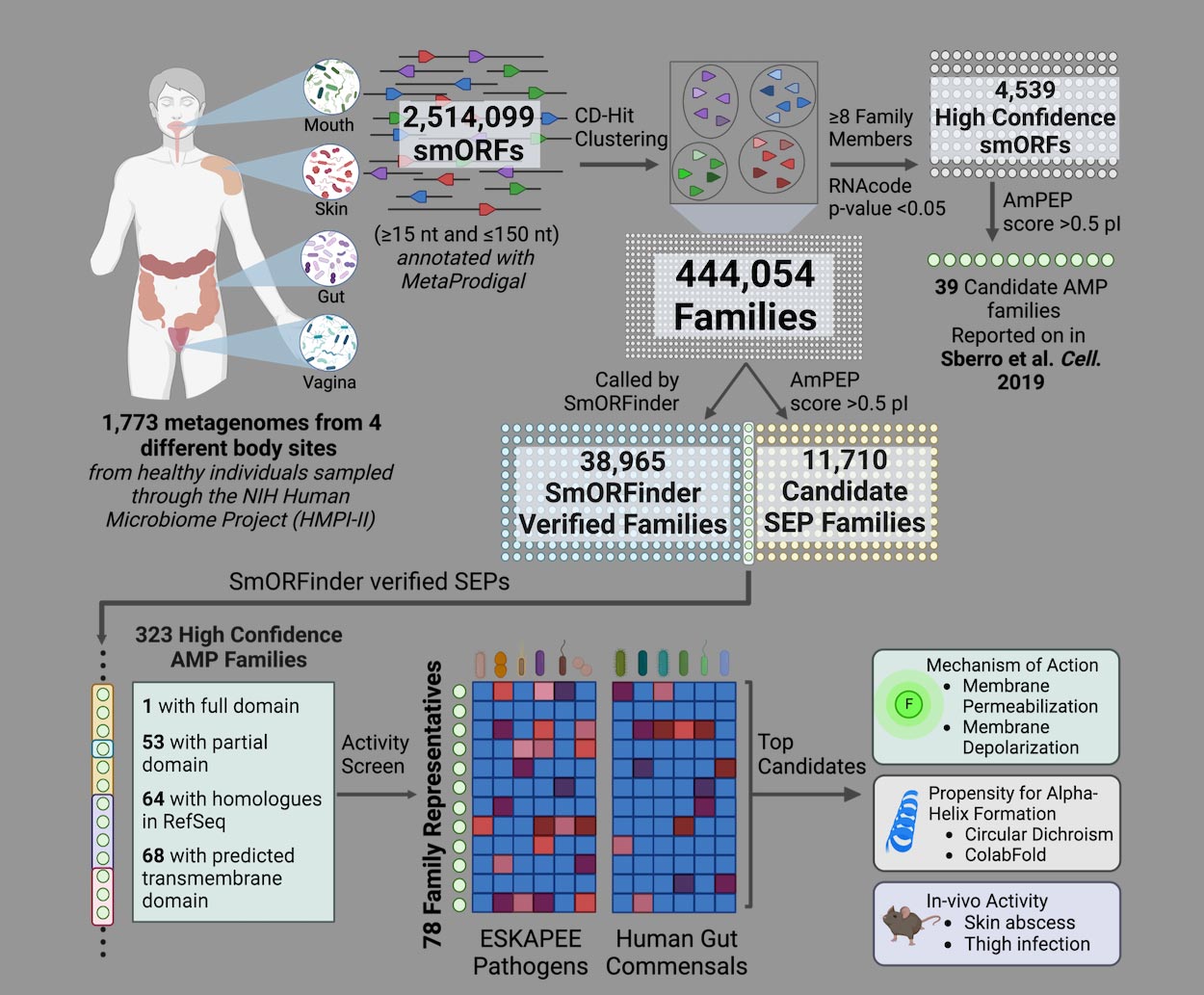
In a new paper in Cell, the labs of de la Fuente and Ami S. Bhatt, Professor in Medicine (Hematology) and Genetics at Stanford, surveyed the gut microbiomes of nearly 2,000 people, discovering dozens of potential new antibiotics. “We think of biology as an information source,” says de la Fuente. “Everything is just code. And if we can come up with algorithms that can sort through that code, we can dramatically accelerate antibiotic discovery.”
Recently, de la Fuente’s lab has made headlines for finding antibiotic candidates everywhere from the genetic information of extinct creatures like Neanderthals and wooly mammoths to masses of bacteria whose genetic material the lab analyzed using artificial intelligence.
“One of our primary goals is to mine the world’s biological information as a source of antibiotics and other useful molecules,” says de la Fuente. “Rather than relying on traditional, painstaking methods that involve collecting soil or water samples and purifying active compounds, we harness the vast array of biological data found in genomes, metagenomes, and proteomes. This allows us to uncover new antibiotics at digital speed.”
Innovative Research Methods
Given that bacteria evolve quickly, de la Fuente and his coauthors hypothesized that an environment that encourages competition — like the human gut — might be home to numerous undiscovered antimicrobial compounds. “When there is a lack of resources,” de la Fuente points out, “that’s when biology really comes up with innovative solutions.”
The group focused on peptides, short chains of amino acids, which have previously shown promise as novel antibiotics. “We computationally mined over 400,000 proteins,” de la Fuente says, referring to the process whereby AI reads the letters of genetic code and, having been trained on a set of known antibiotics, predicts which genetic sequences might have antimicrobial properties.
Promising Results and Future Prospects
“Interestingly, these molecules have a different composition from what has traditionally been considered antimicrobial,” says Marcelo D.T. Torres, a research associate in the de la Fuente lab, and the paper’s first author. “The compounds we have discovered constitute a new class, and their unique properties will help us understand and expand the sequence space of antimicrobials.”
Of course, those predictions must then be experimentally validated; after finding a few hundred antibiotic candidates, the researchers selected 78 to test against actual bacteria. After synthesizing these peptides, the researchers exposed bacterial cultures to each peptide and waited 20 hours to see which peptides successfully inhibited bacterial growth. In addition, the team later tested the antibiotic candidates in animal models.
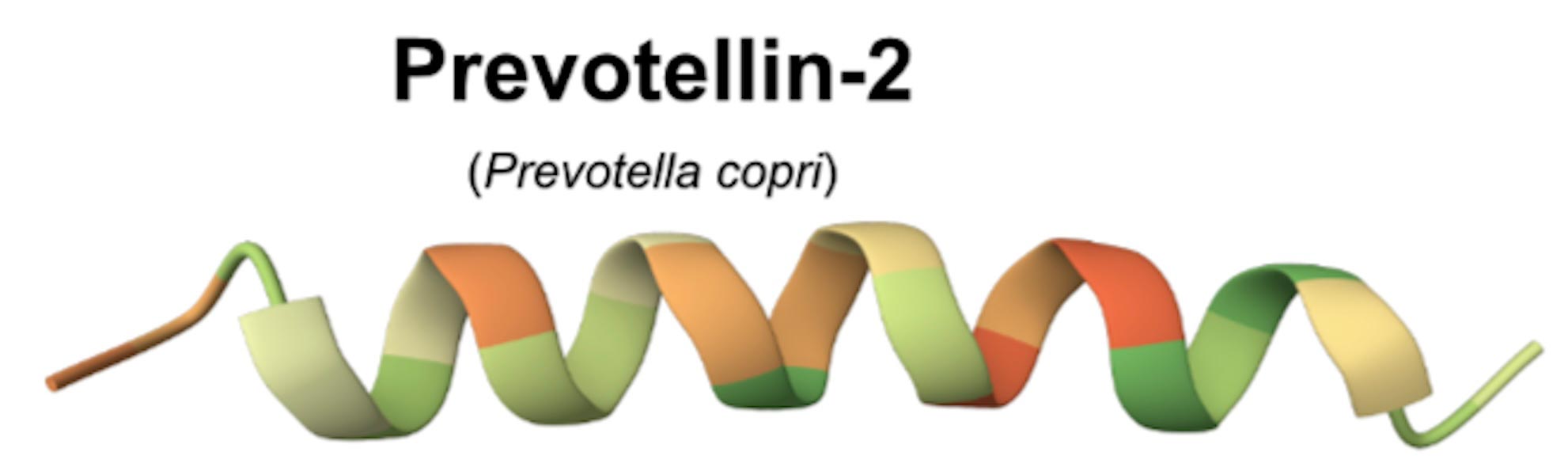
Over half of the peptides tested worked — that is, they inhibited bacterial growth of either friendly or pathogenic bacteria — and the lead candidate, prevotellin-2, demonstrated anti-infective capabilities on par with polymyxin B, an FDA-approved antibiotic used today to treat multidrug-resistant infections, suggesting that the human gut microbiome may contain antibiotics that will someday find clinical application.
“Identifying prevotellin-2, which has activities on par with one of our antibiotics of last resort, polymyxin B, was very surprising to me,” says Bhatt. “This suggests that mining the human microbiome for new and exciting classes of antimicrobial peptides is a promising path forward for researchers and doctors, and most especially for patients.”
Reference: “Mining human microbiomes reveals an untapped source of peptide antibiotics” by Marcelo D.T. Torres, Erin F. Brooks, Angela Cesaro, Hila Sberro, Matthew O. Gill, Cosmos Nicolaou, Ami S. Bhatt and Cesar de la Fuente-Nunez, 19 August 2024, Cell.
DOI: 10.1016/j.cell.2024.07.027
Professor de la Fuente holds a Presidential Professorship at the University of Pennsylvania and is supported by funding from Procter & Gamble, United Therapeutics, a Brain & Behavior Research Foundation Young Investigator Grant, the Nemirovsky Prize, Penn Health-Tech Accelerator Award, the Defense Threat Reduction Agency (HDTRA11810041 and HDTRA1-23-1-0001), and the Dean’s Innovation Fund from the Perelman School of Medicine at the University of Pennsylvania. Professor Bhatt was supported by a Paul Allen Distinguished Investigator Award and the NIH (R01AI148623 and R01AI143757). Research reported in this publication was supported by the Langer Prize (American Institute of Chemical Engineers Foundation), the National Institutes of Health (R35GM138201), and the Defense Threat Reduction Agency (HDTRA1-21-1-0014).
Never miss a breakthrough: Join the SciTechDaily newsletter.
Follow us on Google and Google News.