
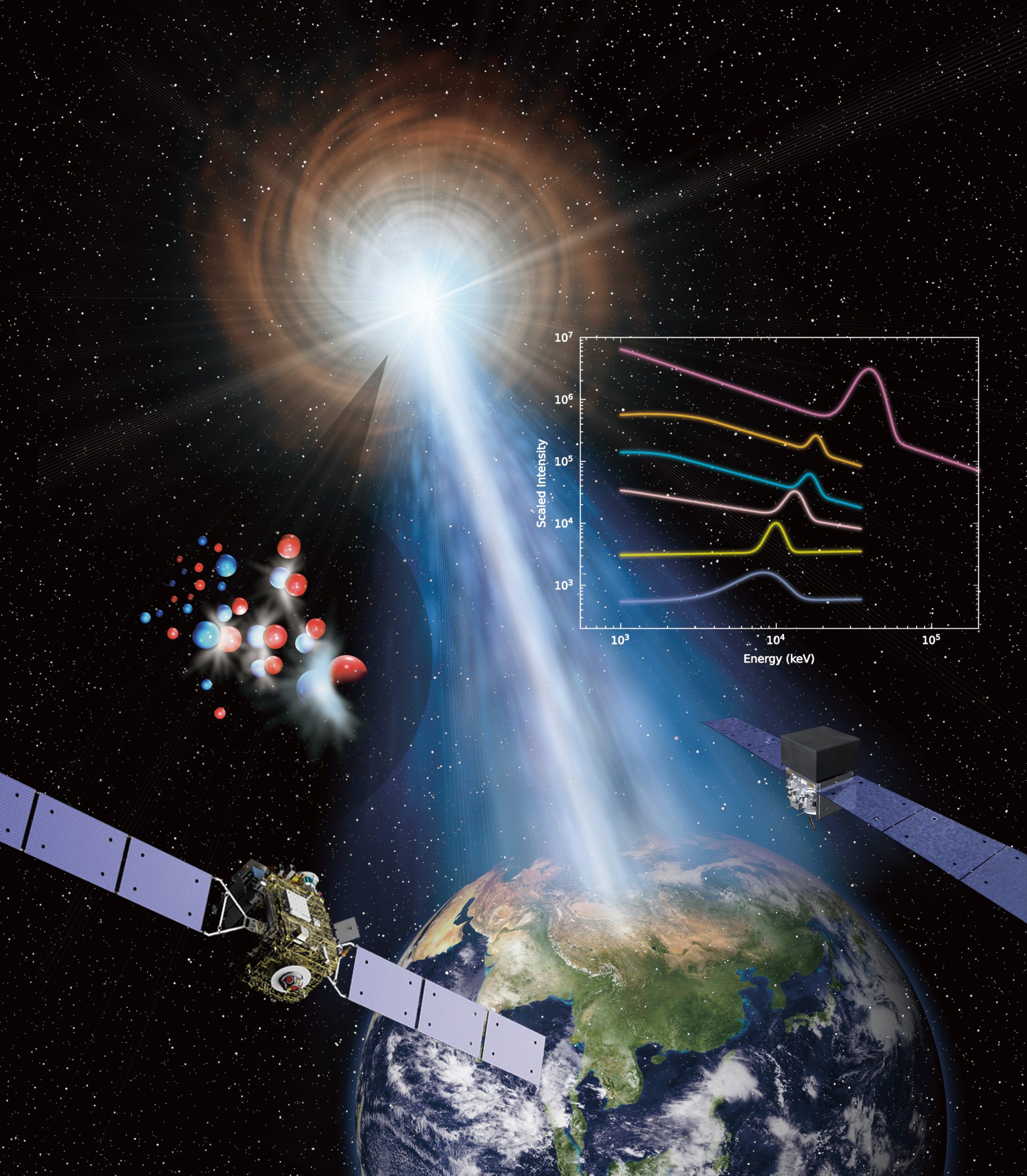
A groundbreaking study uncovered new gamma-ray lines in the universe’s brightest gamma-ray burst, GRB 221009A, revealing deeper insights into gamma-ray burst physics.
New research on the brightest ever gamma-ray bursts (GRBs) revealed unprecedented gamma-ray lines, providing new insights into the physics of gamma-ray bursts.
Gamma-ray bursts (GRBs) are the most powerful explosions in the universe, offering valuable insights into stars, galaxies, and the cosmos. Since their discovery in the 1960s, the brightest GRB ever recorded, GRB 221009A, hit Earth on October 9th, 2022. Its intense brightness was so extreme that it disrupted the normal functioning of many gamma-ray telescopes.
Fortunately, GECAM-C, the third instrument of the GECAM series that Shaolin Xiong proposed, provided an accurate and high-resolution measurement of the burst, thanks to its dedicated design for bright events. Considering the record-breaking brightness and rich observation data sets, the research team quickly realized that this GRB provides a precious opportunity to search for gamma-ray lines in the spectrum, which are critically important but never detected in GRB before.
The research was led by Prof. Shaolin Xiong (Institute of High Energy Physics, Chinese Academy of Sciences) Prof. Jirong Mao (Yunnan Observatories, Chinese Academy of Sciences), and Prof. Shuang-Nan Zhang (Institute of High Energy Physics, Chinese Academy of Sciences).
Comprehensive Spectral Analysis
For this goal, the research team executed a comprehensive spectral analysis of the joint observation data from two space gamma-ray monitors. “GECAM-C provided an accurate spectral measurement for the full course of this burst, while Fermi/GBM could extend the spectrum to a higher energy band. Together, they can provide a very wide range of spectrum measurement and line search,” Shaolin Xiong says.
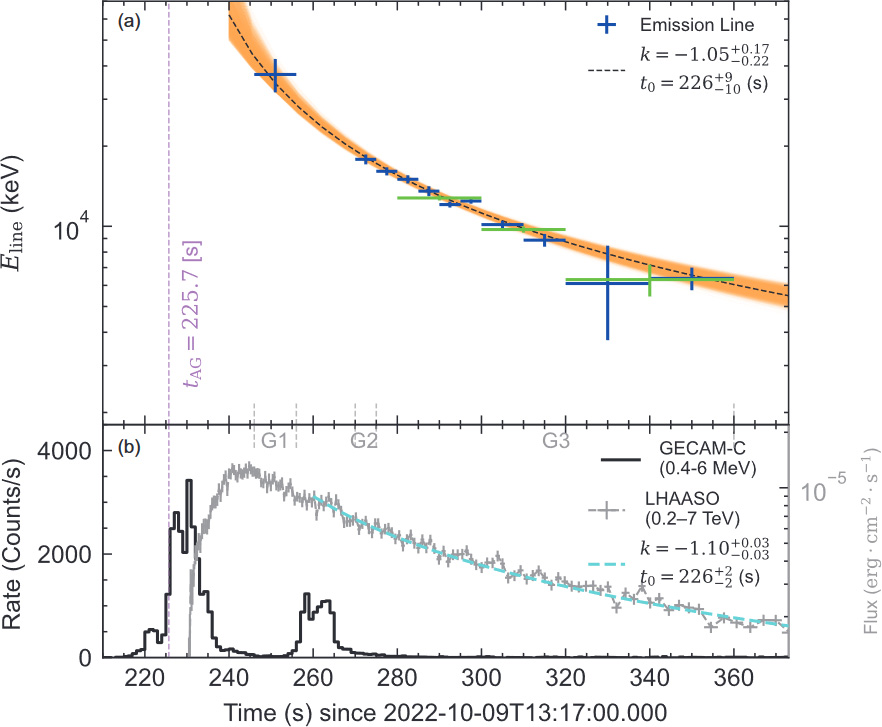
“Soon after we started this analysis, we noticed that, above the continuum spectrum that is usually seen in GRBs, there are some interesting excess features in some time intervals of this burst. We thought they might be the grail we’ve been looking for,” said the first author of this paper, Yanqiu Zhang, a PhD student at the Institute of High Energy Physics.
Rigorous Verification of Results
“But we knew there are so many things to check out before we claim it, because many elusive factors, such as background subtraction, instrumental effects, and systematic errors in detector response, can lead to fake features in the spectrum for bright bursts; thus, we have to investigate all these issues as much as possible. Having two telescopes to cross-check each other helped a lot in this study,” Shaolin Xiong says.
After the very challenging analyses of these issues over many months, the research group managed to derive the reliable spectra of this GRB and find a series of emission lines over the typical GRB spectra. Remarkably, they further found that both the line energy and flux evolve as a power law function of time. “Such a physical evolution cannot be produced by any factors we can think of and thus provides a solid proof of the reality and the GRB origin of these gamma-ray lines,” Shaolin Xiong says.
Interestingly, the team noticed that the line energy is up to 37 million electron volts during the bright part of the burst. “To our knowledge, a significant gamma-ray line with such high energy has never been seen before; thus, we believe it is the highest-energy spectral line observed in the universe so far,” Shuang-Nan Zhang says.
In this work, the team also discussed some possible scenarios to explain the observed gamma-ray line features, including the power-law evolution of the line energy and flux and the nearly constant ratio of the line width to line energy. “These discoveries shed new and unique light on the physics of GRB and its relativistic jet. More theoretical studies are required to fully understand the observed gamma-ray line,” Jirong Mao says.
Reference: “Observation of spectral lines in the exceptional GRB 221009A” by Yan-Qiu Zhang, Shao-Lin Xiong, Ji-Rong Mao, Shuang-Nan Zhang, Wang-Chen Xue, Chao Zheng, Jia-Cong Liu, Zhen Zhang, Xi-Lu Wang, Ming-Yu Ge, Shu-Xu Yi, Li-Ming Song, Zheng-Hua An, Ce Cai, Xin-Qiao Li, Wen-Xi Peng, Wen-Jun Tan, Chen-Wei Wang, Xiang-Yang Wen, Yue Wang, Shuo Xiao, Fan Zhang, Peng Zhang and Shi-Jie Zheng, 11 May 2024, Science China Physics, Mechanics & Astronomy.
DOI: 10.1007/s11433-023-2381-0
Never miss a breakthrough: Join the SciTechDaily newsletter.
Follow us on Google and Google News.