

In a major scientific breakthrough, researchers have identified the enzyme responsible for urine’s yellow color, shedding light on the crucial role of the gut microbiome in human health and disease management.
Researchers at the University of Maryland and National Institutes of Health have identified the microbial enzyme responsible for giving urine its yellow hue, according to a new study published in the journal Nature Microbiology on January 3, 2024.
The discovery of this enzyme, called bilirubin reductase, paves the way for further research into the gut microbiome’s role in ailments like jaundice and inflammatory bowel disease.
Enzyme Unraveling Biological Mysteries
“This enzyme discovery finally unravels the mystery behind urine’s yellow color,” said the study’s lead author Brantley Hall, an assistant professor in the University of Maryland’s Department of Cell Biology and Molecular Genetics. “It’s remarkable that an everyday biological phenomenon went unexplained for so long, and our team is excited to be able to explain it.”
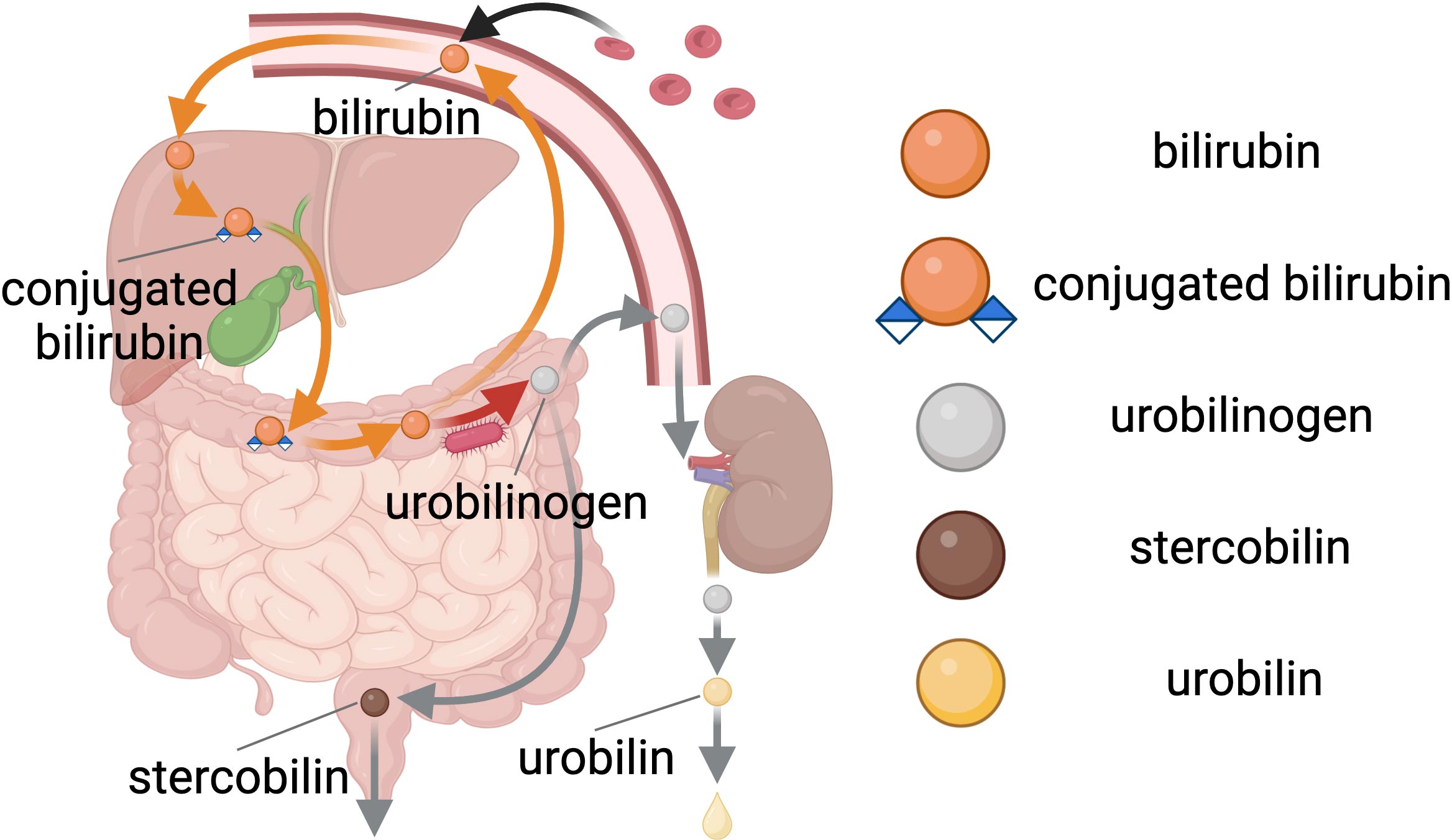
When red blood cells degrade after their six-month lifespan, a bright orange pigment called bilirubin is produced as a byproduct. Bilirubin is typically secreted into the gut, where it is destined for excretion but can also be partially reabsorbed. Excess reabsorption can lead to a buildup of bilirubin in the blood and can cause jaundice—a condition that leads to the yellowing of the skin and eyes. Once in the gut, the resident flora can convert bilirubin into other molecules.
“Gut microbes encode the enzyme bilirubin reductase that converts bilirubin into a colorless byproduct called urobilinogen,” explained Hall, who has a joint appointment in the University of Maryland Institute for Advanced Computer Studies. “Urobilinogen then spontaneously degrades into a molecule called urobilin, which is responsible for the yellow color we are all familiar with.”
Urobilin has long been linked to urine’s yellow hue, but the research team’s discovery of the enzyme responsible answers a question that has eluded scientists for over a century.
Implications for Health and Disease
Aside from solving a scientific mystery, these findings could have important health implications. The research team found that bilirubin reductase is present in almost all healthy adults but is often missing from newborns and individuals with inflammatory bowel disease. They hypothesize that the absence of bilirubin reductase may contribute to infant jaundice and the formation of pigmented gallstones.
“Now that we’ve identified this enzyme, we can start investigating how the bacteria in our gut impact circulating bilirubin levels and related health conditions like jaundice,” said study co-author and NIH Investigator Xiaofang Jiang. “This discovery lays the foundation for understanding the gut-liver axis.”
Gut Microbiome’s Role in Human Health
In addition to jaundice and inflammatory bowel disease, the gut microbiome has been linked to various diseases and conditions, from allergies to arthritis to psoriasis. This latest discovery brings researchers closer to achieving a holistic understanding of the gut microbiome’s role in human health.
“The multidisciplinary approach we were able to implement—thanks to the collaboration between our labs—was key to solving the physiological puzzle of why our urine appears yellow,” Hall said. “It’s the culmination of many years of work by our team and highlights yet another reason why our gut microbiome is so vital to human health.”
This article was adapted from text provided by Brantley Hall and Sophia Levy.
Reference: “BilR is a gut microbial enzyme that reduces bilirubin to urobilinogen” by Brantley Hall, Sophia Levy, Keith Dufault-Thompson, Gabriela Arp, Aoshu Zhong, Glory Minabou Ndjite, Ashley Weiss, Domenick Braccia, Conor Jenkins, Maggie R. Grant, Stephenie Abeysinghe, Yiyan Yang, Madison D. Jermain, Chih Hao Wu, Bing Ma and Xiaofang Jiang, 3 January 2024, Nature Microbiology.
DOI: 10.1038/s41564-023-01549-x
In addition to Hall, UMD-affiliated co-authors included Stephenie Abeysinghe (B.S. ’23, public health science); Domenick Braccia (Ph.D. ’22, biological sciences); biological sciences major Maggie Grant; biochemistry Ph.D. student Conor Jenkins; biological sciences Ph.D. students Gabriela Arp (B.S. ’19, public health science; B.A. ’19, Spanish language), Madison Jermain, Sophia Levy (B.S. ’19, chemical engineering; B.S. ’19, biological sciences) and Chih Hao Wu (B.S. ’21, biological sciences); Glory Minabou Ndjite (B.S. ’22, public health science); and Ashley Weiss (B.S. ’22, biological sciences).
This research was supported by the NIH’s Intramural Research Program, the National Library of Medicine and startup funding from UMD. This article does not necessarily reflect the views of these organizations.
Never miss a breakthrough: Join the SciTechDaily newsletter.
Follow us on Google and Google News.