

Blue sharks shimmer with one of nature’s rarest colors, but their glow isn’t just for show — it’s built from microscopic crystals and pigments hidden in their skin.
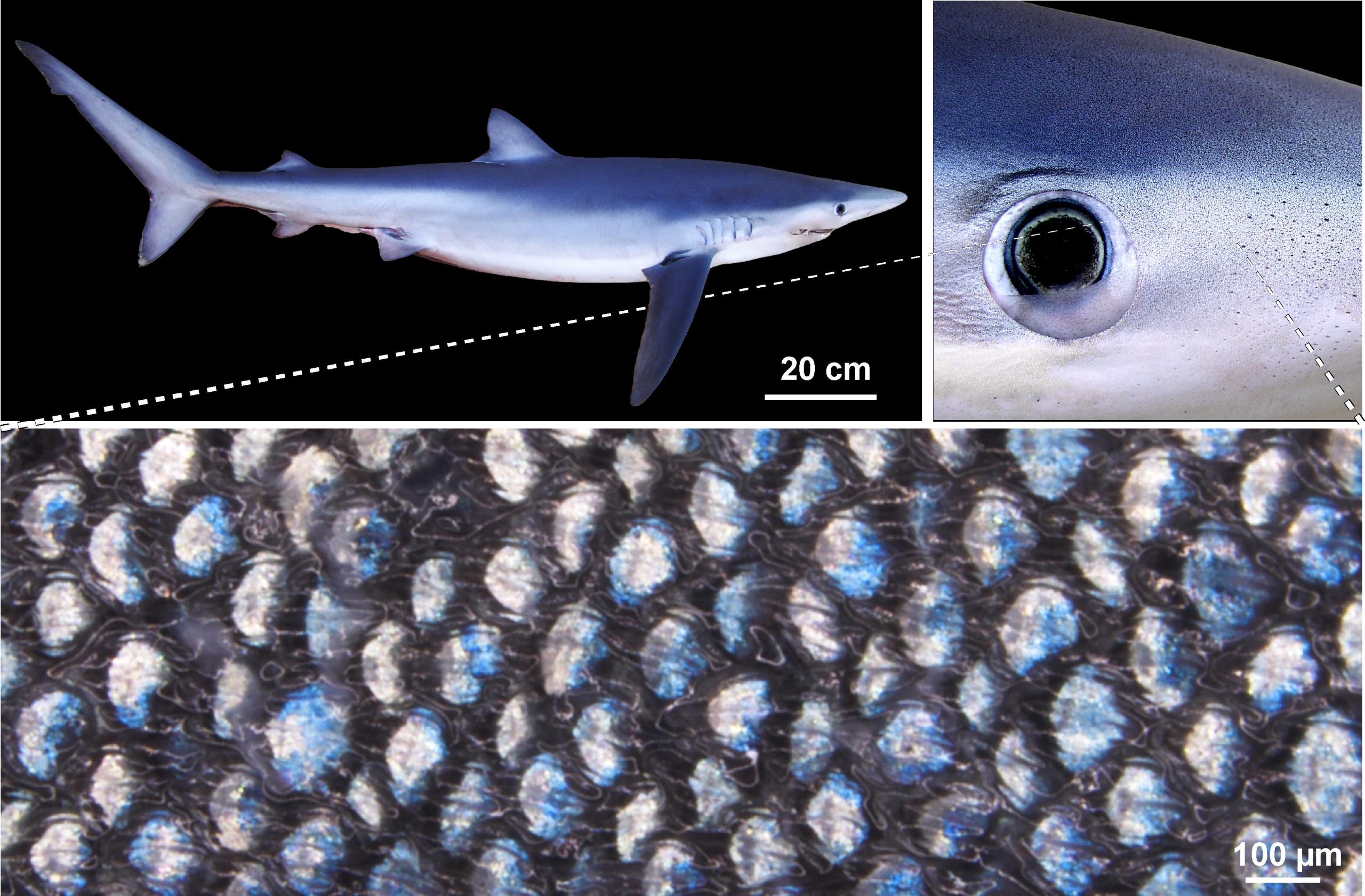
Scientists have discovered that the shark’s tooth-like skin scales house guanine platelets and melanin vesicles that work together to produce a vivid blue hue. What’s more, these nanostructures may actually shift depending on environmental conditions like water pressure, potentially allowing sharks to subtly change color as they move through the ocean.
A Color Mystery Beneath the Waves
A new study on the blue shark (Prionace glauca) has uncovered an intricate nanostructure within its skin that not only creates the shark’s signature blue hue but may also allow for subtle shifts in color.
“Blue is one of the rarest colors in the animal kingdom, and animals have developed a variety of unique strategies through evolution to produce it, making these processes especially fascinating,” says Dr. Viktoriia Kamska, a post-doctoral researcher in the lab of Professor Mason Dean at City University of Hong Kong.
The Microscopic Source of Shark Blue
Researchers found that the vivid blue appearance comes from structures located inside the pulp cavities of dermal denticles—tiny, tooth-like scales that form a protective layer over the shark’s skin. These cavities contain guanine crystals, which reflect blue light, and melanin-filled vesicles called melanosomes, which absorb other wavelengths.
“These components are packed into separate cells, reminiscent of bags filled with mirrors and bags with black absorbers, but kept in close association so they work together,” explains Dr. Kamska. As a result, a pigment (melanin) collaborates with a structured material (guanine platelets of specific thickness and spacing) to enhance color saturation.
More Than Just Pretty Colors
“When you combine these materials together, you also create a powerful ability to produce and change color,” says Professor Dean. “What’s fascinating is that we can observe tiny changes in the cells containing the crystals and see and model how they influence the color of the whole organism.”
This anatomical breakthrough was made possible using a mixture of fine-scale dissection, optical microscopy, electron microscopy, spectroscopy, and a suite of other imaging techniques to characterize the form, function, and architectural arrangements of the color-producing nanostructures. “We started looking at color at the organismal level, on the scale of meters and centimeters, but structural color is achieved at the nanometer scale, so we have to use a range of different approaches,” says Professor Dean.
Simulations That Decode Spectral Magic
Identifying the likely nanoscale culprits behind the shark’s blue color was only part of the equation. Dr. Kamska and her collaborators also used computational simulations to confirm which architectural parameters of these nanostructures are responsible for producing the specific wavelengths of the observed spectral appearance. “It’s challenging to manually manipulate structures at such a small scale, so these simulations are incredibly useful for understanding what color palette is available,” says Dr. Kamska.
The discovery also reveals that the shark’s trademark color is potentially mutable through tiny changes in the relative distances between layers of guanine crystals within the denticle pulp cavities. Whereas narrower spaces between layers create the iconic blues, increasing this space shifts the color into greens and golds.
Environment as a Color Dial
Dr. Kamska and her team have demonstrated that this structural mechanism of color change could be driven by environmental factors that affect guanine platelet spacing. “In this way, very fine scale alterations resulting from something as simple as humidity or water pressure changes could alter body color, which then shapes how the animal camouflages or counter-shades in its natural environment,” says Professor Dean.
For example, the deeper a shark swims, the more pressure that their skin is subjected to, and the tighter the guanine crystals would likely be pushed together, which should darken the shark’s color to better suit its surroundings. “The next step is to see how this mechanism really functions in sharks living in their natural environment,” says Dr. Kamska.
A Breakthrough for Bio-Inspired Design
While this research provides important new insights into shark anatomy and evolution, it also has a strong potential for bio-inspired engineering applications. “Not only do these denticles provide sharks with hydrodynamic and antifouling benefits, but we’ve now found that they also have a role in producing and maybe changing color too,” says Professor Dean. “Such a multi-functional structural design —a marine surface combining features for high-speed hydrodynamics and camouflaging optics— as far as we know, hasn’t been seen before.”
Therefore, this discovery could have implications for improving environmental sustainability within the manufacturing industry. “A major benefit of structural coloration over chemical coloration is that it reduces the toxicity of materials and reduces environmental pollution,” says Dr. Kamska. “Structural color is a tool that could help a lot, especially in marine environments, where dynamic blue camouflage would be useful.”
Sharks: A Separate Evolutionary Spectrum
“As nanofabrication tools get better, this creates a playground to study how structures lead to new functions,” says Professor Dean. “We know a lot about how other fishes make colors, but sharks and rays diverged from bony fishes hundreds of millions of years ago – so this represents a completely different evolutionary path for making color.”
This research, funded by Hong Kong’s University Grants Committee, General Research Fund, was presented at the Society for Experimental Biology Annual Conference in Antwerp, Belgium.
Never miss a breakthrough: Join the SciTechDaily newsletter.
Follow us on Google and Google News.