

A study led by the University of Leicester has linked fossilized tracks of flying reptiles to the specific animals that created them.
Fossilized footprints dating back more than 160 million years have helped paleontologists at the University of Leicester determine when pterosaurs began adapting to life on land.
Although these impressive flying reptiles from the Mesozoic era are typically pictured soaring above dinosaurs, new evidence reveals that some species were equally suited to walking on solid ground.
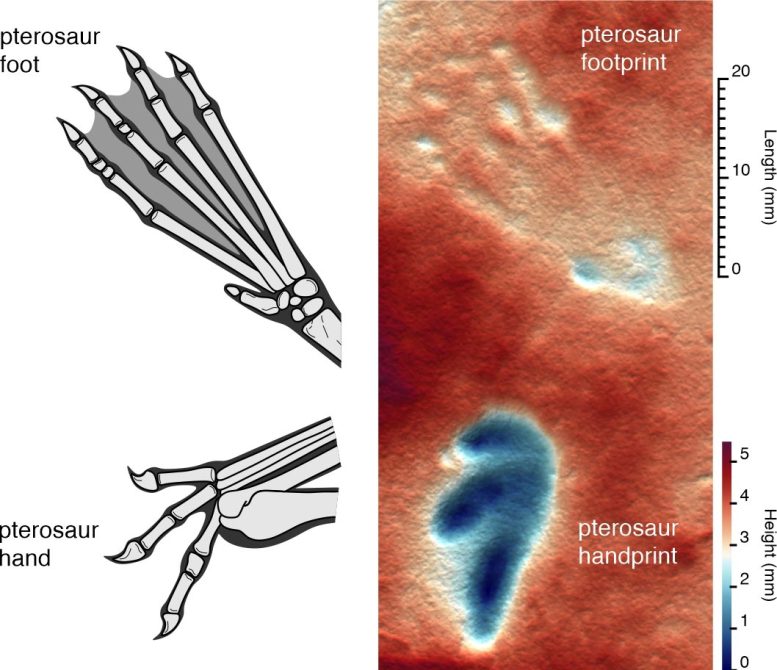
In a groundbreaking study published in Current Biology, University of Leicester scientists linked specific fossil footprints to the pterosaur species that made them. Using 3D modeling, detailed analysis, and comparisons with fossilized skeletons, the researchers identified at least three distinct types of tracks that correspond to different pterosaur groups.
Evidence of ecological transition
The new study supports the idea that pterosaurs underwent a major ecological shift during the middle part of the Age of Dinosaurs, about 160 million years ago, with several groups becoming more terrestrial.
Lead author Robert Smyth, a doctoral researcher in the in the Centre for Palaeobiology and Biosphere Evolution (School of Geography, Geology and the Environment at the University of Leicester), explained: “Footprints offer a unique opportunity to study pterosaurs in their natural environment. They reveal not only where these creatures lived and how they moved, but also offer clues about their behaviour and daily activities in ecosystems that have long since vanished.”

The study uncovered three distinct types of pterosaur footprints, each shedding light on different lifestyles and behaviours. By linking footprints to specific groups, scientists now have a powerful new way to study how these flying reptiles lived, moved, and adapted to different ecosystems across time.
Co-author Dr David Unwin from the School of Museum Studies, University of Leicester explained: “Finally, 88 years after first discovering pterosaur tracks, we now know exactly who made them and how.”
Giants that walked the earth
Perhaps the most striking discovery comes from a group of pterosaurs known as neoazhdarchians—which includes Quetzalcoatlus, a species with a 10-meter wingspan and one of the largest flying animals ever to have existed. Their footprints have been found in coastal and inland areas around the world, supporting the idea that these long-legged creatures not only dominated the skies but were also frequent ground dwellers, inhabiting the same environments as many dinosaur species. Some of these tracks are present right up until the asteroid impact event, 66 million years ago, which led to the extinction of both pterosaurs and dinosaurs.

One group of pterosaurs, ctenochasmatoids, known for their long jaws and needle-like teeth, left behind tracks most commonly found in coastal deposits. These animals likely waded along muddy shores or in shallow lagoons, using their specialised feeding strategies to catch small fish or floating prey. The abundance of these tracks suggests that these coastal pterosaurs were far more common in these environments than their rare bodily remains indicate.
Traces found near fossil bones
Another type of footprint was discovered in rock layers that also preserve the fossilised skeletons of the same pterosaurs. The close association between the footprints and skeletons provides compelling evidence for identifying the print makers. Known as dsungaripterids, these pterosaurs had powerful limbs and jaws, with toothless, curved beak tips designed for prising out prey, while large, rounded teeth at the back of their jaws were perfect for crushing shellfish and other tough food items.
Smyth explains: “Tracks are often overlooked when studying pterosaurs, but they provide a wealth of information about how these creatures moved, behaved, and interacted with their environments. By closely examining footprints, we can now discover things about their biology and ecology that we can’t learn anywhere else.”
Reference: “Identifying pterosaur trackmakers provides critical insights into mid-Mesozoic ground invasion” by Robert S.H. Smyth, Brent H. Breithaupt, Richard J. Butler, Peter L. Falkingham and David M. Unwin, 1 May 2025, Current Biology.
DOI: 10.1016/j.cub.2025.04.017
Never miss a breakthrough: Join the SciTechDaily newsletter.
Follow us on Google and Google News.
1 Comment
thank you