
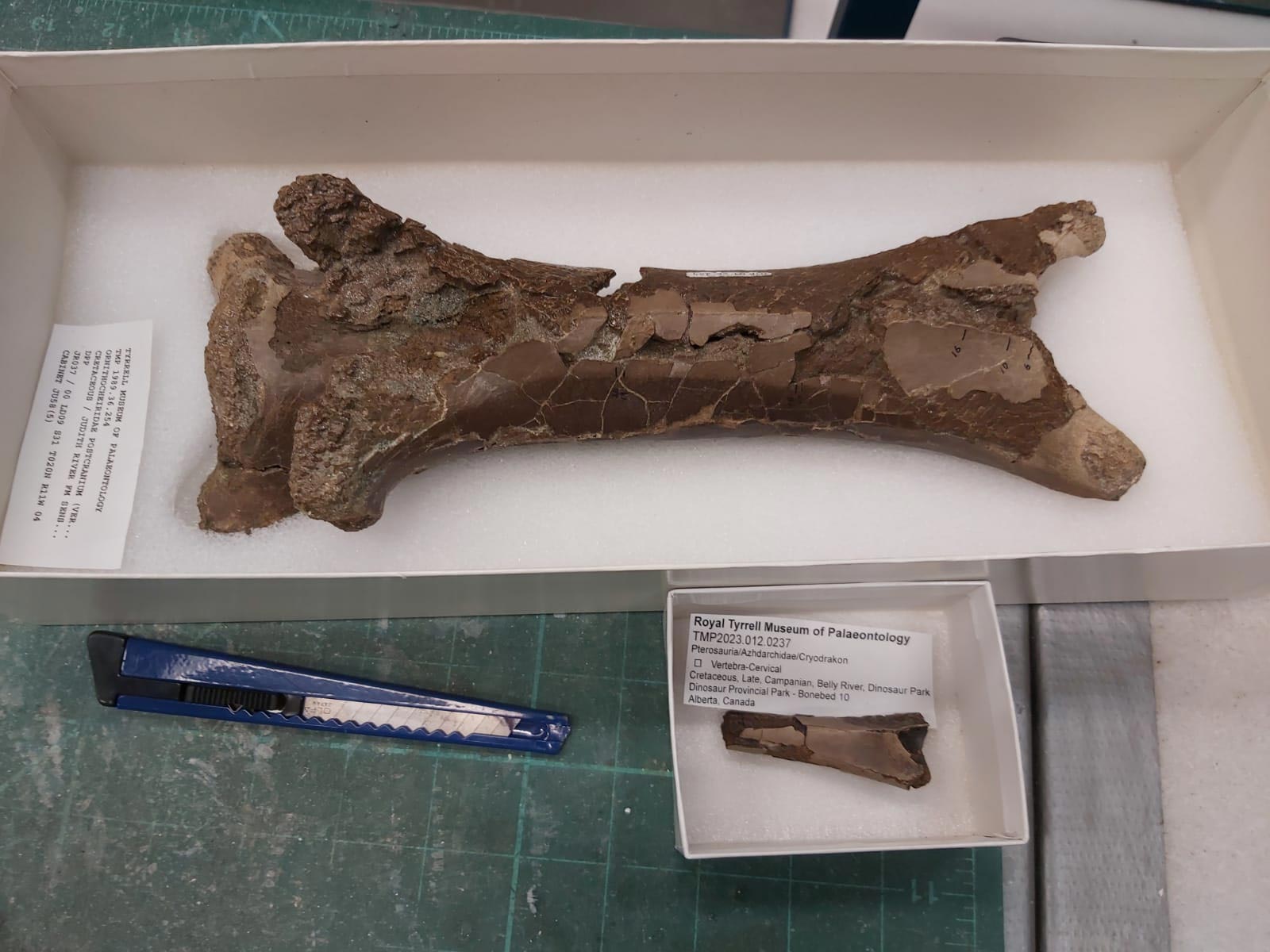
A juvenile pterosaur fossil found in Canada shows a crocodile bite from 76 million years ago, offering rare evidence of predator-prey dynamics during the Cretaceous Period. This marks the first North American case of crocodilians preying on giant flying reptiles.
A fossilized neck bone of a flying reptile, discovered in Canada, reveals clear evidence of a crocodile-like predator attack 76 million years ago, according to a study recently published in the Journal of Palaeontology.
The juvenile pterosaur vertebra, unearthed in Dinosaur Provincial Park, Alberta, features a distinct circular puncture mark, 4 millimeters wide, likely caused by a crocodilian tooth. Researchers from the Royal Tyrrell Museum of Palaeontology (Canada), the University of Reading (UK), and the University of New England (Australia) highlight that this rare find sheds light on predator-prey interactions in the region during the Cretaceous Period.

The discovery was made during an international field course that took place in July 2023, led by Dr Brian Pickles from the University of Reading.
Dr Caleb Brown from the Royal Tyrrell Museum of Palaeontology is the lead author of the paper. He said: “Pterosaur bones are very delicate – so finding fossils where another animal has clearly taken a bite is exceptionally uncommon. This specimen being a juvenile makes it even more rare.”
Dinosaur Provincial Park has produced some of the most important dinosaur fossil discoveries ever made.
The Juvenile Pterosaur and Its Predator
The punctured vertebra belongs to a young Azhdarchid pterosaur (Cryodrakon boreas), with an estimated wingspan of two metres. Adults of this species would have been as tall as a giraffe with a wingspan in the region of 10m.
The researchers used micro-CT scans and comparisons with other pterosaur bones to confirm the puncture is not a result of damage during fossilization or excavation, but an actual bite.

Dr Brian Pickles from the University of Reading and co-author of the paper said: “Bite traces help to document species interactions from this period. We can’t say if the pterosaur was alive or dead when it was bitten but the specimen shows that crocodilians occasionally preyed on, or scavenged, juvenile pterosaurs in prehistoric Alberta over 70 million years ago.”
The paper also shows that this new bone documents the first evidence in North America of ancient crocodilians opportunistically feeding on these giant prehistoric flying reptiles. Other examples of Azhdarchid bones with possible crocodilian bites have previously been found in Romania.
Reference: “A juvenile pterosaur vertebra with putative crocodilian bite from the Campanian of Alberta, Canada” by Caleb M. Brown, Phil R. Bell, Holly Owers and Brian J. Pickles, 23 January 2025, Journal of Paleontology.
DOI: 10.1017/jpa.2024.12
Never miss a breakthrough: Join the SciTechDaily newsletter.
Follow us on Google and Google News.
1 Comment
This not new news spinosauridae evidence was before a crocodile type animal spinosauridae is true crocodilian it’s mesoeucrocodylia like modern crocodilian they have death roll system .clearly pterosaur is very aquatic and flightless and was important prey for spinosauridae .sound like took some time for modern crocodilian to get rid of this primitive dinosaur. spinosauridae rule the water the great predator.advance pterosaur has whale nose like spinosaurus its worst than Nile crocodile and usagator baryonyx.baryonyx nose is even more push back than the gator more Whaley