
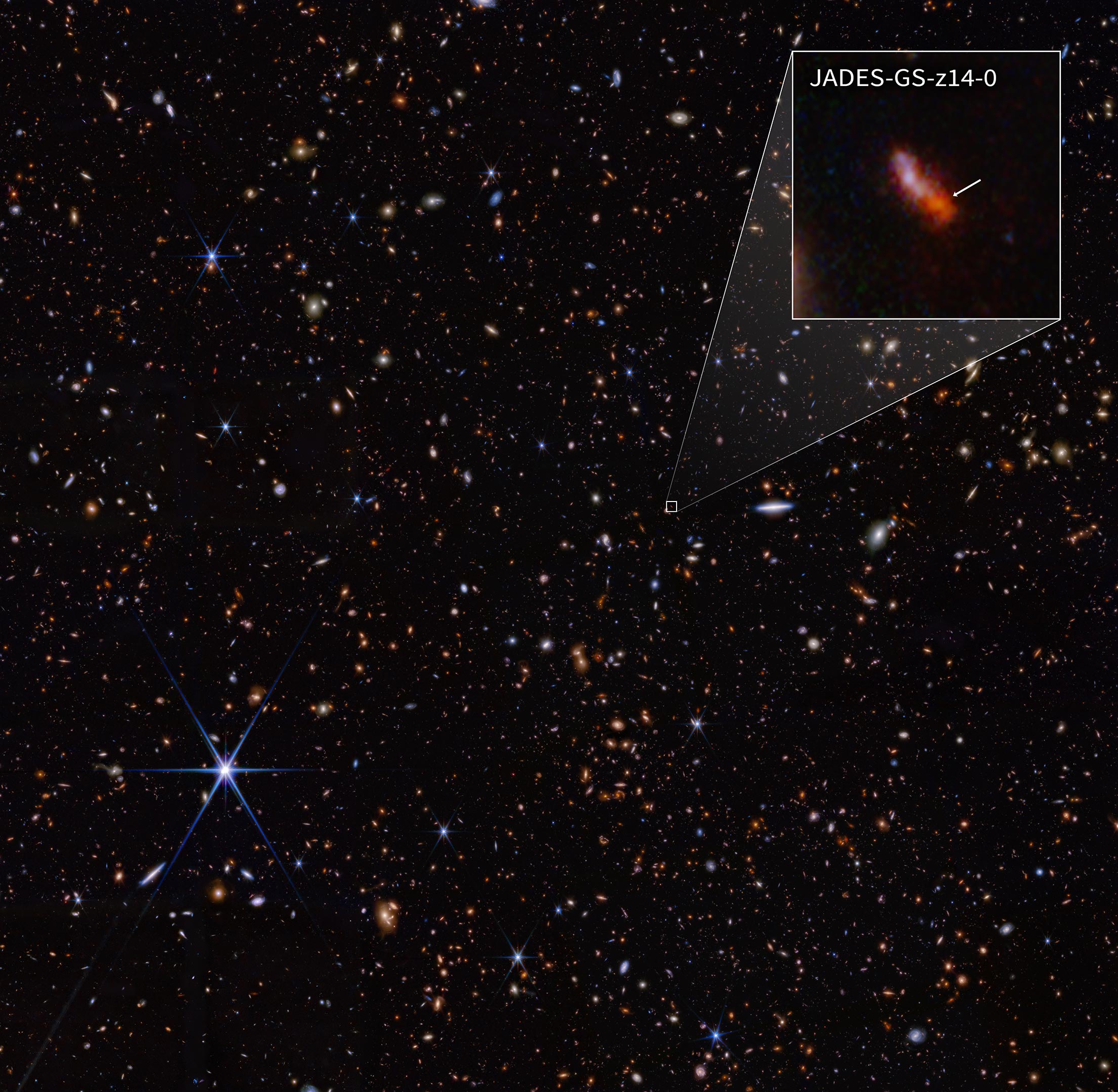
Astronomers from the University of Arizona have uncovered astonishing details about a galaxy that existed when the universe was less than 300 million years old, just 2% of its current age.
Using NASA’s James Webb Space Telescope, they found JADES-GS-z14-0 to be far brighter and chemically complex than expected, challenging current understandings of early galaxy formation. The discovery of significant oxygen suggests that this galaxy had already been forming stars for at least 100 million years, pushing back the timeline for cosmic evolution.
A Surprisingly Mature Galaxy at the Dawn of Time
Astronomers at the University of Arizona have uncovered new details about a remarkably mature galaxy that existed when the universe was less than 300 million years old, just 2% of its current age.
Using NASA’s James Webb Space Telescope (JWST), researchers studied the galaxy, known as JADES-GS-z14-0, and found it to be unexpectedly bright and chemically complex for such an early period in cosmic history. This discovery offers a rare window into the universe’s formative years.
Breaking Records in the Search for Distant Galaxies
Published in Nature Astronomy, the study builds on a 2024 finding that identified JADES-GS-z14-0 as the most distant galaxy ever observed. While that initial discovery established its extreme distance and surprising brightness, the new research explores its chemical makeup and evolutionary state in greater depth.
The study is part of the JWST Advanced Deep Extragalactic Survey (JADES), a large-scale program designed to examine distant galaxies.
This wasn’t simply stumbling upon something unexpected, said Kevin Hainline, co-author of the new study and an associate research professor at the U of A Steward Observatory. The survey was deliberately designed to find distant galaxies, but this one broke the team’s records in ways they didn’t anticipate; it was intrinsically bright and had a complex chemical composition that was totally unexpected so early in the universe’s history.
“It’s not just a tiny little nugget. It’s bright and fairly extended for the age of the universe when we observed it,” Hainline said.

Galaxies Like This Might Be Everywhere
“The fact that we found this galaxy in a tiny region of the sky means that there should be more of these out there,” said lead study author Jakob Helton, a graduate researcher at Steward Observatory. “If we looked at the whole sky, which we can’t do with JWST, we would eventually find more of these extreme objects.”
The research team used multiple instruments onboard JWST, including the Near Infrared Camera, or NIRCam, whose construction was led by U of A Regents Professor of Astronomy Marcia Rieke. Another instrument on the telescope – the Mid-Infrared Instrument, or MIRI – revealed something extraordinary: significant amounts of oxygen.
In astronomy, anything heavier than helium is considered a “metal,” Helton said. Such metals require generations of stars to produce. The early universe contained only hydrogen, helium and trace amounts of lithium. But the discovery of substantial oxygen in the JADES-GS-z14-0 galaxy suggests the galaxy had been forming stars for potentially 100 million years before it was observed.
The Life Cycle of Stars in a Young Universe
To make oxygen, the galaxy must have started out very early on, because it would have had to form a generation of stars, said George Rieke, Regents Professor of Astronomy and the study’s senior author. Those stars must have evolved and exploded as supernovae to release oxygen into interstellar space, from which new stars would form and evolve.
“It’s a very complicated cycle to get as much oxygen as this galaxy has. So, it is genuinely mind-boggling,” Rieke said.
The finding suggests that star formation began even earlier than scientists previously thought, which pushes back the timeline for when the first galaxies could have formed after the Big Bang.
A Lucky Alignment for Groundbreaking Discovery
The observation required approximately nine days of telescope time, including 167 hours of NIRCam imaging and 43 hours of MIRI imaging, focused on an incredibly small portion of the sky.
The U of A astronomers were lucky that this galaxy happened to sit in the perfect spot for them to observe with MIRI. If they had pointed the telescope just a fraction of a degree in any direction, they would have missed getting this crucial mid-infrared data, Helton said.
“Imagine a grain of sand at the end of your arm. You see how large it is on the sky – that’s how large we looked at,” Helton said.
A Powerful Challenge for Galaxy Formation Models
The existence of such a developed galaxy so early in cosmic history serves as a powerful test case for theoretical models of galaxy formation.
“Our involvement here is a product of the U of A leading in infrared astronomy since the mid-’60s, when it first started. We had the first major infrared astronomy group over in the Lunar and Planetary lab, with Gerard Kuiper, Frank Low, and Harold Johnson,” Rieke said.
As humans gain the ability to directly observe and understand galaxies that existed during the universe’s infancy, it may provide crucial insights into how the universe evolved from simple elements to the complex chemistry necessary for life as we know it.
The Magic of Understanding the Early Universe
“We’re in an incredible time in astronomy history,” Hainline said. “We’re able to understand galaxies that are well beyond anything humans have ever found and see them in many different ways and really understand them. That’s really magic.”
Reference: “Photometric detection at 7.7 μm of a galaxy beyond redshift 14 with JWST/MIRI” by Jakob M. Helton, George H. Rieke, Stacey Alberts, Zihao Wu, Daniel J. Eisenstein, Kevin N. Hainline, Stefano Carniani, Zhiyuan Ji, William M. Baker, Rachana Bhatawdekar, Andrew J. Bunker, Phillip A. Cargile, Stéphane Charlot, Jacopo Chevallard, Francesco D’Eugenio, Eiichi Egami, Benjamin D. Johnson, Gareth C. Jones, Jianwei Lyu, Roberto Maiolino, Pablo G. Pérez-González, Marcia J. Rieke, Brant Robertson, Aayush Saxena, Jan Scholtz, Irene Shivaei, Fengwu Sun, Sandro Tacchella, Lily Whitler, Christina C. Williams, Christopher N. A. Willmer, Chris Willott, Joris Witstok and Yongda Zhu, 7 March 2025, Nature Astronomy.
DOI: 10.1038/s41550-025-02503-z
The study was supported in part by NASA contracts NAS5-02105 and NNX13AD82G to the University of Arizona, the European Research Council Advanced Grant 789056 “FirstGalaxies,” and ERC Advanced Grant 695671 “QUENCH.” Additional funding was provided by the Science and Technology Facilities Council, the UKRI Frontier Research grant “RISEandFALL,” the Spanish Ministerio de Ciencia e Innovación, the National Science Foundation and the Royal Society, among others.
Never miss a breakthrough: Join the SciTechDaily newsletter.
Follow us on Google and Google News.
5 Comments
Scientists like to hang on to an existing theory even when the evidence starts to accumulate to show that it isn’t correct. Things are starting to indicate that either the estimated age of the universe or the big bang theory are incorrect.
The “big bang” theory is in its most general definition simply the robust observation of space expansion, which sets an age estimate. Before the discovery of dark energy in the late 90s and the dark energy-dark matter LCDM theory that Planck elucidated in the 10s, the star age and universe age estimate could differ with a factor tow (with stars older than the universe).
After that LCDM has fit ever better in surveys, even if Hubble and s8 parameters are in tension in some observations. There is no support for the claim that unreferenced “things are starting to indicate” that the age estimate is in error – it has become increasingly precise:
“NASA’s Wilkinson Microwave Anisotropy Probe (WMAP) project’s nine-year data release in 2012 estimated the age of the universe to be (13.772±0.059)×109 years (13.772 billion years, with an uncertainty of plus or minus 59 million years).”
“In 2015, the Planck Collaboration estimated the age of the universe to be 13.813±0.038 billion years, slightly higher but within the uncertainties of the earlier number derived from the WMAP data.”
“In 2018, the Planck Collaboration updated its estimate for the age of the universe to 13.787±0.020 billion years.”
– Wikipedia
Some typos:
“general definition simply” = general definition is simply
“a factor tow” = a factor two
“×109 years” = ×10^9 years
It is a very convincing Balmer break in two different analyses pipelines. They don’t agree on star formation rates, but the general result of a metal rich galaxy is relatively insensitive to that. The metal is 1/3 of the galaxies at x ~ 8 or twice the age of the JADES-GS-z14-0 galaxy.
Typo:
“x ~ 8” – z ~ 8