

A tiny star just one-fifth the mass of our Sun has shocked astronomers by hosting a gas giant planet, TOI-6894b—something long thought nearly impossible.
The find, made through TESS data and confirmed by one of the world’s largest telescopes, challenges leading theories of planet formation.
Discovery of a Planet Around a Tiny Star
TOI-6894 is a small red dwarf, just 20% the mass of our Sun. Stars like this are common across the galaxy, but they aren’t usually considered likely homes for giant planets. In fact, astronomers have long believed that such low-mass stars don’t have the right conditions to form or support large planets at all.
But in a surprising new discovery published in Nature Astronomy, scientists have detected the clear signature of a giant planet—named TOI-6894b—orbiting this tiny star.
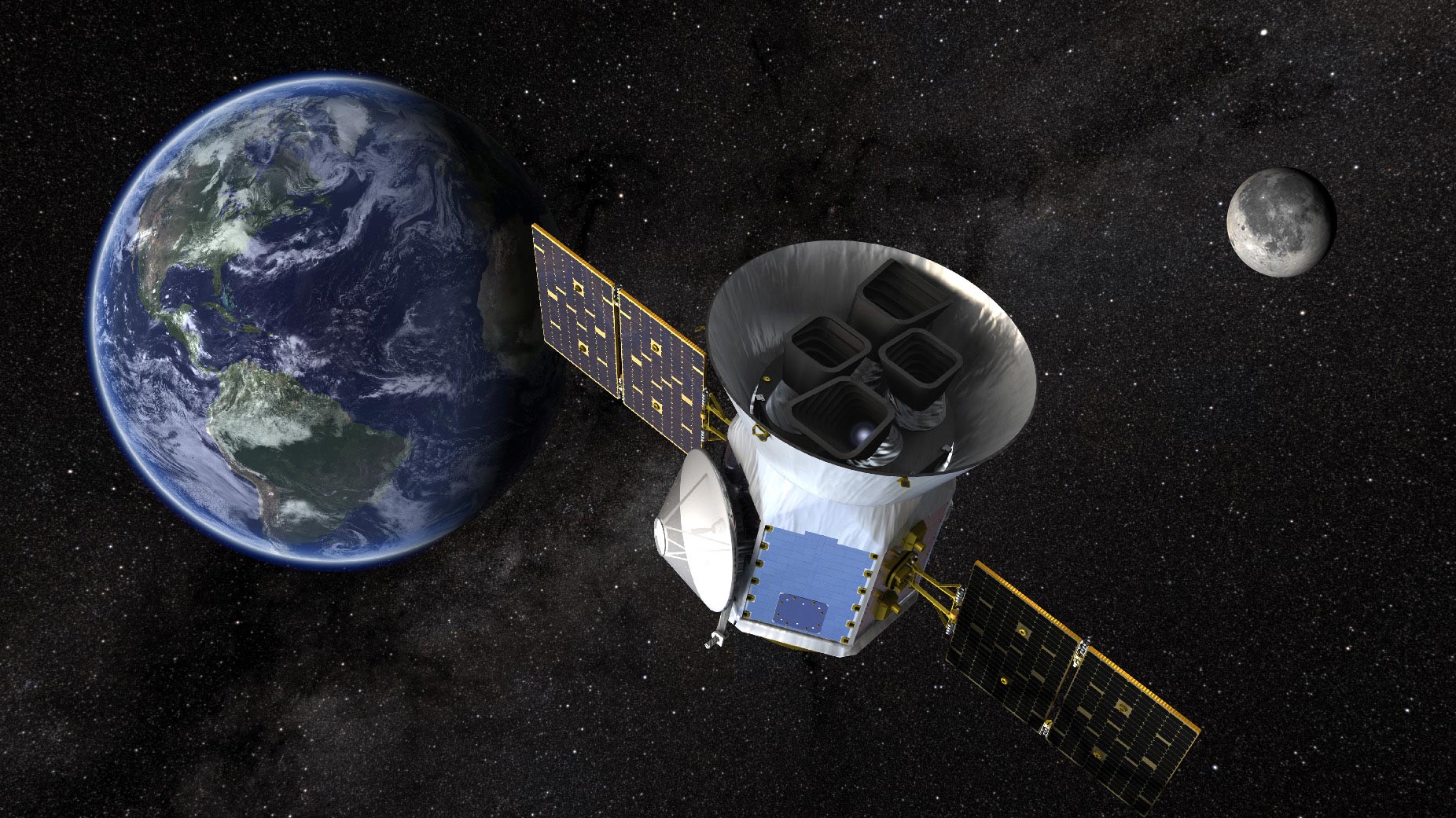
The planet was found during a large survey of data from NASA’s TESS mission, which searches for exoplanets by monitoring the brightness of stars. The project focused on spotting giant planets around smaller stars and was led by Dr. Edward Bryant, who conducted the research at the University of Warwick and UCL’s Mullard Space Science Laboratory.
A Landmark Find in Exoplanet Research
Dr. Edward Bryant, Warwick Astrophysics Prize Fellow and first author, said: “I was very excited by this discovery. I originally searched through TESS observations of more than 91,000 low-mass red-dwarf stars looking for giant planets.
“Then, using observations taken with one of the world’s largest telescopes, ESO’s VLT, I discovered TOI-6894b, a giant planet transiting the lowest mass star known to date to host such a planet. We did not expect planets like TOI-6894b to be able to form around stars this low-mass. This discovery will be a cornerstone for understanding the extremes of giant planet formation.”
The Lightest Star With a Giant Planet
The planet (TOI-6894b) is a low-density gas giant with a radius a little larger than Saturn’s but with only ~50% of Saturn’s mass. The star (TOI-6894) is the lowest mass star to have a transiting giant planet discovered to date and is just 60% the size of the next smallest star to host such a planet.
Dr. Daniel Bayliss, Associate Professor at The University of Warwick, said: “Most stars in our Galaxy are actually small stars exactly like this, with low masses and previously thought not to be able to host gas giant planets. So, the fact that this star hosts a giant planet has big implications for the total number of giant planets we estimate exist in our Galaxy.”
Rethinking Planet Formation Models
Dr. Vincent Van Eylen, from UCL’s Mullard Space Science Laboratory, said: “It’s an intriguing discovery. We don’t really understand how a star with so little mass can form such a massive planet! This is one of the goals of the search for more exoplanets. By finding planetary systems different from our solar system, we can test our models and better understand how our own solar system formed.”
The most widely held theory of planet formation is called the core accretion theory. A planetary core forms first through accretion (gradual accumulation of material), and as the core becomes more massive, it eventually attracts gases that form an atmosphere. It then gets massive enough to enter a runaway gas accretion process to become a gas giant.
In this theory, the formation of gas giants is harder around low-mass stars because the amount of gas and dust in a protoplanetary disc around the star (the raw material of planet formation) is too limited to allow a massive enough core to form, and the runaway process to occur.
Yet the existence of TOI-6894b (a giant planet orbiting an extremely low-mass star) suggests this model cannot be completely accurate, and alternative theories are needed.
An Unsolved Formation Puzzle
Edward added: “Given the mass of the planet, TOI-6894b could have formed through an intermediate core-accretion process, in which a protoplanet forms and steadily accretes gas without the core becoming massive enough for runaway gas accretion.
“Alternatively, it could have formed because of a gravitationally unstable disc. In some cases, the disc surrounding the star will become unstable due to the gravitational force it exerts on itself. These discs can then fragment, with the gas and dust collapsing to form a planet.”
But the team found that neither theory could completely explain the formation of TOI-6894b from the available data, which leaves the origin of this giant planet as an open question for now.
Probing a Chilly, Alien Atmosphere
One avenue to shed light on the mystery of TOI-6894b’s formation is a detailed atmospheric analysis. By measuring the distribution of material within the planet, astronomers can determine the size and structure of the planet’s core, which can tell us whether TOI-6894b formed via accretion or via an unstable disc.
This is not the only interesting feature of TOI-6894b’s atmosphere; it is unusually cold for a gas giant. Most of the gas giants found by exoplanet hunters are hot Jupiters, massive gas giants with temperatures of ~1000-2000 Kelvin. TOI-6894b, by comparison, is just 420 Kelvin. The cool temperature, alongside other features of this planet, such as the very deep transits, makes it one of the most promising giant planets for astronomers to characterise with a cool atmosphere.
Methane, Ammonia, and a Cool Twist
Professor Amaury Triaud, University of Birmingham, co-author, and member of the SPECULOOS collaboration said: “Based on the stellar irradiation of TOI-6894b, we expect the atmosphere is dominated by methane chemistry, which is exceedingly rare to identify. Temperatures are low enough that atmospheric observations could even show us ammonia, which would be the first time it is found in an exoplanet atmosphere.
“TOI-6894b likely presents a benchmark exoplanet for the study of methane-dominated atmospheres and the best ‘laboratory’ to study a planetary atmosphere containing carbon, nitrogen, and oxygen outside the Solar System.”
JWST and the Road Ahead
The atmosphere of TOI-6894b is already scheduled to be observed by the James Webb Space Telescope (JWST) within the next 12 months. This should allow astronomers to determine which, if either, of the possible theories can explain the formation of this unexpected planet.
Co-author Dr. Andrés Jordán, researcher at the Millennium Institute of Astrophysics and professor at Adolfo Ibáñez University, said: “This system provides a new challenge for models of planet formation, and it offers a very interesting target for follow-up observations to characterize its atmosphere.
“This discovery is the result of a systematic program we have been carrying out for several years from Chile and the UK. Our efforts have allowed us to contribute significantly to a better understanding of how often small stars can form giant planets, and we are providing prime targets for follow-up with space-based platforms.”
Reference: “A transiting giant planet in orbit around a 0.2-solar-mass host star” by Edward M. Bryant, Andrés Jordán, Joel D. Hartman, Daniel Bayliss, Elyar Sedaghati, Khalid Barkaoui, Jamila Chouqar, Francisco J. Pozuelos, Daniel P. Thorngren, Mathilde Timmermans, Jose Manuel Almenara, Igor V. Chilingarian, Karen A. Collins, Tianjun Gan, Steve B. Howell, Norio Narita, Enric Palle, Benjamin V. Rackham, Amaury H. M. J. Triaud, Gaspar Á. Bakos, Rafael Brahm, Melissa J. Hobson, Vincent Van Eylen, Pedro J. Amado, Luc Arnold, Xavier Bonfils, Artem Burdanov, Charles Cadieux, Douglas A. Caldwell, Victor Casanova, David Charbonneau, Catherine A. Clark, Kevin I. Collins, Tansu Daylan, Georgina Dransfield, Brice-Olivier Demory, Elsa Ducrot, Gareb Fernández-Rodríguez, Izuru Fukuda, Akihiko Fukui, Michaël Gillon, Rebecca Gore, Matthew J. Hooton, Kai Ikuta, Emmanuel Jehin, Jon M. Jenkins, Alan M. Levine, Colin Littlefield, Felipe Murgas, Kendra Nguyen, Hannu Parviainen, Didier Queloz, S. Seager, Daniel Sebastian, Gregor Srdoc, R. Vanderspek, Joshua N. Winn, Julien de Wit and Sebastián Zúñiga-Fernández, 4 June 2025, Nature Astronomy.
DOI: 10.1038/s41550-025-02552-4
Never miss a breakthrough: Join the SciTechDaily newsletter.
Follow us on Google and Google News.
1 Comment
Scientists don’t understand why a big planet is orbiting a small planet. When Newton wrote F=MA, his calculus actually takes the mass and calculates the curve of an object or volume, so it’s really M/V which is density. It’s the density of an object that pushes the forces out. So in the case of the small planet, it has more mass than volume. The larger planet has more volume, but less mass. So the moral of the story is to use both mass/volume when calculating any object, or you will be like Einstein with half a formula E=MC2 or it should be E=M/VC2