
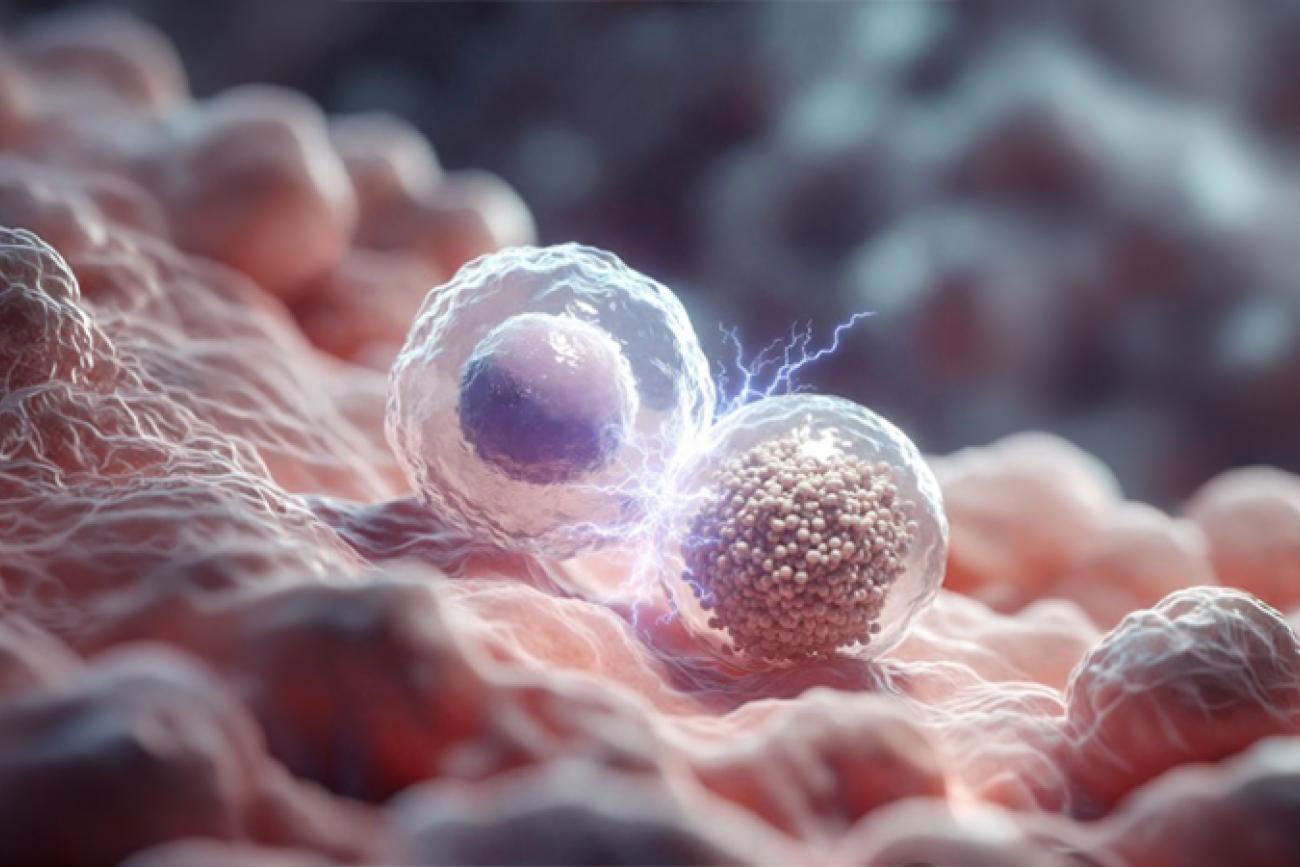
A tiny implant may give cancer-fighting immune cells the boost they need to keep working longer.
Immunotherapy has changed cancer care by turning the immune system into a weapon against disease. But there is a major weakness in that strategy: many lab-engineered immune cells lose momentum soon after they enter the body. That problem is especially severe inside solid tumors, where cancer can create a hostile environment that dampens immune activity.
Researchers at UCLA say they may have found a way to help those cells keep fighting.
They developed an implantable device that works like a nearby support station, giving cancer-targeted immune cells the signals they need to stay active longer. The study, published in Nature Biomedical Engineering, showed promising results in human melanoma and lymphoma samples and in lab-based experiments.
Chimeric antigen receptor-invariant natural killer T cells, known as CAR-iNKT cells, have shown early promise, particularly for solid tumors that are difficult to treat with standard CAR-T therapy. Still, these cells often lose their effectiveness after being introduced into the body. To address this, the UCLA team created a system that works like a recharging station. Once placed near a tumor, it draws in CAR-iNKT cells that are engineered to recognize cancer.
At the heart of the approach are tiny biomimetic particles designed to mimic the activation signals for iNKT cells.
“These engineered microparticles are where CAR-iNKT cells recharge and switch back into attack mode,” said study co-leader Song Li, chancellor’s professor of bioengineering at the UCLA Samueli School of Engineering. “Instead of delivering a one-time boost, the device provides sustained signals that help the cells stay active, multiply and form long-term memory.”
How the Device Reactivates Immune Cells
The particles reactivate immune cells using a molecule called TCR antigen. They also contain capsules filled with IL-15, a signaling protein that promotes cell growth.
“It’s similar in concept to plugging your phone into a charging cable,” said study first author Yan-Ruide “Charlie” Li, a postdoctoral scholar of microbiology, immunology & molecular genetics at UCLA. “In this case, the CAR-iNKT cells connect to the TCR antigen, which sets off a series of molecular signals that activate them, sending them back out to destroy cancer cells.”
Experiments showed that the effects extend throughout the body. Once reactivated, the immune cells entered the bloodstream and eliminated cancer cells in multiple locations.
“This approach significantly improves the durability and effectiveness of CAR-iNKT cell responses in both solid tumor and systemic blood cancer models, offering a new strategy to strengthen cell-based cancer therapies and expand their clinical potential,” said study co-leader Lili Yang, a UCLA professor of microbiology, immunology & molecular genetics.
Balancing Activation and Safety
Developing the system required careful fine-tuning. Too much stimulation can wear out immune cells, while too little allows them to lose function. The researchers optimized the strength of activation signals, the release of growth-supporting proteins, and the physical design of the material to maintain a balanced immune response.
Keeping the signals localized was also critical. Earlier methods that relied on immune-activating drugs circulating through the body often caused harmful side effects. By concentrating these signals at a small implanted site near the tumor, the new approach supports immune cells while limiting exposure elsewhere in the body.
In preclinical testing, the platform showed strong compatibility with biological systems. The team is continuing to refine the technology and investigate how it could be applied to other types of cancer immunotherapy.
Reference: “Engineering an in vivo charging station for CAR-redirected invariant natural killer T cells to enhance cancer therapy” by Yan-Ruide Li, Haochen Nan, Zeyang Liu, Ying Fang, Yichen Zhu, Zibai Lyu, Zhengyao Shao, Enbo Zhu, Bo Zhang, Youcheng Yang, Xinyuan Shen, Yuning Chen, Tzung Hsiai, Lili Yang and Song Li, 17 March 2026, Nature Biomedical Engineering.
DOI: 10.1038/s41551-026-01629-3
The research was funded by the California Institute for Regenerative Medicine, the National Institutes of Health, the U.S. Department of Defense and UCLA.
Never miss a breakthrough: Join the SciTechDaily newsletter.
Follow us on Google and Google News.
1 Comment
Gwen Tennyson