
Close Menu
    Facebook X (Twitter) Instagram
    SciTechDaily
    • Biology
    • Chemistry
    • Earth
    • Health
    • Physics
    • Science
    • Space
    • Technology
    Facebook X (Twitter) Pinterest YouTube RSS
    SciTechDaily
    Home»Space»To Avoid Freezing to Death, NASA’s Juno Prepares to Jump Jupiter’s Shadow
    Space

    To Avoid Freezing to Death, NASA’s Juno Prepares to Jump Jupiter’s Shadow

    By DC Agle, Jet Propulsion LaboratoryOctober 1, 2019No Comments3 Mins Read
    Facebook Twitter Pinterest Telegram LinkedIn WhatsApp Email Reddit
    Share
    Facebook Twitter LinkedIn Pinterest Telegram Email Reddit
    NASA Juno Jupiter Approach
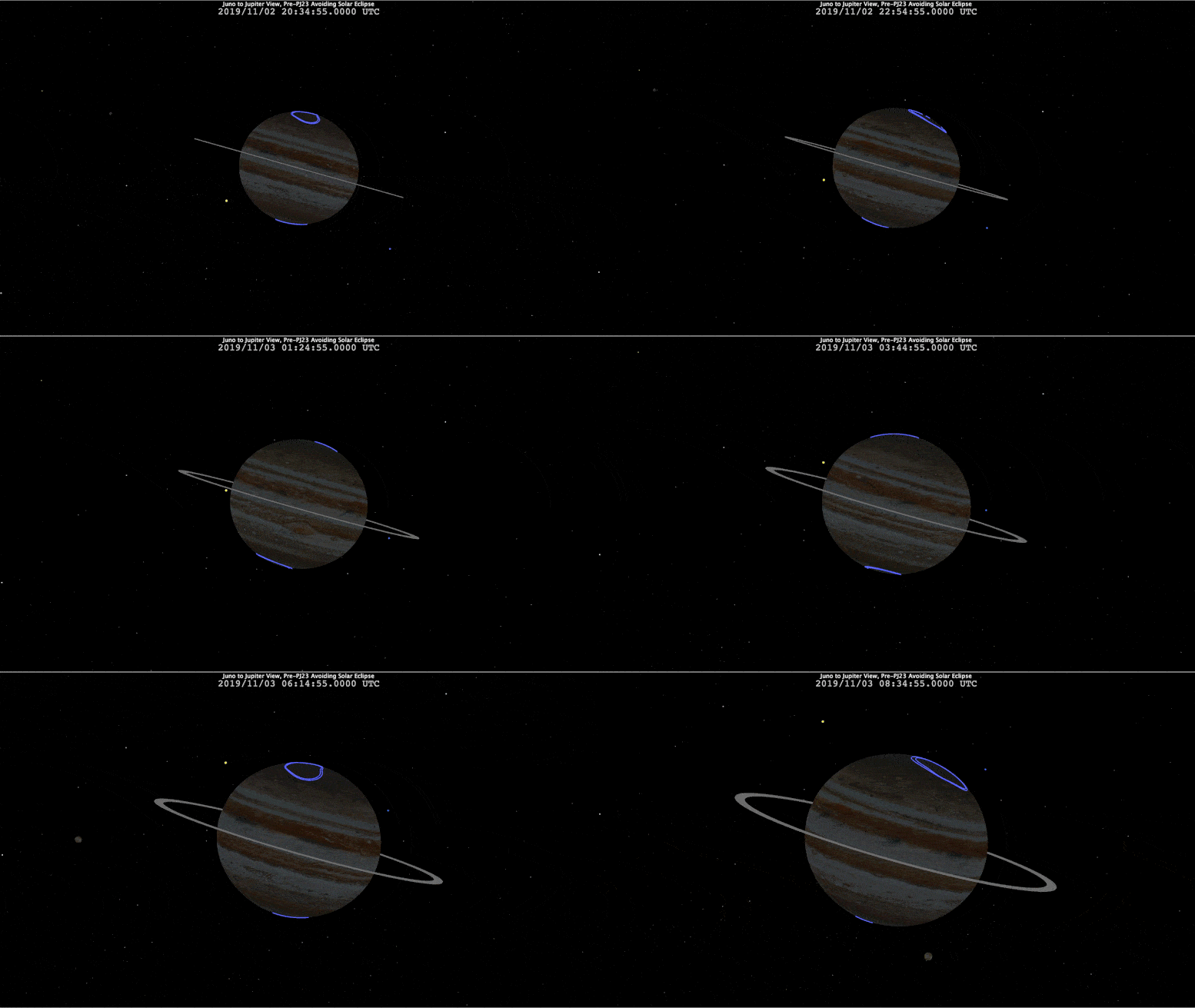
    This animated gif depicts the point of view of NASA’s Juno spacecraft during its eclipse-free approach to the gas giant November 3, 2019. The Sun is depicted as the yellow dot rising up just to left of the planet. Credit: NASA/JPL-Caltech/SWRI

    Last night, NASA’s Juno mission to Jupiter successfully executed a 10.5-hour propulsive maneuver — extraordinarily long by mission standards. The goal of the burn, as it’s known, will keep the solar-powered spacecraft out of what would have been a mission-ending shadow cast by Jupiter on the spacecraft during its next close flyby of the planet on November 3, 2019.

    Juno began the maneuver yesterday, September 30, at 7:46 p.m. EDT (4:46 p.m. PDT), and completed it early on October 1. Using the spacecraft’s reaction-control thrusters, the propulsive maneuver lasted five times longer than any previous use of that system. It changed Juno’s orbital velocity by 126 mph (203 kph) and consumed about 160 pounds (73 kilograms) of fuel. Without this maneuver, Juno would have spent 12 hours in transit across Jupiter’s shadow — more than enough time to drain the spacecraft’s batteries. Without power, and with spacecraft temperatures plummeting, Juno would likely succumb to the cold and be unable to awaken upon exit.

    “With the success of this burn, we are on track to jump the shadow on November 3,” said Scott Bolton, Juno principal investigator at the Southwest Research Institute in San Antonio. “Jumping over the shadow was an amazingly creative solution to what seemed like a fatal geometry. Eclipses are generally not friends of solar-powered spacecraft. Now instead of worrying about freezing to death, I am looking forward to the next scientific discovery that Jupiter has in store for Juno.”

    Juno has been navigating in deep space since 2011. It entered an initial 53-day orbit around Jupiter on July 4, 2016. Originally, the mission planned to reduce the size of its orbit a few months later to decrease the period between science flybys of the gas giant to every 14 days. But the project team recommended to NASA to forgo the main engine burn due to concerns about the spacecraft’s fuel delivery system. Juno’s 53-day orbit provides all the science as originally planned; it just takes longer to do so. The spacecraft’s longer life at Jupiter is what led to the need to avoid the gas giant’s shadow.

    “Pre-launch mission planning did not anticipate a lengthy eclipse that would plunge our solar-powered spacecraft into darkness,” said Ed Hirst, Juno project manager at NASA’s Jet Propulsion Laboratory in Pasadena, California. “That we could plan and execute the necessary maneuver while operating in Jupiter’s orbit is a testament to the ingenuity and skill of our team, along with the extraordinary capability and versatility of our spacecraft.”

    NASA’s JPL manages the Juno mission for the principal investigator, Scott Bolton, of the Southwest Research Institute in San Antonio. Juno is part of NASA’s New Frontiers Program, which is managed by NASA’s Marshall Space Flight Center in Huntsville, Alabama, for the agency’s Science Mission Directorate. The Italian Space Agency (ASI) contributed two instruments, a Ka-band frequency translator (KaT) and the Jovian Infrared Auroral Mapper (JIRAM). Lockheed Martin Space in Denver built and operates the spacecraft.

    Never miss a breakthrough: Join the SciTechDaily newsletter.
    Follow us on Google and Google News.

    Astronomy JPL Juno Spacecraft Jupiter NASA
    Share. Facebook Twitter Pinterest LinkedIn Email Reddit

    Related Articles

    A Halloween Treat: NASA’s Juno Mission Glimpses an Eerie “Face” on Jupiter

    40-Year Mystery Solved: Source of Jupiter’s Strange X-Ray Flares Uncovered

    NASA’s Juno Mission Expands Into the Future – To Explore Jupiter and Its Rings and Moons

    Juno Mission Prepares for Jupiter Flyby

    Jupiter’s Atmosphere Experiencing Large Scale Changes

    NASA’s WISE Uncovers New Clues on Jovian Trojans

    NASA’s Juno Spacecraft Completes First Deep-Space Maneuver

    Study Finds a Mixture of Both Deep and Shallow Heating on Io

    Juno Spacecraft Completes First Trajectory Correction Maneuver

    Leave A Reply Cancel Reply

    • Facebook
    • Twitter
    • Pinterest
    • YouTube

    Don't Miss a Discovery

    Subscribe for the Latest in Science & Tech!

    Trending News

    Scientists Say This Hellish “Day-Night” Planet May Support Life

    Historians Got It Wrong: New Findings Rewrite the Story of the Battle of Hastings

    Scientists Just Broke the Solar Power Limit Everyone Thought Was Absolute

    Scientists Discover Protein That Turns Brown Fat Into a Calorie-Burning Machine

    Scientists Call for a Complete Rethink of Alzheimer’s Treatment

    Scientists Identify Molecular Switch That Lets Exercise Reverse Muscle Aging

    Why Your Most Vivid Dreams Might Be the Key to Deep, Restful Sleep

    A Bright Star Hid a Massive Secret for 50 Years: Mystery of Gamma Cassiopeiae Finally Solved

    Follow SciTechDaily
    • Facebook
    • Twitter
    • YouTube
    • Pinterest
    • Newsletter
    • RSS
    SciTech News
    • Biology News
    • Chemistry News
    • Earth News
    • Health News
    • Physics News
    • Science News
    • Space News
    • Technology News
    Recent Posts
    • Scientists Find Surprising Way To Protect Hedgehogs From Roads
    • Penguins in Zoos Age Faster Than Their Wild Counterparts
    • Scientists Discover New “Magic Mushroom” Species That Rewrites Evolutionary History
    • Scientists Create Tiny “Nanolaser” That Could Revolutionize Future Computers
    • Mystery Deepens: Astrophysicists Say Dark Matter May Not Be One Thing
    Copyright © 1998 - 2026 SciTechDaily. All Rights Reserved.
    • Science News
    • About
    • Contact
    • Editorial Board
    • Privacy Policy
    • Terms of Use

    Type above and press Enter to search. Press Esc to cancel.