
Researchers Hope Sensors Using Quantum Tech Could Transform Biology Research
Scientists discovered nuclear magnetic resonance, a physical phenomenon where nuclei absorb and re-emit energy when placed in a magnetic field, in 1938. But it took almost 30 years for this fundamental physics discovery to find its most widely known application: MRI imaging, a crucial diagnostic tool in medical and biological research.
Now in the 21st century, researchers can make quantum devices precise enough to sense single ions—and University of Chicago chemistry professor Greg Engel doesn’t want to wait 30 years to find their most useful applications.
“It’s rapidly becoming clear that quantum sensing could be transformative in the next phases of biology research,” Engel says.
The Advantage of Superposition
Quantum technology takes advantage of scientific phenomena that are only accessible on the smallest of scales, such as the concept of superposition: where a system exists in a combination of possible states rather than in a single one. This unique characteristic of quantum systems is quite fragile—when a quantum system in superposition interacts with its environment in any way, its superposition “collapses” and it exists in one state instead of many.
This incredible fragility is what makes quantum communication and computing technologies so difficult to implement. Keeping something as tiny as an atom isolated enough to exist in superposition takes a lot of energy, funding, and logistics.
Quantum sensing, however, takes that fragility and makes it an advantage. If the superposition of a system can be disturbed by a single molecule, a single atom, or even a single photon, that system can be turned into a sensor to monitor these individual particles.
Many important phenomena in biology originate from single atoms, like the motion of an individual ion or a small change in the electric charge of a protein. These processes, however, are currently incredibly difficult or even impossible to measure. Quantum biosensing offers a way to investigate these biological events with unprecedented sensitivity.
“With the convergence between the sensitivity that is possible with quantum measurement, and the absolute need in biology to understand things on exactly these scales: it’s just a match made in heaven,” says Engel, who is also the director of the new $25 million Quantum Leap Challenge Institute for Quantum Sensing for Biophysics and Bioengineering (QuBBE).
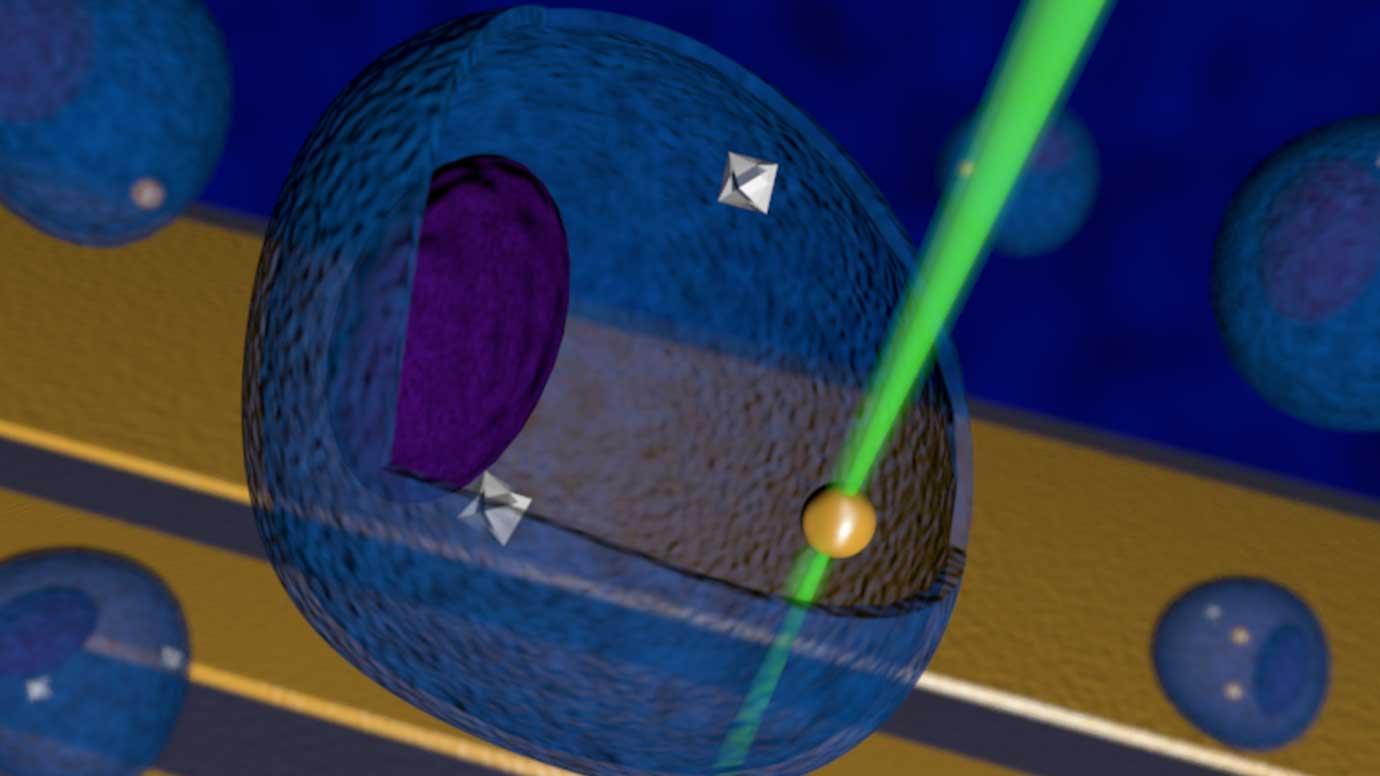
The potential applications of quantum biosensing range from tracking a drug through the membrane and across the cytoplasm of a single cell, to precise demarcation of tumor margins during surgery.
Quantum sensing, however, takes that fragility and makes it an advantage.
Quantum sensors might even be able to record critical biological processes like protein folding and the movement of particles through ion channels in cellular membranes, as well as the transmission of electrical signals through neurons.
“Quantum sensing allows you to measure quantities that are traditionally hard to measure at those scales, such as temperature, pressure, or electromagnetic fields,” says UChicago molecular engineering professor Peter Maurer. Maurer’s research lab can use quantum sensors to track temperature changes across a single cell, which is important for understanding how cells respond to different kinds of stress.
Developing New Tools for Manipulating Sensors
To get the measurements researchers want, quantum biosensors have to be positioned at the exact locations where interesting biological events are happening. But the fragility of quantum technology often requires extremely controlled environments, like a vacuum chamber with near-zero temperature—in this sort of setting, biological processes can only be seen as frozen “snapshots.” To access the full potential of quantum biosensors, researchers are finding new ways to manipulate quantum sensors in warmer, less-controlled environments, so they can see “movies” of events rather than snapshots.
The go-to tool for controlling single molecules or particles are optical tweezers, which use highly focused laser beams to manipulate their targets. “But they can’t really trap anything smaller than a micron, unless you go to very low temperatures,” says UChicago molecular engineering professor Allison Squires. “That doesn’t really work for biology. Biology happens at room temperature, so these nanoscale processes take place in a wet and messy environment. To see those processes in action, we have to be able to work in that setting.”
Squires’ research lab is developing tools to manipulate and control quantum sensors in a biological system, including a technique that uses electric potentials as “walls” to keep the quantum sensor floating in one place without touching it. Squires expects this “arsenal” of nanoscale biophysical tools to provide new kinds of information.
Quantum sensors could measure the electric fields in a neuronal synapse, track a single ion moving through a cell membrane, or record the transfer of proteins between the smaller organelles inside a cell: all processes that are challenging to directly observe. Technology at the intersection of these two fields—quantum engineering and biology—has the potential to revolutionize our understanding of medical science at the smallest possible levels.
“I see quantum biosensing as pushing the limits of measurement resolution in the life sciences,” Maurer says. “By probing very sensitive systems in their physiological environment, this technology could produce invaluable tools.”
Never miss a breakthrough: Join the SciTechDaily newsletter.
Follow us on Google and Google News.