
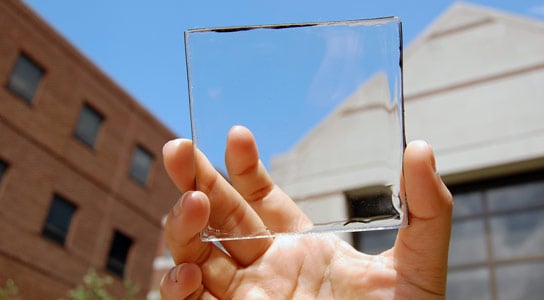
By using small organic molecules that absorb specific nonvisible wavelengths of sunlight, researchers at Michigan State University have developed a transparent luminescent solar concentrator that can create solar energy without blocking the view.
A team of researchers at Michigan State University has developed a new type of solar concentrator that when placed over a window creates solar energy while allowing people to actually see through the window.
It is called a transparent luminescent solar concentrator and can be used on buildings, cell phones and any other device that has a clear surface.
And, according to Richard Lunt of MSU’s College of Engineering, the key word is “transparent.”
Research in the production of energy from solar cells placed around luminescent plastic-like materials is not new. These past efforts, however, have yielded poor results – the energy production was inefficient and the materials were highly colored.
“No one wants to sit behind colored glass,” said Lunt, an assistant professor of chemical engineering and materials science. “It makes for a very colorful environment, like working in a disco. We take an approach where we actually make the luminescent active layer itself transparent.”
The solar harvesting system uses small organic molecules developed by Lunt and his team to absorb specific nonvisible wavelengths of sunlight.
“We can tune these materials to pick up just the ultraviolet and the near infrared wavelengths that then ‘glow’ at another wavelength in the infrared,” he said.
The “glowing” infrared light is guided to the edge of the plastic where it is converted to electricity by thin strips of photovoltaic solar cells.
“Because the materials do not absorb or emit light in the visible spectrum, they look exceptionally transparent to the human eye,” Lunt said.
One of the benefits of this new development is its flexibility. While the technology is at an early stage, it has the potential to be scaled to commercial or industrial applications at an affordable cost.
“It opens a lot of areas to deploy solar energy in a non-intrusive way,” Lunt said. “It can be used on tall buildings with lots of windows or any kind of mobile device that demands high aesthetic quality like a phone or e-reader. Ultimately we want to make solar harvesting surfaces that you do not even know are there.”
Lunt said more work is needed in order to improve its energy-producing efficiency. Currently, it is able to produce a solar conversion efficiency close to 1 percent, but noted they aim to reach efficiencies beyond 5 percent when fully optimized. The best colored LSC has an efficiency of around 7 percent.
The research was featured on the cover of a recent issue of the journal Advanced Optical Materials.
Other members of the research team include Yimu Zhao, an MSU doctoral student in chemical engineering and materials science; Benjamin Levine, assistant professor of chemistry; and Garrett Meek, doctoral student in chemistry.
Reference: “Light Harvesting: Near-Infrared Harvesting Transparent Luminescent Solar Concentrators” by Yimu Zhao, Garrett A. Meek, Benjamin G. Levine and Richard R. Lunt, 15 July 2014, Advanced Optical Materials.
DOI: 10.1002/adom.201470040
Never miss a breakthrough: Join the SciTechDaily newsletter.
Follow us on Google and Google News.
3 Comments
“Lunt said more work is needed in order to improve its energy-producing efficiency. Currently it is able to produce a solar conversion efficiency close to 1 percent, but noted they aim to reach efficiencies beyond 5 percent when fully optimized. The best colored LSC has an efficiency of around 7 percent.”
Percent of what?!
Quick definition from Wikipedia…Solar cell efficiency is the ratio of the electrical output of a solar cell to the incident energy in the form of sunlight. The energy conversion efficiency of a solar cell is the percentage of the solar energy to which the cell is exposed that is converted into electrical energy.
As a new design building constructor I can employ this for my window glass electricity generation in future designs even in my eye protection spectacles ,mobile phones and TV screens.Wonderful wonderful wonderful!Thank you MSU doctoral student Yimu Zhao