
Close Menu
    Facebook X (Twitter) Instagram
    SciTechDaily
    • Biology
    • Chemistry
    • Earth
    • Health
    • Physics
    • Science
    • Space
    • Technology
    Facebook X (Twitter) Pinterest YouTube RSS
    SciTechDaily
    Home»Earth»Trou Au Natron: The Ghostly Volcanic Face From Space
    Earth

    Trou Au Natron: The Ghostly Volcanic Face From Space

    By Adam Voiland, NASA Earth ObservatoryOctober 31, 2023No Comments3 Mins Read
    Facebook Twitter Pinterest Telegram LinkedIn WhatsApp Email Reddit
    Share
    Facebook Twitter LinkedIn Pinterest Telegram Email Reddit
    Trou au Natron Ghostly Face Annotated
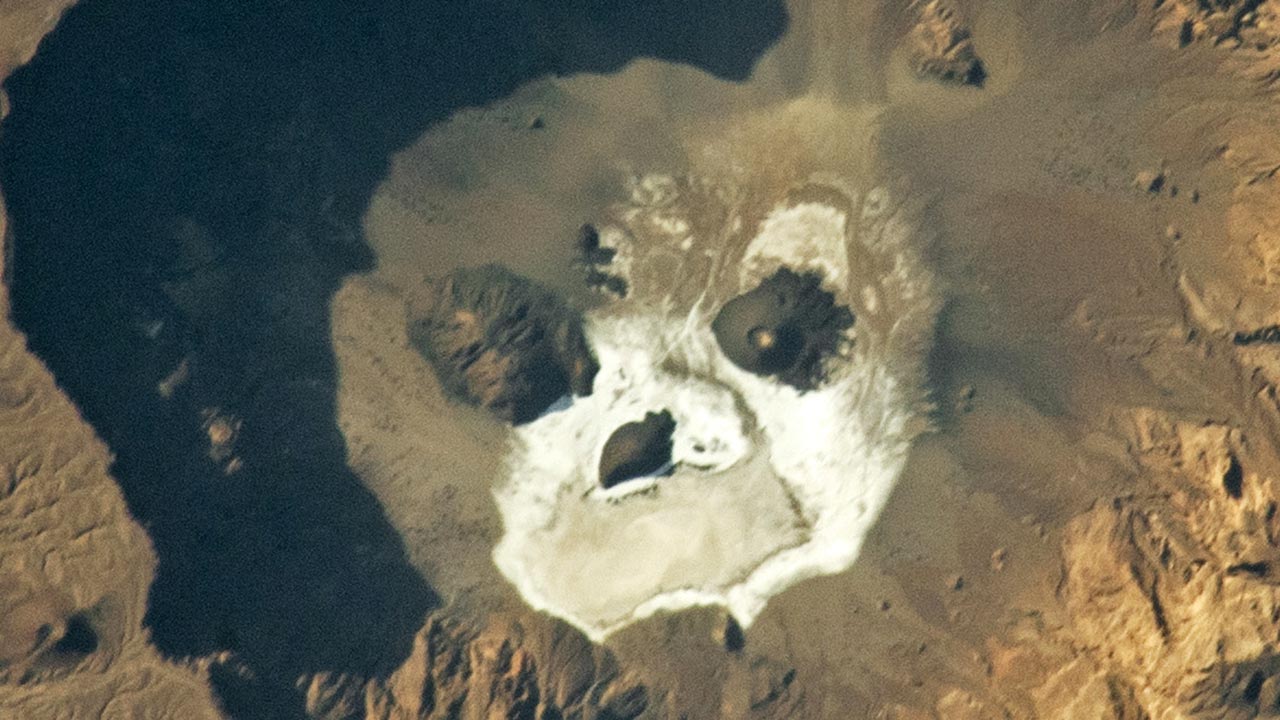
    Trou au Natron in Chad resembles a ghostly face from space, formed by distinctive volcanic features. Satellite observations and research expeditions have unveiled its rich geological history.

    Past volcanic eruptions and salt deposits from present-day hot springs left this distinctive “face” in northern Chad.

    From above, the 1,000-meter (3,300-foot) deep volcanic pit and soda lake Trou au Natron in northern Chad has the look of a ghostly face staring back at you. An astronaut on the International Space Station captured this photograph of the distinctive feature on February 12, 2023.

    The edge of the “face” is partly formed by shadows cast by the rim of a caldera—a type of volcanic crater formed after an explosive eruption or the collapse of the surface into a partially-emptied magma chamber. The “eyes” and “nose” are cinder cones—steep conical hills built around volcanic vents. The cinder cones are thought to be relatively young in geological terms, likely forming within the past few million years and possibly as recently as the past few thousand years.
    Trou au Natron Chad Annotated
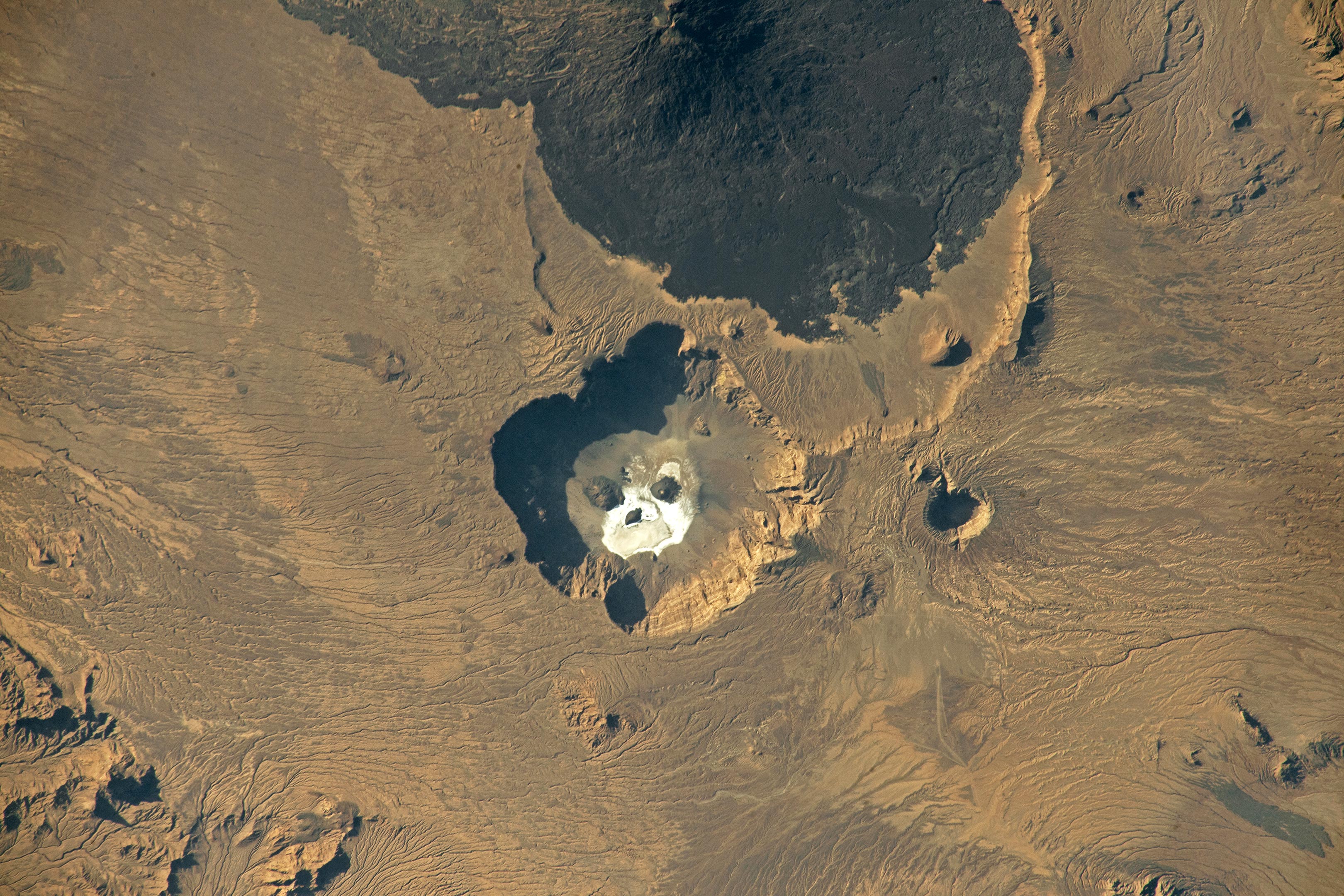
    Astronaut photograph, captured from the International Space Station on February 12, 2023, features the deep volcanic pit and soda lake Trou au Natron in northern Chad.

    The white area around the “mouth” is a mineral crust made of a salt known as natron—a mixture of sodium carbonate, sodium bicarbonate, sodium chloride, and sodium sulfate. It forms as hot spring water pools on the surface and evaporates, and mineral-rich steam rises from the surface of the geothermally active area.

    Trou au Natron lies just southeast of Tarso Toussidé, a broad volcanic feature with fumaroles and an active stratovolcano. One of several volcanic peaks in the Tibesti Mountains, it is the source of several relatively recent—though poorly documented and studied—eruptions.

    The remoteness of Trou au Natron makes it difficult for scientists to access. However, analysis of rock and fossil samples collected in the 1960s indicate that Trou au Natron was filled by a glacial lake hundreds of meters deep about 14,000 years ago. An expedition led by German researcher Stefan Kröpelin reached Trou au Natron in 2015 and collected samples of fossilized aquatic algae thought to have formed some 120,000 years ago.

    Satellite observations of the region have helped fill in some details. One pair of University of Cambridge researchers have pieced together a rough sequence of the region’s volcanic activity based on observations from the ASTER (Advanced Spaceborne Thermal Emission and Reflection Radiometer) sensor on NASA’s Terra satellite. They divided the activity into six phases, with the formation of Trou au Natron as one of the most recent events of geologic significance.

    Astronaut photograph ISS068-E-53507 was acquired on February 12, 2023, with a Nikon D5 digital camera using a focal length of 500 millimeters. The image was provided by the ISS Crew Earth Observations Facility and the Earth Science and Remote Sensing Unit, Johnson Space Center. The image was taken by a member of the Expedition 68 crew. It has been cropped and enhanced to improve contrast, and lens artifacts have been removed. The International Space Station Program supports the laboratory as part of the ISS National Lab to help astronauts take pictures of Earth that will be of the greatest value to scientists and the public, and to make those images freely available on the Internet.

    Never miss a breakthrough: Join the SciTechDaily newsletter.
    Follow us on Google and Google News.

    Geography NASA NASA Earth Observatory Volcano
    Share. Facebook Twitter Pinterest LinkedIn Email Reddit

    Related Articles

    Island Obliterated: Dramatic Changes at Hunga Tonga-Hunga Ha’apai

    Hunga Tonga Island Obliterated – NASA Satellites Capture Massive Blast

    A Wolf Awakens in the Galápagos Islands at Night

    A Deadly Day on Mount Semeru: Destructive Rivers of Debris on Indonesian Volcano

    Wall of Lava Burns a Path Through La Palma

    Cumbre Vieja Lights Up the Night – Astronaut Photo Captures Volcanic Eruption From Space

    Socked in Stratovolcano: Astronaut on ISS Captures Incredible View of Uninhabited Atlasov Island

    Kilauea’s Lava Lake Returns – Hawaii’s Most Active Volcano Is Erupting Again

    Newberry Volcano Photographed by Astronaut Onboard the International Space Station

    Leave A Reply Cancel Reply

    • Facebook
    • Twitter
    • Pinterest
    • YouTube

    Don't Miss a Discovery

    Subscribe for the Latest in Science & Tech!

    Trending News

    Breakthrough Bowel Cancer Trial Leaves Patients Cancer-Free for Nearly 3 Years

    Natural Compound Shows Powerful Potential Against Rheumatoid Arthritis

    100,000-Year-Old Neanderthal Fossils in Poland Reveal Unexpected Genetic Connections

    Simple “Gut Reset” May Prevent Weight Gain After Ozempic or Wegovy

    2.8 Days to Disaster: Scientists Warn Low Earth Orbit Could Suddenly Collapse

    Common Food Compound Shows Surprising Power Against Superbugs

    5 Simple Ways To Remember More and Forget Less

    The Atomic Gap That Could Cost the Semiconductor Industry Billions

    Follow SciTechDaily
    • Facebook
    • Twitter
    • YouTube
    • Pinterest
    • Newsletter
    • RSS
    SciTech News
    • Biology News
    • Chemistry News
    • Earth News
    • Health News
    • Physics News
    • Science News
    • Space News
    • Technology News
    Recent Posts
    • Early Cannabis Use May Stall Key Brain Skills in Teens
    • Popular Vitamin D Supplement Has “Previously Unknown” Negative Effect, Study Finds
    • Powerful Antioxidant Found To Play a Key Role in Proper Protein Folding
    • MIT Laser Breakthrough Lets Scientists Watch Drugs Enter the Brain in Real Time
    • Study Reveals Malaria’s Hidden Role in Human Evolution
    Copyright © 1998 - 2026 SciTechDaily. All Rights Reserved.
    • Science News
    • About
    • Contact
    • Editorial Board
    • Privacy Policy
    • Terms of Use

    Type above and press Enter to search. Press Esc to cancel.