
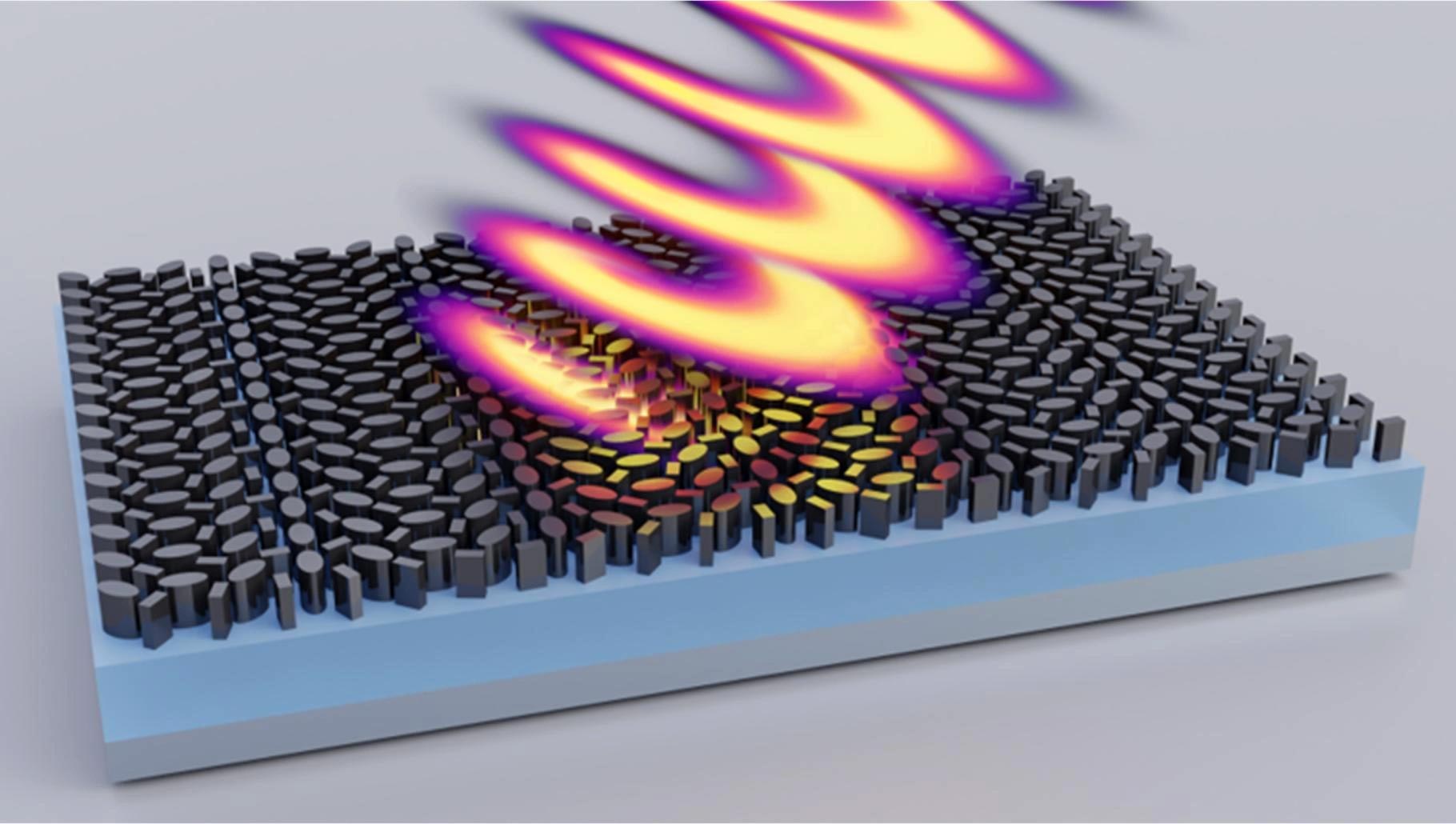
Researchers at the CUNY Graduate Center have made significant strides in manipulating the optical properties of thermal radiation using metasurfaces.
Their latest study demonstrates how these two-dimensional materials can control thermal radiation to create customizable light sources, which could influence a range of applications from military operations to space technology.
Groundbreaking Advancements in Light Control
In a groundbreaking advancement, researchers with the Advanced Science Research Center at the CUNY Graduate Center (CUNY ASRC) have experimentally demonstrated that metasurfaces (two-dimensional materials structured at the nanoscale) can precisely control the optical properties of thermal radiation generated within the metasurface itself. This pioneering work, published in Nature Nanotechnology, paves the way for creating custom light sources with unprecedented capabilities, impacting a wide array of scientific and technological applications.
Thermal radiation — a form of electromagnetic waves generated by heat-driven random fluctuations in matter— is inherently broadband in nature, consisting of many colors. A good example is the light emitted by an incandescent bulb. It also is unpolarized, and it spreads out in all directions due to its randomness. These characteristics often limit its utility in applications that require well-defined light properties. In contrast, laser light, known for its defined frequency, polarization, and propagation direction, is well defined, making it invaluable for many key applications of modern society.
Shaping Light with Metasurfaces
Metasurfaces offer a solution for greater utility by controlling electromagnetic waves through meticulously engineered shapes of nanopillars that are arrayed across their surfaces. By varying these structures, researchers can achieve control over light scattering, effectively “shaping” light in customizable ways. So far, however, metasurfaces have only been developed to control laser light sources, and they require bulky, expensive excitation setups.
“Our ultimate aim is enabling metasurface technology that does not require external laser sources, but can provide precise control over the way its own thermal radiation is emitted and propagates,” said one of the paper’s lead authors Adam Overvig, formerly a postdoctoral researcher with the CUNY ASRC’s Photonics Initiative and currently assistant professor at the Stevens Institute of Technology. “Our work is an important step in this quest, providing the foundation for a new class of metasurfaces that do not require external laser sources, but are fed by internal incoherent oscillations of matter driven by heat.”
Revolutionizing Thermal Radiation Control
The research team previously published theoretical work showing that a properly designed metasurface could shape the thermal radiation it generates, imparting desirable features such as defined frequencies, custom polarization, and even a desired wavefront shape capable of creating a hologram. This study predicted that, unlike conventional metasurfaces, a suitably engineered metasurface could both produce and control its own thermal radiation in novel ways.
In the present breakthrough, the team set out to experimentally validate these predictions and build on their new functionalities. The metasurface was achieved by simplifying the previously envisioned device architecture, elegant but challenging to realize, to a single structured layer with a 2D pattern. This streamlined design facilitates easier fabrication and practical implementation.
While conventional thermal radiation is unpolarized, a significant focus of the research was enabling thermal radiation with circularly polarized light, where the electric field oscillates in a rotating manner. Recent works had shown that opposite circular polarizations (rotating respectively with left-handed and right-handed features) could be split into opposite directions, but there seemed to be a fundamental limit to further control the polarization of emitted light. The team’s new design transcends this limitation, allowing for asymmetric emission of circular polarization towards a single direction, demonstrating full control over thermal emission.
Custom Light Sources and Future Prospects
“Custom light sources are integral to a number of scientific and technological fields,” said Andrea Alù, distinguished professor and Einstein Professor of Physics at The City University of New York Graduate Center and founding director of the CUNY ASRC Photonics Initiative. “The ability to create compact, lightweight sources with desired spectral, polarization, and spatial features is particularly compelling for applications requiring portability, such as space-based technology, field research in geology and biology, and military operations. This work represents a significant step towards realizing these capabilities.”
The team noted that the principles applied in their current work can be extended to light-emitting diodes (LEDs), with the potential of enhancing another very common and cheap source of light that is notoriously difficult to control.
Looking ahead, the research team aims to combine these building blocks to achieve more complex thermal emission patterns such as focusing thermal emission to a specific point above the device or creating a thermal hologram. Such advancements could revolutionize the design and functionality of custom light sources.
This research was supported by the Department of Defense Vannevar Bush Faculty Fellowship, the Simons Foundation, and the Air Force Office of Scientific Research MURI program.
Reference: “Local control of polarization and geometric phase in thermal metasurfaces” by J. Ryan Nolen, Adam C. Overvig, Michele Cotrufo and Andrea Alù, 23 August 2024, Nature Nanotechnology.
DOI: 10.1038/s41565-024-01763-6
Never miss a breakthrough: Join the SciTechDaily newsletter.
Follow us on Google and Google News.
1 Comment
If a metamaterial with high enough melting point can be created at reasonable cost, thermophotovoltaic energy conversion will be a thing. Screw petroleum distillate fuel, an internal combustion engine, and a rotating electrical machine for electrical generation.
You’d need some sort of burner with a high emissivity coating, covered by the metamaterial, and a photovoltaic device useful for the wavelength passed by the metamaterial.