
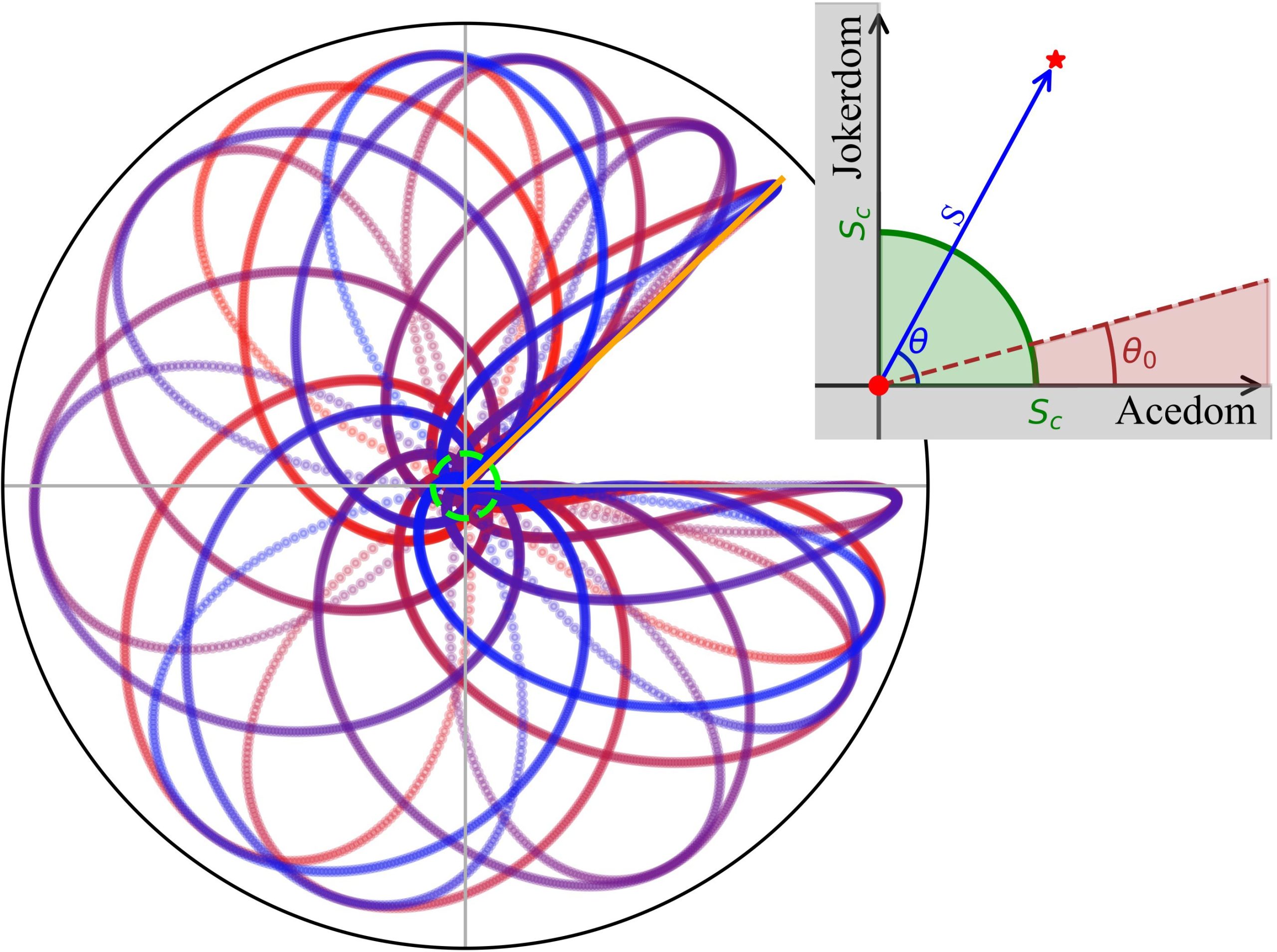
Authors Ian Tregillis and George R.R. Martin develop a formula to capture the dynamics driving viral behavior in the Wild Cards series.
Many science fiction authors try to incorporate scientific principles into their work, but Ian Tregillis, who is a contributing author of the Wild Cards book series when he’s not working as a physicist at Los Alamos National Laboratory, took it one step further: He derived a formula to describe the dynamics of the fictional universe’s viral system.
In independent research published in the American Journal of Physics, from AIP Publishing, Tregillis and George R.R. Martin presented their formula modeling viral behavior within the Wild Cards universe.
Wild Cards is a science fiction series written by a collection of authors and edited by Martin and Melinda M. Snodgrass. Sitting at over 30 volumes, the books are about an alien virus called the Wild Card that mutates human DNA. Martin is credited as a co-author of the paper, making it his first peer-reviewed physics publication.
The idea to explore the science behind the fictional virus came from a series of blog posts on the Wild Cards website.
“Like any physicist, I started with back-of-the-envelope estimates, but then I went off the deep end. Eventually, I suggested, only half-jokingly, that it might be easier to write a genuine physics paper than another blog post,” Tregillis said. “Being a theoretician, I couldn’t help but wonder if a simple underlying model might tidy up the canon.”
The Lagrangian Approach to Fictional Science
The formula he derived is a Lagrangian formulation, which considers the different ways a system can evolve. It’s also a fundamental physics principle, which also makes the fictional example a powerful teaching tool.
Tregillis shared that deriving this physical model was a fun but open-ended puzzle. After some trial and error of models based on fractals or thermodynamic analogies, he and Martin settled on the Lagrangian approach.
“We translated the abstract problem of Wild Card viral outcomes into a simple, concrete dynamical system. The time-averaged behavior of this system generates the statistical distribution of outcomes,” he said.
While the Wild Card virus can be modeled by physics, Tregillis emphasized that it isn’t a hard-and-fast rule in the canon.
“Good storytelling is about characters: their wants, needs, obstacles, challenges, and how they interact with their world,” Tregillis said. “The fictional virus is really just an excuse to justify the world of Wild Cards, the characters who inhabit it, and the plot lines that spin out from their actions.”
Reference: “Ergodic Lagrangian dynamics in a superhero universe” by I. L. Tregillis and George R. R. Martin, 1 February 2025, American Journal of Physics.
DOI: 10.1119/5.0228859
Never miss a breakthrough: Join the SciTechDaily newsletter.
Follow us on Google and Google News.
5 Comments
The time-averaged behavior of this system generates the statistical distribution of outcomes.
Ask the researchers:
Do you really understand time?
Scientific research guided by correct theories can enable researchers to think more.
According to the Topological Vortex Theory (TVT), spins create everything, spins shape the world. There are substantial distinctions between Topological Vortex Theory (TVT) and traditional physical theories. Grounded in the inviscid and absolutely incompressible spaces, TVT introduces the concept of topological phase transitions and employs topological principles to elucidate the formation and evolution of matter in the universe, as well as the impact of interactions between topological vortices and anti-vortices on spacetime dynamics and thermodynamics.
Within TVT, low-dimensional spacetime matter serves as the foundation for high-dimensional spacetime matter, and the hierarchical structure of matter and its interaction mechanisms challenge conventional macroscopic and microscopic interpretations. The conflict between Quantum Physics and Classical Physics can be attributed to their differing focuses: Quantum Physics emphasizes low-dimensional spacetime matter, whereas Classical Physics centers on high-dimensional spacetime matter.
Subatomic particles in the quantum world often defy the familiar rules of the physical world. The fact repeatedly suggests that the familiar rules of the physical world are pseudoscience. In the familiar rules of the physical world, two sets of cobalt-60 can form the mirror image of each other by rotating in opposite directions, and can receive heavy rewards.
Please witness the grand performance of some so-called academic publications (including PRL, Nature, Science, etc.). https://scitechdaily.com/microscope-spacecrafts-most-precise-test-of-key-component-of-the-theory-of-general-relativity/#comment-854286. Some so-called academic publications (including PRL, Nature, Science, etc.) are addicted to their own small circles and have long deviated from science. They hardly know what ashamed is.
If the researchers are truly interested in time, please read: The Challenge of Topological Vortex Theory (TVT) to Traditional Time Concepts. (https://scitechdaily.com/microscope-spacecrafts-most-precise-test-of-key-component-of-the-theory-of-general-relativity/#comment-869260).
I’d be a lot more impressed if GRRM would actually finish the books he’s already started.
Cryptic or plain fact?
“In the Beginning was THE WORD.”
If we’re actually discussing DNA; suddenly it all makes sense. We came with our knowledge and 3D printers; populated the planet and it froze and we survived but now must re interpret all of our collective hunches; which we have; and are well on our way to continue our endless wandering from planet to planet. We are the ver aliens we seek; we are the saviors, the martyrs; and the only conscious creatures here. Be proud.
VERY GOOD.
Please continue your scientific popularization.
Some so-called academic publications (including PRL, Nature, Science, etc.) mislead the direction of science and are known for their various wonders.