
Close Menu
    Facebook X (Twitter) Instagram
    SciTechDaily
    • Biology
    • Chemistry
    • Earth
    • Health
    • Physics
    • Science
    • Space
    • Technology
    Facebook X (Twitter) Pinterest YouTube RSS
    SciTechDaily
    Home»Science»Unexpected Appendages Found in Trilobite Fossils Challenge Old Theories
    Science

    Unexpected Appendages Found in Trilobite Fossils Challenge Old Theories

    By American Museum of Natural HistorySeptember 12, 2024No Comments4 Mins Read
    Facebook Twitter Pinterest Telegram LinkedIn WhatsApp Email Reddit
    Share
    Facebook Twitter LinkedIn Pinterest Telegram Email Reddit
    Well Preserved Triarthrus eatoni
    A photograph of an extremely well-preserved fossil of Triarthrus eatoni from upstate New York Credit: © M. Hopkins and J-B Hou

    Researchers discovered an additional set of legs under the head of a trilobite species, suggesting complex segmentation previously unrecognized.

    By comparing fossils from New York and British Columbia, they propose a new model showing six head segments in trilobites, enhancing our understanding of their evolutionary relationship with other arthropods.

    A new study finds that a trilobite species with exceptionally well-preserved fossils from upstate New York has an additional set of legs underneath its head. The research, led by the American Museum of Natural History and Nanjing University in China, suggests that having a fifth pair of head appendages might be more widespread among trilobites than once thought. Published today (September 12) in the journal Palaeontology, the study helps researchers better understand how trilobite heads are segmented.

    Significance of Segmentation in Trilobites

    Trilobites are a group of extinct arthropods whose living relatives include lobsters and spiders. Like other arthropods, the bodies of trilobites are made up of many segments, with the head region comprised of several fused segments. As with other parts of the trilobite body (the thorax and tail), these segments were associated with appendages, which ranged in function from sensing to feeding to locomotion.

    Melanie Hopkins With Fossil
    Coauthor Melanie Hopkins with a well-preserved fossil of Triarthrus eatoni from upstate New York. Credit: Daniel Kim/ ©AMNH

    “The number of these segments and how they are associated with other important traits, like eyes and legs, is important for understanding how arthropods are related to one another, and therefore, how they evolved,” said Melanie Hopkins, curator and chair of the Museum’s Division of Paleontology.

    The segments in the trilobite head can be counted in two different ways: by looking at the grooves (called furrows) on the upper side of the trilobite fossil’s hard exoskeleton, or by counting the pairs of preserved antennae and legs on the underside of the fossil. The soft appendages of trilobites are rarely preserved, though, and when looking at the segments in the trilobite head, researchers regularly find a mismatch between these two methods.

    New Insights from Exceptional Fossils

    In the new study, Hopkins and colleague Jin-Bo Hou from Nanjing University examined newly recovered specimens of the exceptionally preserved trilobite Triarthrus eatoni from upstate New York. These fossils, known for the gold shine of the pyrite replacement preserving them, show an additional, previously undescribed leg underneath the head.
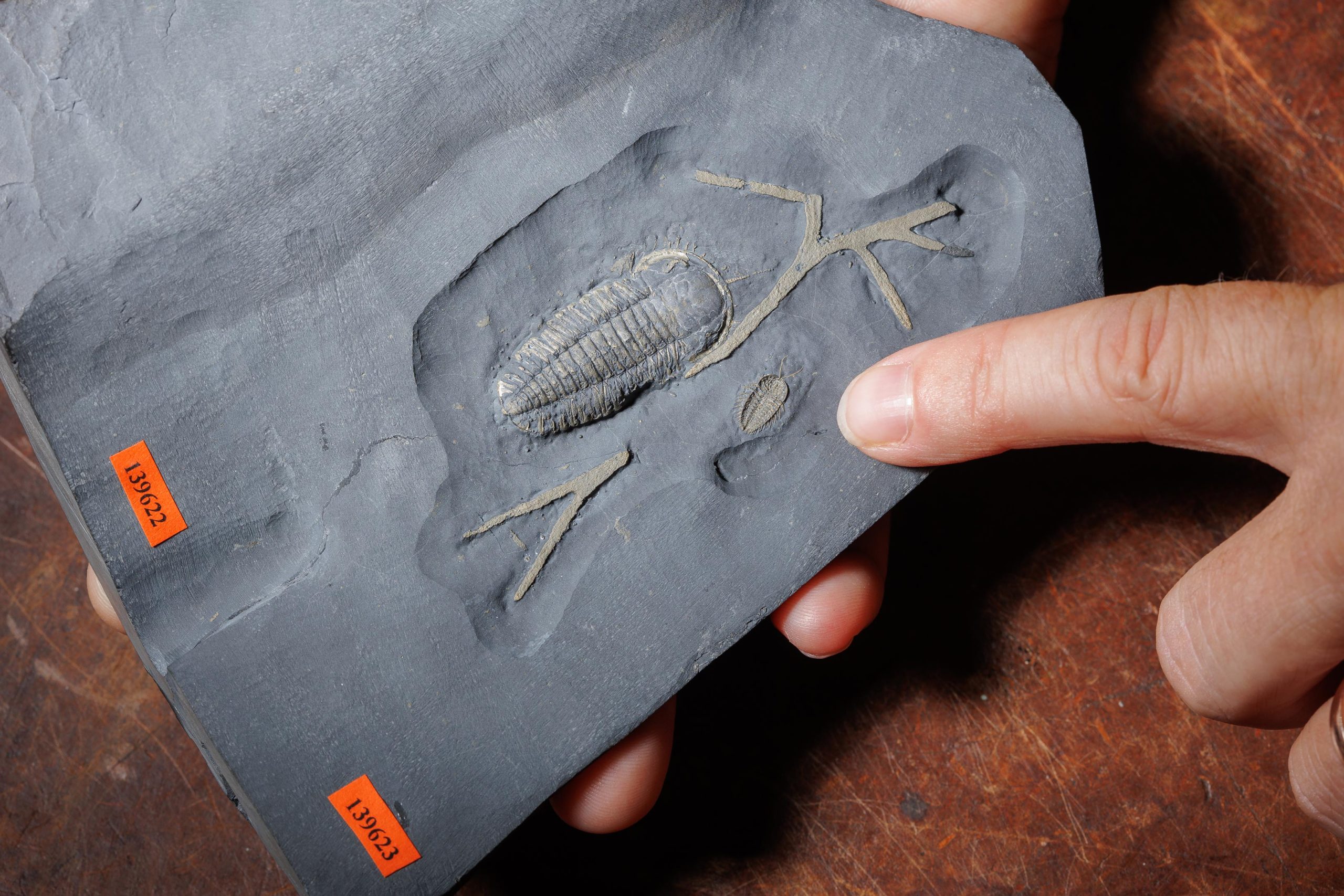
    Triarthrus eatoni Fossil
    An extremely well-preserved fossil of Triarthrus eatoni from upstate New York (on right). Credit: Daniel Kim/ ©AMNH

    “This fantastic preservation style allows us to observe 3D appendages in hundreds of specimens directly from the ventral side of the animals, just like looking at the appendages of horseshoe crabs on a beach by grabbing them and turning them upside down,” said Hou.

    Model of Trilobite Appendage Attachment

    By making comparisons with another trilobite species, the exceptionally preserved Olenoides serratus from the Burgess Shale in British Columbia, Hopkins and Hou propose a model for how appendages were attached to the head in relation to the grooves in the exoskeleton. This model resolves the apparent mismatch and indicates that the trilobite head included six segments: an anterior segment associated with the developmental origin of the eyes and five additional segments, associated with one pair of antennae and four pairs of walking legs, respectively.

    This study expands on the analysis that Hou and Hopkins have done on Triarthrus eatoni, which showed that the walking legs carry micron-sized respiratory structures (gills) and that the function of some of the spines on the walking legs was to keep these gills clean.

    Reference: “New evidence for five cephalic appendages in trilobites and implications for segmentation of the trilobite head” by Jin-bo Hou and Melanie J. Hopkins, 12 September 2024, Palaeontology.
    DOI: 10.1111/pala.12723

    Never miss a breakthrough: Join the SciTechDaily newsletter.
    Follow us on Google and Google News.

    American Museum of Natural History Fossils Paleontology Popular
    Share. Facebook Twitter Pinterest LinkedIn Email Reddit

    Related Articles

    167-Million-Year-Old Lizard With Snake-Like Jaws Puzzles Scientists

    Real Life Sea Monster – Scientists Discover Colossal New Species of Mosasaur

    “Bold Theory” That T. rex Was 3 Species Rebutted – “Tyrannosaurus rex Remains the One True King of the Dinosaurs”

    Fossils Reveal Headbutts May Have Been Used as a Dinosaur Courtship Behavior

    Jaw Structures of Fossils Seems to Suggest That Three Homo Species Roamed Africa Concurrently

    Prehistoric Fossilized Eocene Epoch Turtles Died Locked In Coitus

    Cretaceous Period Sankofa Pyrenaica Fossilized Eggs Are Unusually Shaped

    Microraptor Feathers Were Black With Iridescent Sheen

    Hundreds of Lost Fossils From the Darwin Collection Rediscovered by the British Geological Survey

    Leave A Reply Cancel Reply

    • Facebook
    • Twitter
    • Pinterest
    • YouTube

    Don't Miss a Discovery

    Subscribe for the Latest in Science & Tech!

    Trending News

    First-of-Its-Kind Discovery: Homer’s Iliad Found Embedded in a 1,600-Year-Old Egyptian Mummy

    Beyond Inflammation: Scientists Uncover New Cause of Persistent Rheumatoid Arthritis

    A Simple Molecule Could Unlock Safer, Easier Weight Loss

    Scientists Just Built a Quantum Battery That Charges Almost Instantly

    Researchers Unveil Groundbreaking Sustainable Solution to Vitamin B12 Deficiency

    Millions of People Have Osteopenia Without Realizing It – Here’s What You Need To Know

    Researchers Discover Boosting a Single Protein Helps the Brain Fight Alzheimer’s

    World-First Study Reveals Human Hearts Can Regenerate After a Heart Attack

    Follow SciTechDaily
    • Facebook
    • Twitter
    • YouTube
    • Pinterest
    • Newsletter
    • RSS
    SciTech News
    • Biology News
    • Chemistry News
    • Earth News
    • Health News
    • Physics News
    • Science News
    • Space News
    • Technology News
    Recent Posts
    • After Decades, MIT Researchers Capture the First 3D Atomic View of a Mysterious Material
    • Your Favorite Fishing Spot Is Turning Brown – and the Fish Are Changing
    • 380-Million-Year-Old Fish Fossil Reveals Secrets of Life’s First Steps Onto Land
    • Mezcal “Worm” in a Bottle Mystery: DNA Testing Reveals a Surprise
    • Scientists Turn Red Lettuce Green, Unlocking Hidden Nutrients
    Copyright © 1998 - 2026 SciTechDaily. All Rights Reserved.
    • Science News
    • About
    • Contact
    • Editorial Board
    • Privacy Policy
    • Terms of Use

    Type above and press Enter to search. Press Esc to cancel.