
Close Menu
    Facebook X (Twitter) Instagram
    SciTechDaily
    • Biology
    • Chemistry
    • Earth
    • Health
    • Physics
    • Science
    • Space
    • Technology
    Facebook X (Twitter) Pinterest YouTube RSS
    SciTechDaily
    Home»Chemistry»Unexpected Effect: Nanorippled Graphene Becomes a Powerful Catalyst
    Chemistry

    Unexpected Effect: Nanorippled Graphene Becomes a Powerful Catalyst

    By University of ManchesterMarch 16, 2023No Comments3 Mins Read
    Facebook Twitter Pinterest Telegram LinkedIn WhatsApp Email Reddit
    Share
    Facebook Twitter LinkedIn Pinterest Telegram Email Reddit
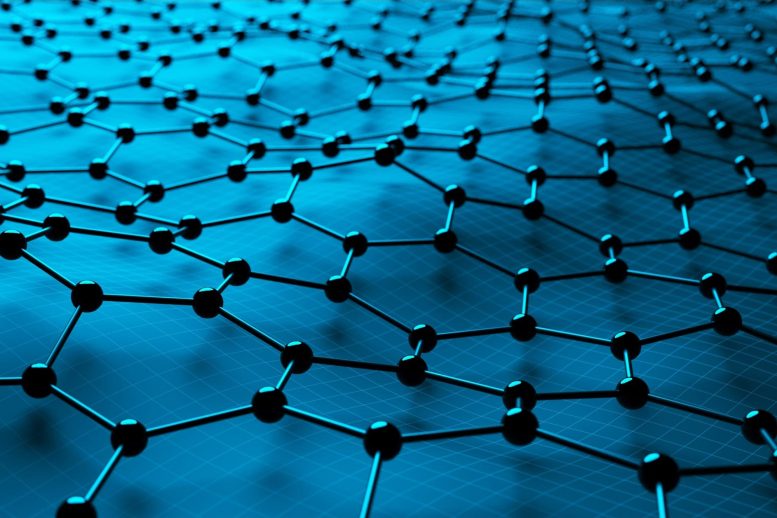
    Graphene Sheet
    Scientists have found that nanoripples in graphene make it a strong catalyst, even though it was expected to be chemically inert. Their research, published in PNAS, demonstrated that nanoscale corrugations on graphene’s surface accelerate hydrogen splitting as well as the best metallic-based catalysts, and this effect may be present in all 2D materials.

    Revolutionizing Catalysis with Graphene

    A team of researchers led by Prof. Andre Geim from the National Graphene Institute (NGI) have discovered that nanoripples in graphene can make it a strong catalyst, contrary to general expectations that the carbon sheet is as chemically inert as the bulk graphite from which it is obtained.

    Published this week in the Proceedings of the National Academy of Sciences (PNAS), the research has shown that graphene with nanoscale corrugations of its surface can accelerate hydrogen splitting as well as the best metallic-based catalysts. This unexpected effect is likely to be present in all two-dimensional materials, which are all inherently non-flat.

    The Manchester team in collaboration with researchers from China and USA conducted a series of experiments to show that non-flatness of graphene makes it a strong catalyst. First, using ultrasensitive gas flow measurements and Raman spectroscopy, they demonstrated that graphene’s nanoscale corrugations were linked to its chemical reactivity with molecular hydrogen (H2) and that the activation energy for its dissociation into atomic hydrogen (H) was relatively small.
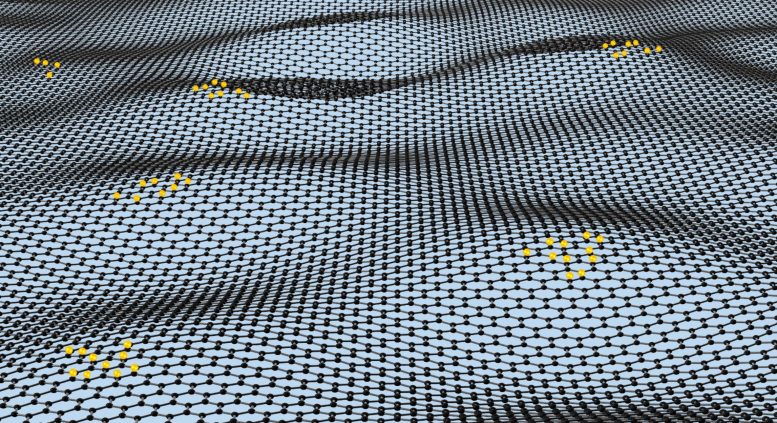
    Rippled Graphene With Dissociated Hydrogen Atoms on Top
    Rippled graphene with dissociated hydrogen atoms on top. Credit: University of Manchester

    The team evaluated whether this reactivity is enough to make the material an efficient catalyst. To this end, the researchers used a mixture of hydrogen and deuterium (D2) gases and found that graphene indeed behaved as a powerful catalyst, converting H2 and D2 into HD. This was in stark contrast to the behavior of graphite and other carbon-based materials under the same conditions. The gas analyses revealed that the amount of HD generated by monolayer graphene was approximately the same as for the known hydrogen catalysts, such as zirconia, magnesium oxide, and copper, but graphene was required only in tiny quantities, less than 100 times of the latter catalysts.

    Debunking Graphene’s Inert Reputation

    “Our paper shows that freestanding graphene is quite different from both graphite and atomically flat graphene that are chemically extremely inert. We have also proved that nanoscale corrugations are more important for catalysis than the ‘usual suspects’ such as vacancies, edges, and other defects on graphene’s surface,” said Dr. Pengzhan Sun, first author of the paper.

    Lead author of the paper Prof. Geim added, “As nanorippling naturally occurs in all atomically thin crystals, because of thermal fluctuations and unavoidable local mechanical strain, other 2D materials may also show similarly enhanced reactivity. As for graphene, we can certainly expect it to be catalytically and chemically active in other reactions, not only those involving hydrogen.”

    “2D materials are most often perceived as atomically flat sheets, and effects caused by unavoidable nanoscale corrugations have so far been overlooked. Our work shows that those effects can be dramatic, which has important implications for the use of 2D materials. For example, bulk molybdenum sulfide and other chalcogenides are often employed as 3D catalysts. Now we should wonder if they could be even more active in their 2D form.”

    Reference: “Unexpected catalytic activity of nanorippled graphene” by P. Z. Sun, W. Q. Xiong, A. Bera, I. Timokhin, Z. F. Wu, A. Mishchenko, M. C. Sellers, B. L. Liu, H. M. Cheng, E. Janzen, J. H. Edgar, I. V. Grigorieva, S. J. Yuan and A. K. Geim, 13 March 2023, Proceedings of the National Academy of Sciences.
    DOI: 10.1073/pnas.2300481120

    Never miss a breakthrough: Join the SciTechDaily newsletter.
    Follow us on Google and Google News.

    2D Materials Catalysts Graphene Nanotechnology University of Manchester
    Share. Facebook Twitter Pinterest LinkedIn Email Reddit

    Related Articles

    White Graphene: The One-Atom Wonder Driving Greener Energy and Faster Tech

    More Graphene Magic Starts When Flatness Ends: A Proton Permeability Puzzle Solved!

    Producing High-Quality Graphene Cheaply Using Carbon Monoxide

    Measuring the “Wettability” of Graphene and Other 2D Materials at the Molecular Level

    Findings to Help Achieve Holy Grail of 2D Materials – Superfast Electronic Devices

    Chemists Achieve Breakthrough in the Synthesis of Graphene Nanoribbons

    Progressing Electronics Beyond Moore’s Law With Graphene and 2D Materials

    New Graphene–Carbon Nanotube Catalyst Could Ignite Clean Energy Revolution

    Cobalt-Graphene Catalyst Performs Nearly As Well as Platinum

    Leave A Reply Cancel Reply

    • Facebook
    • Twitter
    • Pinterest
    • YouTube

    Don't Miss a Discovery

    Subscribe for the Latest in Science & Tech!

    Trending News

    What Causes Chronic Pain? Scientists Identify Key Culprit in the Brain

    Semaglutide Shows Surprising Mental Health Benefits in Massive 100,000-Person Study

    This Liquid Snapped Instead of Flowing and Scientists Were Shocked

    Breakthrough Alzheimer’s Drug Rewires the Brain Instead of Just Clearing Plaques

    Scientists Discover Hidden “Footprint of Death” That Could Transform How We Fight Disease

    A Simple Nose Swab Could Detect Alzheimer’s Years Before Symptoms Appear

    Scientists Just Rewrote the Timeline of Complex Life on Earth

    Teenager’s Fossil Find Leads to Discovery of Shark Teeth in 5 Million-Year-Old Whale Skull

    Follow SciTechDaily
    • Facebook
    • Twitter
    • YouTube
    • Pinterest
    • Newsletter
    • RSS
    SciTech News
    • Biology News
    • Chemistry News
    • Earth News
    • Health News
    • Physics News
    • Science News
    • Space News
    • Technology News
    Recent Posts
    • Scientists Discover Why the Brain Gets Stuck in Schizophrenia
    • Scientists Engineer “Tumor-Eating” Bacteria That Devour Cancer From Within
    • Even “Failed” Diets May Deliver Long-Term Health Gains, Study Finds
    • Childhood Junk Food May Rewire the Brain for Life
    • NIH Scientists Discover Powerful New Opioid That Relieves Pain Without Dangerous Side Effects
    Copyright © 1998 - 2026 SciTechDaily. All Rights Reserved.
    • Science News
    • About
    • Contact
    • Editorial Board
    • Privacy Policy
    • Terms of Use

    Type above and press Enter to search. Press Esc to cancel.