

Could microbial life be drifting in the clouds of Venus? With unexplained signs of phosphine and ammonia scientists are developing a bold new space mission to find out.
A UK-backed space mission may soon provide a definitive answer to one of science’s most intriguing questions: could microscopic lifeforms be living in the clouds of Venus?
In the last five years, scientists have identified traces of two possible indicators of life: phosphine and ammonia. On Earth, both of these gases are known to originate only from living organisms or industrial processes.
The presence of these compounds in Venus’s atmosphere cannot be easily explained by any natural chemical or geological processes known to science. In response, Professor Jane Greaves of Cardiff University and her research team are working on a way to investigate the mystery more closely.
At the 2025 National Astronomy Meeting hosted by the Royal Astronomical Society in Durham, the team introduced their mission concept. The plan involves detecting and mapping phosphine, ammonia, and other hydrogen-rich gases that are not expected to occur naturally on Venus.
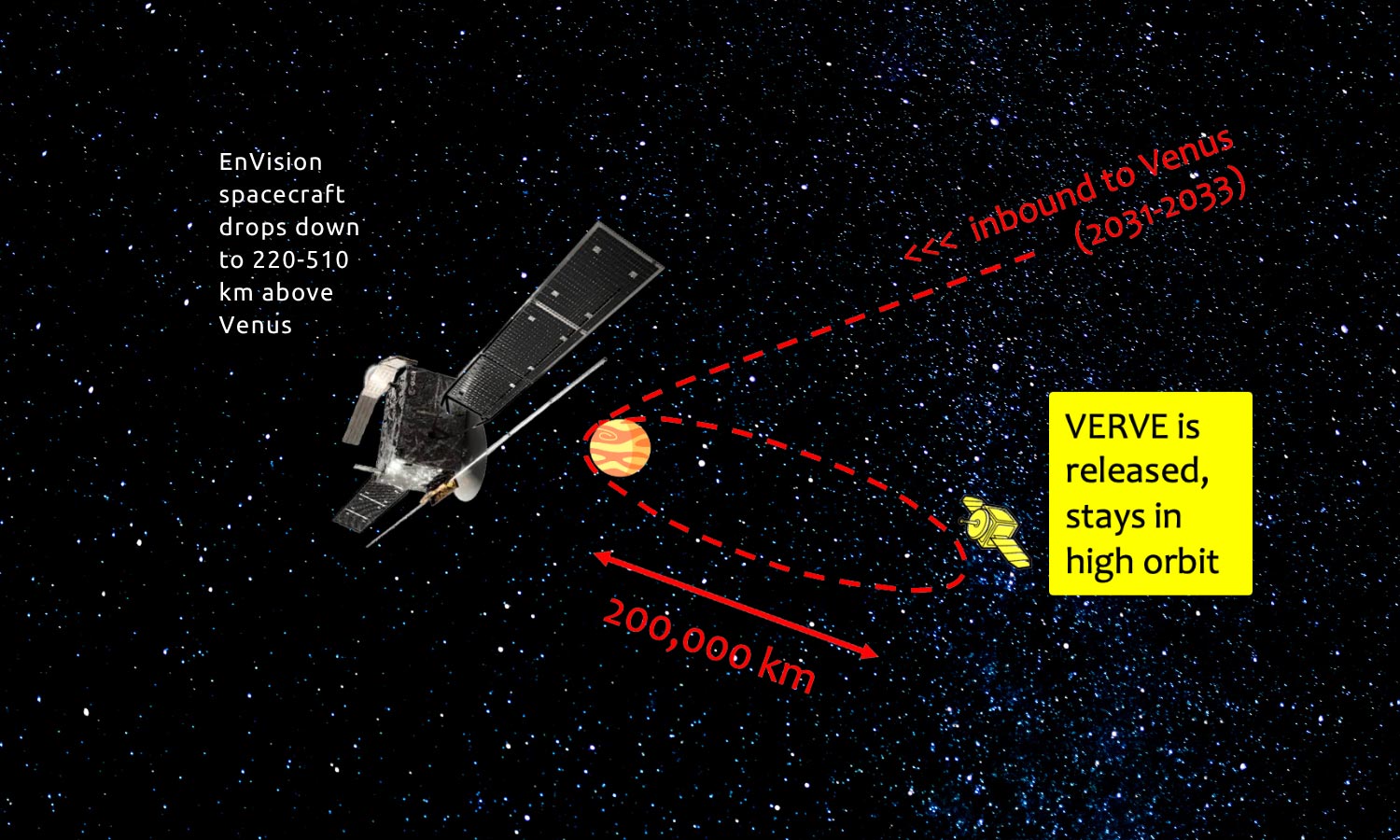
This would involve building a CubeSat-sized probe with a budget of 50 million euros (£43 million) to hitch a ride with the European Space Agency’s EnVision mission, scheduled for 2031. VERVE (the Venus Explorer for Reduced Vapours in the Environment) would then detach on arrival at Venus and carry out an independent survey, while EnVision probes the planet’s atmosphere, surface, and interior.
Chemical Clues in the Clouds
“Our latest data has found more evidence of ammonia on Venus, with the potential for it to exist in the habitable parts of the planet’s clouds,” Professor Greaves said.
“There are no known chemical processes for the production of either ammonia or phosphine, so the only way to know for sure what is responsible for them is to go there. The hope is that we can establish whether the gases are abundant or in trace amounts, and whether their source is on the planetary surface, for example, in the form of volcanic ejecta. Or whether there is something in the atmosphere, potentially microbes that are producing ammonia to neutralize the acid in the Venusian clouds.”
Phosphine was first detected in the Venusian clouds in 2020, but the finding proved controversial because subsequent observations failed to replicate the discovery.
However, that didn’t deter the team of researchers behind the JCMT-Venus project – a long-term program to study the molecular content of the atmosphere of Venus, which first involved the James Clerk Maxwell Telescope in Hawaii.
They tracked the phosphine signature over time and found that its detection appeared to follow the planet’s day-night cycle – i.e., it was destroyed by sunlight.
They also established that the abundance of the gas varied with time and position across Venus.
“This may explain some of the apparently contradictory studies and is not a surprise given that many other chemical species, like sulfur dioxide and water, have varying abundances, and may eventually give us clues to how phosphine is produced,” said Dr Dave Clements, of Imperial College London, who is the leader of the JCMT-Venus project.
Ammonia, Extremophiles, and Habitability
It was then revealed at last year’s National Astronomy Meeting in Hull that ammonia had also been tentatively detected on Venus. On Earth, this is primarily produced by biological activity and industrial processes.
But there are no known chemical processes or any atmospheric or geological phenomena that can explain its presence on Venus.
Although temperatures on the surface of the planet are around 450 °C, about 50 km (31 miles) up it can range from 30 °C to 70 °C, with an atmospheric pressure similar to Earth’s surface.
Under these conditions, it would be just about possible for “extremophile” microbes to survive, potentially having remained in the Venusian clouds after emerging during the planet’s more temperate past.
But the only way to know for sure, the JCMT-Venus researchers say, is to send a probe to find out.
New research papers about the latest discoveries are expected to be published later this year.
Meeting: National Astronomy Meeting 2025
Never miss a breakthrough: Join the SciTechDaily newsletter.
Follow us on Google and Google News.
2 Comments
Unicorn farts.
microbes from crashed and landed Russian and US probes