
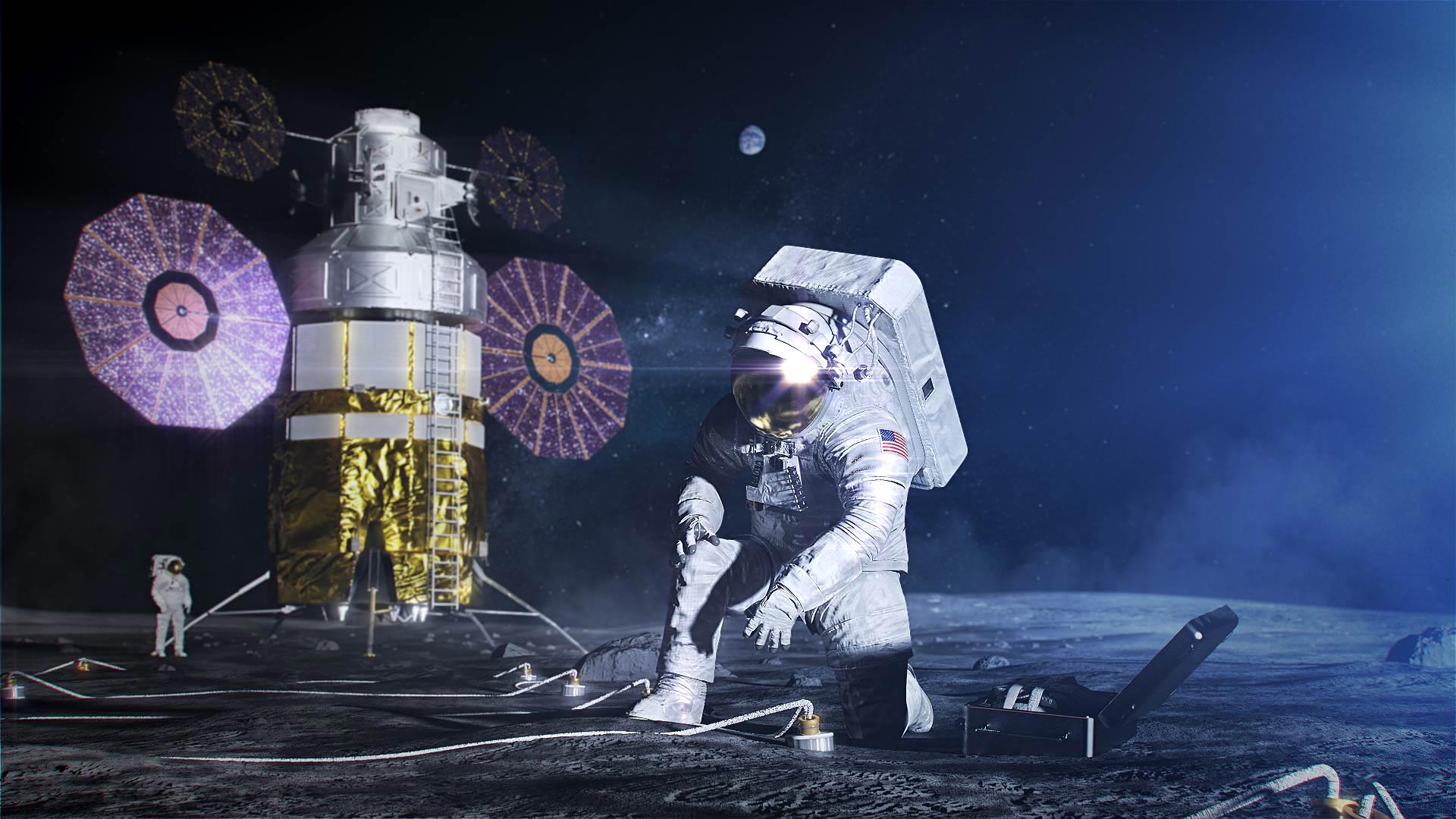
NASA partners with universities to pioneer lunar mining and energy systems, essential for future deep space missions.
Power and in-situ resources are two things humans will need as they explore deep space. How future astronauts use these commodities depends on the technology at hand. That’s why NASA is looking to U.S. universities for lunar-focused research to bring about advancements in in-situ resource utilization and sustainable power solutions. NASA selected six project proposals under its first-ever Lunar Surface Technology Research (LuSTR) solicitation.
“Our inaugural LuSTR opportunity targeted two technology areas within NASA’s Lunar Surface Innovation Initiative that are essential to the agency’s Artemis program, which will land the first woman and next man on the Moon,” said Walt Engelund, deputy associate administrator for programs in NASA’s Space Technology Mission Directorate (STMD). “The systems developed by U.S. universities could make future exploration more accessible, robust, and exciting.”
The farther human explorers travel into space, the more important it will be to generate products with local materials. Before large-scale technologies to collect, process, and convert resources into usable supplies make it to Mars, NASA is researching and developing systems for the Moon. Eventually, the agency aims to demonstrate in-situ resource utilization technologies on the Moon, using it as a testbed for Mars.

Through LuSTR, NASA selected three university-led proposals to research innovative ways to identify resources, like water, on the Moon, and inventive designs for extraction and utilization equipment.
- The University of Texas in El Paso – one of the largest Hispanic-serving institutions in the country – will research an advanced thermal mining approach that could release, trap, and transport water vapor found on the Moon. The team, led by principal investigator Ahsan Choudhuri, plans to experimentally demonstrate over two pounds (about one kilogram) of collection capacity within 11 hours.
- Washington University in St. Louis will build a rover-mounted drill to quantify the 3D distribution of water at the Moon’s South Pole. A laser instrument located at the bottom of the drill, capable of analyzing regolith, would quantify the amount of water and other chemicals present beneath the surface. Principal investigator Alian Wang will lead the research team and reconnaissance instrument development.
- Michigan Technological University in Houghton will adapt a heated percussive cone penetrometer – an engineering instrument regularly used on Earth – to characterize the strength of lunar soil, or regolith. Understanding a lunar region’s regolith strength could inform methods of excavating water and building structures using local materials. Paul van Susante will serve as the project’s principal investigator.
Complementing this research, three other university teams will mature next-generation energy storage and power distribution technologies. The projects could help power in-situ resource utilization operations and other robust infrastructure on the Moon.
- The University of California in Santa Barbara, led by principal investigator Philip Lubin, will research wireless power transfer feasibility from a base station to multiple distant assets on the Moon. Small rovers, for example, could be equipped with low-power beacons capable of receiving around 100 Watts of power in regions where solar or tethered power transfer is impractical, such as in the Moon’s deep and dark craters.
- Vanderbilt University in Nashville will look into using silicon carbide power components for lunar surface applications. At present, these power components are particularly susceptible to radiation and frequently fail or experience reduced performance in space. Principal investigator Arthur Witulski will lead the project.
- The Ohio State University in Columbus will explore flexible energy distribution between multiple, different power grids – that may use solar, radioisotope, and battery sources – that could be deployed on the lunar surface to support the Artemis program. The project, led by Jin Wang, will focus on control methodologies and perform both hardware and software demonstrations.
Via the LuSTR selections, NASA aims to stimulate lunar technology development within academia and help fast-track the readiness of critical lunar technologies and components. The NASA funding for each project varies. The maximum grant amount is $2 million per selection, over two years.
The LuSTR opportunity is part of NASA’s Space Technology Research Grants (STRG) program and is one of five STRG solicitations meant to engage academia and accelerate the development of high-priority technologies. The program and the Lunar Surface Innovation Initiative are part of STMD.
Never miss a breakthrough: Join the SciTechDaily newsletter.
Follow us on Google and Google News.