
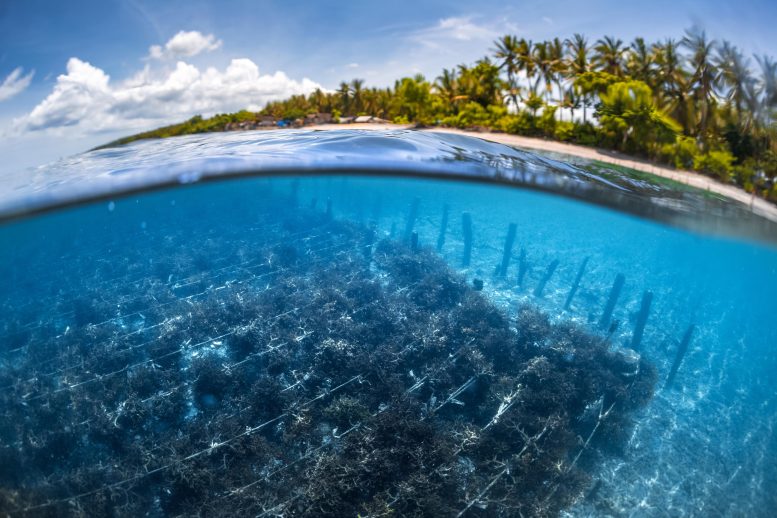
Seaweed Farming Offers Sustainable Solutions to Food Security and Climate Change
A University of Queensland-led study has shown that expanding global seaweed farming could go a long way to addressing the planet’s food security, biodiversity loss, and climate change challenges.
PhD Candidate Scott Spillias, from UQ’s School of Earth and Environmental Science, said seaweed offered a sustainable alternative to land-based agricultural expansion to meet the world’s growing need for food and materials.
“Seaweed has great commercial and environmental potential as a nutritious food and a building block for commercial products including animal feed, plastics, fibers, diesel, and ethanol,” Mr. Spillias said.
Environmental Benefits of Seaweed Farming
“Our study found that expanding seaweed farming could help reduce demand for terrestrial crops and reduce global agricultural greenhouse gas emissions (GHG) by up to 2.6 billion tonnes of CO2-equivalent per year.”
Researchers mapped the potential of farming more of the 34 commercially important seaweed species using the Global Biosphere Management Model. They estimated the environmental benefits of a range of scenarios based on land-use changes, GHG emissions, water and fertilizer use, and projected changes in species presence by 2050.
“In one scenario where we substituted 10 percent of human diets globally with seaweed products, the development of 110 million hectares of land for farming could be prevented,” Mr Spillias said.
“We also identified millions of available hectares of ocean within global exclusive economic zones[1] (EEZs), where farming could be developed.
“The largest share of suitable ocean was in the Indonesian EEZ, where up to 114 million hectares is estimated to be suitable for seaweed farming.
“The Australian EEZ also shows great potential and species diversity, with at least 22 commercially viable species and an estimated 75 million hectares of ocean being suitable.”
Future Potential of Seaweed as a Staple
Mr. Spillias said many native species of seaweed in Australian waters had not yet been studied from a commercial production perspective.
“The way I like to look at this is to think about ancestral versions of everyday crops – like corn and wheat – which were uninspiring, weedy things,” he said. “Through thousands of years of breeding we have developed the staple crops that underpin modern societies and seaweed could very well hold similar potential in the future.”
UQ study collaborator Professor Eve McDonald-Madden said the seaweed solution would have to be carried out with care, to avoid displacing problems from the land to the ocean.
“Our study points out what could be done to address some of the mounting problems of global sustainability facing us, but it can’t be implemented without exercising extreme caution,” she said.
This research will be published today (January 26, 2023) in the journal Nature Sustainability.
Reference: “Reducing global land-use pressures with seaweed farming” by Scott Spillias, Hugo Valin, Miroslav Batka, Frank Sperling, Petr Havlík, David Leclère, Richard S. Cottrell, Katherine R. O’Brien and Eve McDonald-Madden, 26 January 2023, Nature Sustainability.
DOI: 10.1038/s41893-022-01043-y
The University of Queensland (UQ) acknowledges the collaborative efforts of researchers from the International Institute for Applied Systems Analysis, CSIRO, and the University of Tasmania.
Notes
- An area of the sea in which a sovereign state has special rights regarding the exploration and use of marine resources, including energy production from water and wind.
Never miss a breakthrough: Join the SciTechDaily newsletter.
Follow us on Google and Google News.