
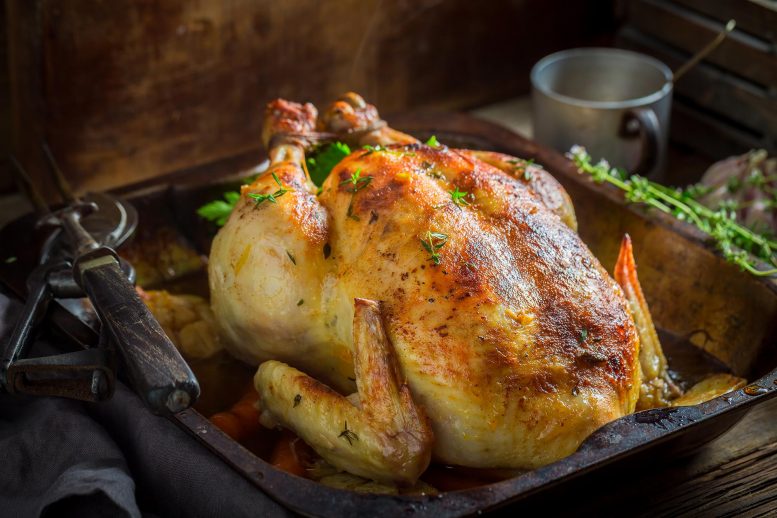
Poultry industry will be encouraged by study that finds the root of wooden breast syndrome.
University of Delaware researchers have discovered that lipoprotein lipase, an enzyme crucial for fat metabolism, may be contributing to wooden breast syndrome in broiler chickens.
Wooden breast syndrome can affect broiler chickens, making the meat hard and chewy. It is a costly problem that can render the birds unmarketable, causing significant economic losses for growers, who sometimes see the disease in up to half their flocks.
The UD research team, led by Behnam Abasht, associate professor of animal and food sciences in UD’s College of Agriculture and Natural Resources, have identified gene expression irregularities at the onset of wooden breast syndrome that suggest the disease is a metabolic disorder characterized by abnormal fat accumulation in the breast muscle tissue.
The research team reported their results on Wednesday, November 20, 2019, in the journal Scientific Reports.
The findings of a new study co-authored by University of Delaware professor Behnam Abasht could provide potential markers to identify chickens that will develop wooden breast syndrome, which makes meat hard and chewy. Credit: University of Delaware/ Jeffrey C. Chase
The findings could help drive short-term solutions to help growers manage the condition in chickens at the production level through feed additives or supplements, or to reduce the number of birds that develop the condition.
“The industry desperately needs a solution right now. Conservative estimates project that wooden breast syndrome is costing the U.S. agricultural community $200 million dollars per year, but this number may be much higher,” said Abasht.
The United States leads the production of broiler chickens worldwide. Delaware has more than 700 producers who raise commercial broiler chickens and over 1,000 small backyard poultry owners. Wooden breast syndrome is a concern around the world, too, as global consumption of chicken has risen in recent years as a leading source of dietary protein.
The research also could inform human health research related to metabolic syndromes, such as diabetes and atherosclerosis, which is associated with fatty deposits in the arteries.
Source of the problem
Abasht has been studying wooden breast syndrome in broiler chickens for nearly a decade. In previous work, his research team analyzed the genes involved in the disease and identified biomarkers for the disorder. They also characterized the unique biochemistry of the hardened breast tissue in chickens with the disease.
In their current work, the UD research team noticed that the expression of lipoprotein lipase was higher in chickens affected with wooden breast syndrome, leading more fat to accumulate in the chicken’s pectoral (or breast) muscles. Lipoprotein lipase serves as a “metabolic gatekeeper” that determines how much fat is allowed inside a given tissue.
This was curious because breast muscle fibers in chicken typically rely on sugar (glucose) molecules for fuel, not fat molecules.
The research team used RNA sequencing to determine which genes were being expressed in modern fast-growing broiler chickens and slower-growing legacy chickens. They then employed a new technology, called RNA in situ hybridization, to pinpoint exactly where this gene expression occurred inside the muscle.
The researchers found genetic evidence of lipoprotein lipase being expressed in endothelial cells in chickens, which was previously unknown. Present in all blood vessels, endothelial cells serve as a barrier between the blood and the surrounding tissue.
Abasht hypothesized that when more fat is oxidized for energy in the breast tissue of chickens, it may be causing the excessive release of free radical molecules that would modify (damage) fats and proteins in the muscle, prompting the chicken’s immune system to kick in to clear up the problem.
“We observed that if a particular vein was attacked by immune cells, the same vein typically also expressed higher levels of lipoprotein lipase,” said Abasht.
The researchers went a step further and compared this data with the gene expression signals found in two commercial broiler chicken lines, at three weeks of age and again at market age. In their analysis, the researchers found signals consistent with the fact that young chickens may be showing the same changes as market-age broiler chickens with wooden breast syndrome, even before the disease shows up.
The findings could provide potential markers to identify chickens that will develop the disease.
In recently published research in Genes, the researchers also reported finding common features between wooden breast syndrome in chickens and diabetes complications in humans, specifically diabetic cardiomyopathy, a chronic disease characterized by molecular and structural changes in the heart muscle.
Abasht’s research team is currently combing available literature for treating diabetes to see if there are ways to apply similar approaches to help broiler chickens avoid — or cope — with wooden breast syndrome, through diet, supplements or medication.
If they can find common solutions, Abasht said, a far-reaching goal of the work might be to use chickens as a model to study possible treatments for diabetes in humans.
“Our main focus was to address this problem from an agricultural perspective, but our findings open new horizons for future research that could benefit both agriculture and human health. This is a very interesting prospect for us,” said Abasht.
Longer term, Juniper Lake, a UD doctoral student in Abasht’s lab, said that having a deeper understanding of the genetic causes behind the disease could lead to solutions for agricultural producers to selectively breed out the traits that cause wooden breast disease, which has a relatively high heritability.
“There’s a lot to be gained from basic research of wooden breast, even if the main goal is to mitigate economic losses in the poultry industry,” said Lake.
Reference: “Dysregulation of lipid metabolism and appearance of slow myofiber-specific isoforms accompany the development of Wooden Breast myopathy in modern broiler chickens” by Michael B. Papah and Behnam Abasht, 20 November 2019, Scientific Reports.
DOI: 10.1038/s41598-019-53728-8
The UD research team’s work to characterize the genetic basis of wooden breast syndrome is part of an ongoing collaborative study between UD, Iowa State University, and the Ohio State University, funded by the U.S. Department of Agriculture (Grant No. 2016-67015-25027).
With the Thanksgiving holiday just around the corner, it is important to note that wooden breast disease is currently only found in broiler chickens. It is not known to affect turkeys.
Never miss a breakthrough: Join the SciTechDaily newsletter.
Follow us on Google and Google News.
1 Comment
That’s interesting. Hoping you guys will fing the solution soon