
Astronomers at the International Centre for Radio Astronomy Research (ICRAR), working with international collaborators, have made a striking discovery involving a previously unknown type of cosmic phenomenon.
A strange astronomical object known as ASKAP J1832-0911 produces bursts of radio waves and X-rays that last about two minutes and repeat every 44 minutes. This regular pattern places it in a rare class of sources called long-period transients, or LPTs.
A cosmic signal breaks the pattern
What makes this discovery especially notable is that it marks the first time an LPT has been observed emitting X-rays. Astronomers believe this new evidence could help explain the origin of other puzzling signals that have been detected across the sky but remain poorly understood.
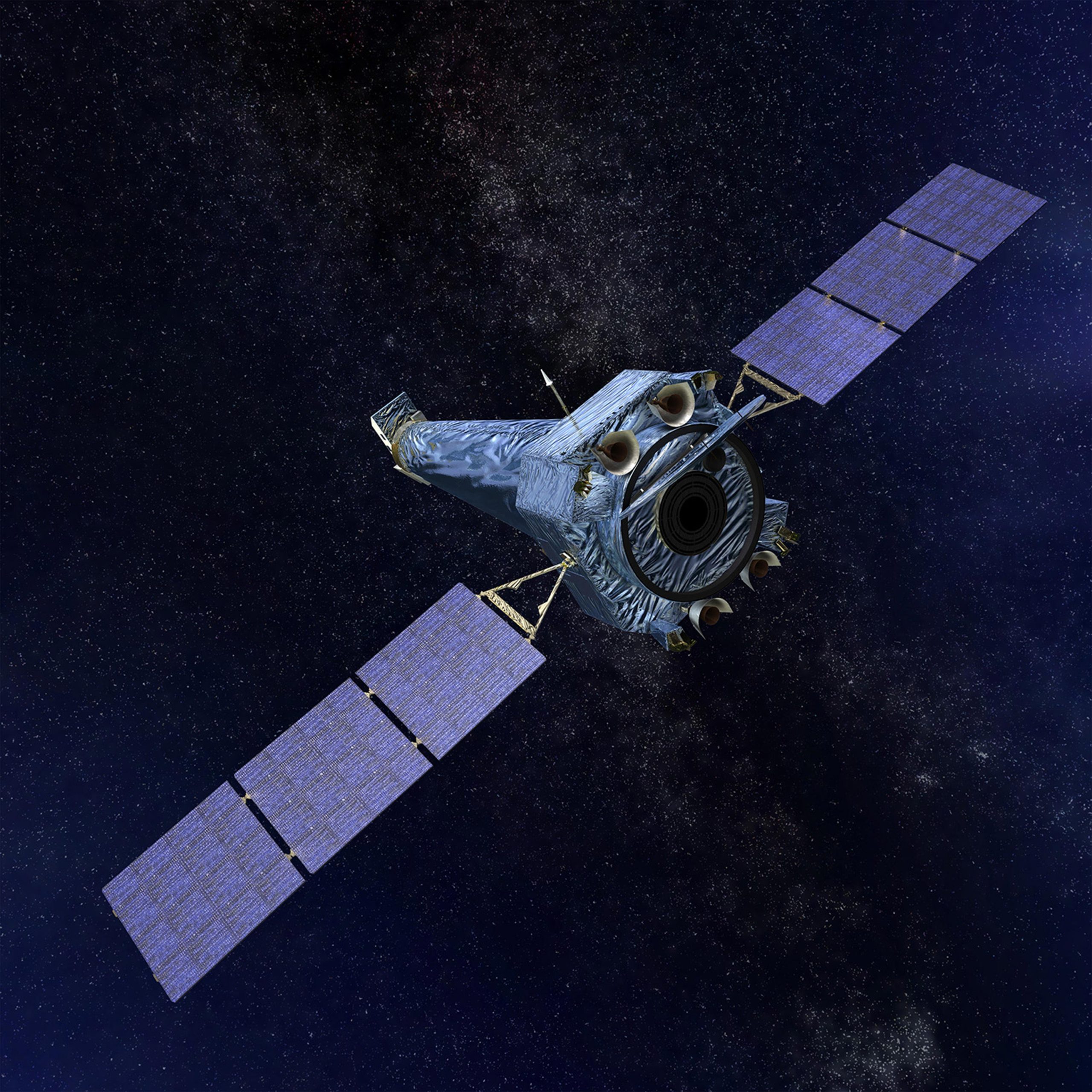
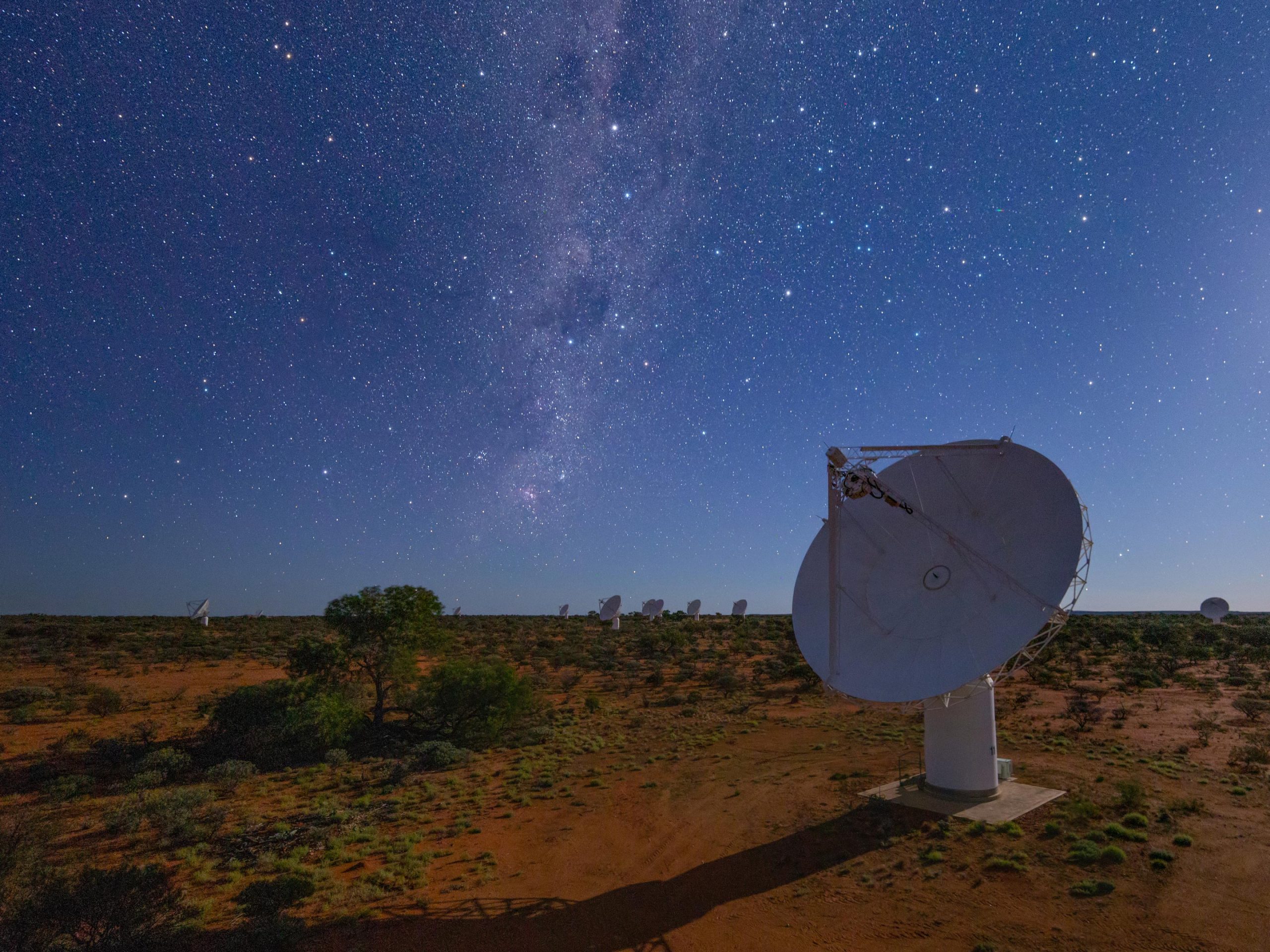
The research team identified ASKAP J1832-0911 using the Australian Square Kilometer Array Pathfinder radio telescope on Wajarri Country in Australia, which is operated by CSIRO. They then matched those radio pulses with X-ray flashes recorded by the Chandra X-ray Observatory, which happened to be observing the same region of the sky at the same time.

“Discovering that ASKAP J1832-0911 was emitting X-rays felt like finding a needle in a haystack,” said lead author Dr. Ziteng (Andy) Wang from the Curtin University node of ICRAR.
“The ASKAP radio telescope has a wide field view of the night sky, while Chandra observes only a fraction of it. So, it was fortunate that Chandra observed the same area of the night sky at the same time.”
ICRAR’s Ziteng (Andy) Wang explains a mysterious new object that pulses in both radio waves and X-rays every 44 minutes. Credit: ICRAR
Long-period transients are a relatively new category of cosmic source, defined by radio pulses separated by minutes or even hours. Since ICRAR researchers first identified this type of object in 2022, astronomers worldwide have found ten examples so far.
Despite these discoveries, scientists still do not know what produces LPTs or why their signals turn on and off at such long, regular, and unusual intervals. The detection of X-rays from ASKAP J1832-0911 now provides a crucial new clue that may help narrow down the physical processes behind these enigmatic cosmic signals.

Old theories under new pressure
“This object is unlike anything we have seen before,” Dr. Wang said.
“ASKAP J1831-0911 could be a magnetar (the core of a dead star with powerful magnetic fields), or it could be a pair of stars in a binary system where one of the two is a highly magnetized white dwarf (a low-mass star at the end of its evolution). However, even those theories do not fully explain what we are observing. This discovery could indicate a new type of physics or new models of stellar evolution.”

A path toward many more discoveries
Detecting these objects using both X-rays and radio waves may help astronomers find more examples and learn more about them.
According to second author Professor Nanda Rea from the Institute of Space Science (ICE-CSIC) and Catalan Institute for Space studies (IEEC) in Spain, “Finding one such object hints at the existence of many more. The discovery of its transient X-ray emission opens fresh insights into their mysterious nature,” she says.
“What was also truly remarkable is that this study showcases an incredible teamwork effort, with contributions from researchers across the globe with different and complementary expertise,” she continues.
The discovery also helps narrow down what the objects might be. Since X-rays are much higher energy than radio waves, any theory must account for both types of emission – a valuable clue, given their nature remains a cosmic mystery.
ASKAP J1832-0911 is located in our Milky Way galaxy about 15,000 light-years from Earth.
Reference: “Detection of X-ray emission from a bright long-period radio transient” by Ziteng Wang, Nanda Rea, Tong Bao, David L. Kaplan, Emil Lenc, Zorawar Wadiasingh, Jeremy Hare, Andrew Zic, Akash Anumarlapudi, Apurba Bera, Paz Beniamini, A. J. Cooper, Tracy E. Clarke, Adam T. Deller, J. R. Dawson, Marcin Glowacki, Natasha Hurley-Walker, S. J. McSweeney, Emil J. Polisensky, Wendy M. Peters, George Younes, Keith W. Bannister, Manisha Caleb, Kristen C. Dage, Clancy W. James, Mansi M. Kasliwal, Viraj Karambelkar, Marcus E. Lower, Kaya Mori, Stella Koch Ocker, Miguel Pérez-Torres, Hao Qiu, Kovi Rose, Ryan M. Shannon, Rhianna Taub, Fayin Wang, Yuanming Wang, Zhenyin Zhao, N. D. Ramesh Bhat, Dougal Dobie, Laura N. Driessen, Tara Murphy, Akhil Jaini, Xinping Deng, Joscha N. Jahns-Schindler, Y. W. Joshua Lee, Joshua Pritchard, John Tuthill and Nithyanandan Thyagarajan, 28 May 2025, Nature.
DOI: 10.1038/s41586-025-09077-w
Never miss a breakthrough: Join the SciTechDaily newsletter.
Follow us on Google and Google News.
9 Comments
Biz-arr
studying space is not difficult with fusions from sattelytes. pressures from radio waves and learning how different pressures adapt in said space. even mining from our planets in our solar system. we would have e to study our quadrant first. radion waves could be pressurized with any matter in space to study said properties of said matter
Marvin,
Did you have a stroke after that word salad?
Does this post add up to a coherent thought? Each half of each sentence could almost be a thought, until it isn’t. This sounds closer to Star Trek than astronomy.
Just enjoy the grooming
[email protected]
Whut?!?
Hello
Is it possible for all x rays, gamma rays and all Rays whizzing about the sky add up to dark energy?
It is just there and maybe confusing the astronomers and their machines?
Cheers A
awsome sauce my dudes.