

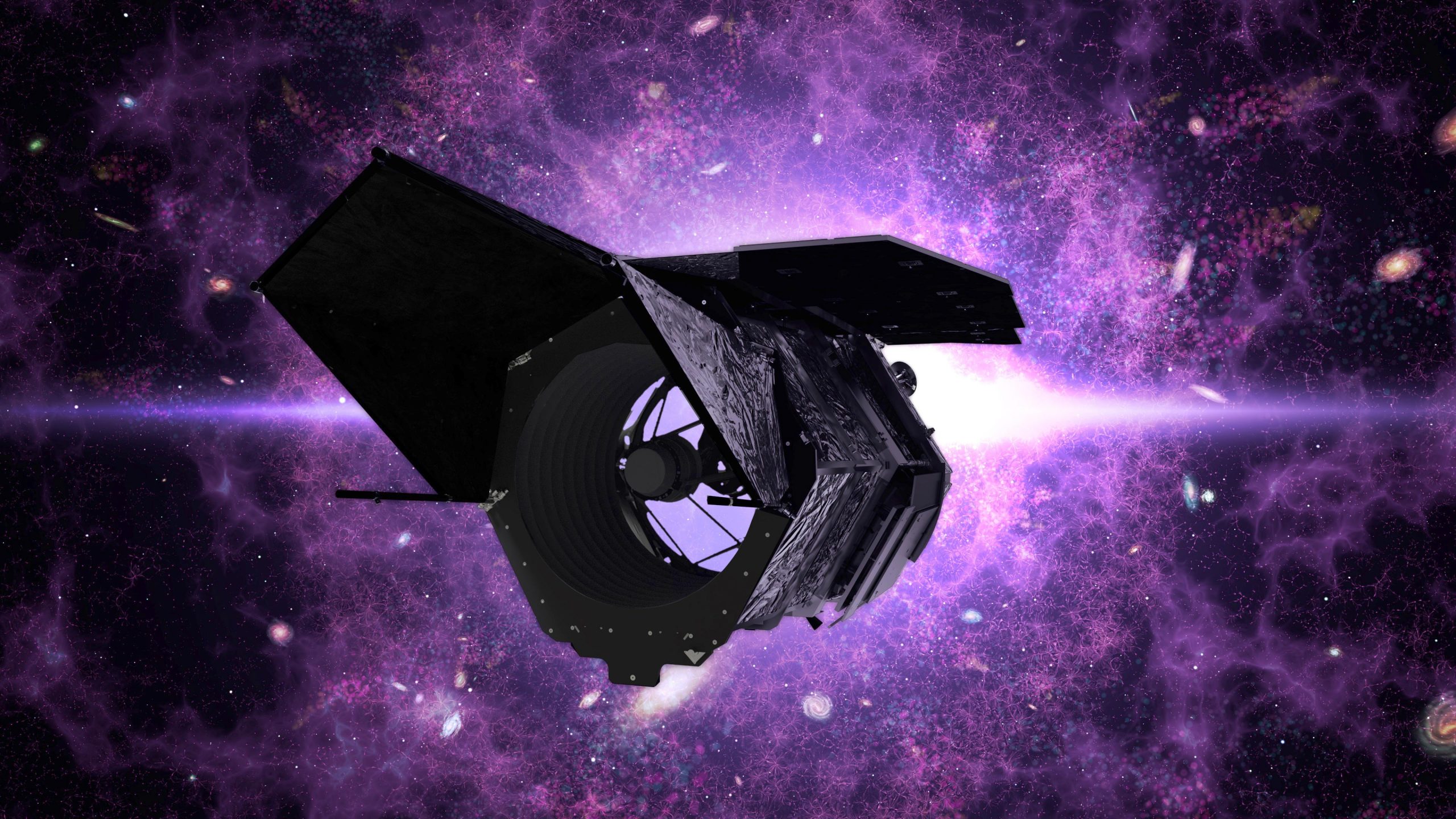
Credit: NASA, Joseph Olmsted (STScI)
The Nancy Grace Roman Space Telescope, set to launch in 2027, aims to capture high-resolution images of galaxies and cosmic phenomena across the universe.
It will offer a deeper understanding of galactic evolution and dark matter through its advanced observational capabilities. This telescope will greatly enhance our knowledge by examining galactic structures, providing clues about galaxy formation, and aiding in the study of mysterious dark matter in the universe.
Cosmic Vastness and Observation Challenges
At approximately 100,000 light years in diameter, the Milky Way’s vastness and the broader, ever-changing dynamics of the cosmos defy any attempt to fully understand our home galaxy and its history. Even today’s most powerful telescopes and astronomy tools can’t give us a clear and complete picture of the Milky Way from an outsider’s point of view.
Puragra “Raja” GuhaThakurta, a University of California, Santa Cruz astronomer, sums up this dilemma in more familiar and figurative terms: “We simply don’t have a selfie stick long enough to take those kinds of photos.”
That’s why he’s so excited to be part of a collaboration that has announced plans to use a powerful space telescope that’s currently under construction to capture high-resolution images of galaxies in the nearby universe—and the cosmic clues that surround them that could explain their formation.
‘Mother’ of the Hubble Space Telescope
When launched by NASA in 2027, the Nancy Grace Roman Space Telescope will observe from a vantage point about 930,000 miles away from Earth in the direction opposite the sun. Named after NASA’s first chief astronomer, the telescope is intended to help solve some of the most profound mysteries in astrophysics, such as how the universe evolved, its ultimate fate, and whether life exists beyond Earth.
Roman is billed as a next-generation observatory that will peer through dust and across vast stretches of space and time to survey the infrared universe, with a barrel-like shape that will help block out unwanted light from the sun, Earth, and moon—and a field of view in the infrared at least 200 times larger than the Hubble Space Telescope.
“Roman is ideal because of its combination of large field of view and high angular resolution, comparable to Hubble,” said GuhaThakurta, a professor of astronomy and astrophysics who is part of the Roman Infrared Nearby Galaxies Survey (RINGS), a set of possible observations that astronomers are designing through a grant from NASA.
The RINGS survey is a preliminary concept that may or may not be implemented during Roman’s science mission. If it is, RINGS will capture wide-field, high-resolution images of galaxies in the nearby universe, and the cosmic clues about their histories that they leave behind.

Galactic Archaeology
Galaxies leave behind hints of their evolution in their stellar structures, almost like how organisms on Earth leave behind imprints in rock. These galactic “fossils” are groups of ancient stars that hold the history of the galaxy’s formation and evolution, including the chemistry of the galaxy when those stars formed.
Such cosmic fossils are of particular interest to Robyn Sanderson, the deputy principal investigator of RINGS at the University of Pennsylvania. She describes the process of analyzing stellar structures in galaxies as “like going through an excavation and trying to sort out bones and put them back together.”
Roman’s high resolution will allow scientists to pick out these galactic fossils, using structures ranging from long tidal tails on a galaxy’s outskirts to stellar streams within the galaxy. These large-scale structures, which Roman is uniquely capable of capturing, can give clues to a galaxy’s merger history. The goal, says Sanderson, is to “reassemble these fossils in order to look back in time and understand how these galaxies came to be.”
Investigating Dark Matter With RINGS
RINGS will also enable further investigations of one of the most mysterious substances in the universe: dark matter, an invisible form of matter that makes up most of a galaxy’s mass. A particularly useful class of objects for testing dark-matter theories are ultra-faint dwarf galaxies.
“Ultra-faint dwarf galaxies are so dark matter-dominated that they have very little normal matter for star formation,” GuhaThakurta explained. “Even when they do form stars, the process will blow away more of the gas needed to create the next generation of stars, so they are deeply inefficient at producing stars.”
With so few stars being created, ultra-faint galaxies can essentially be seen as nearly pure blobs of dark matter to study. And with Roman having the large field of view and high resolution to observe these types of galaxies, the telescope will help test multiple theories—and hopefully, come closer to finding the truth about the unobservable matter that vastly outweighs visible matter: Dark matter makes up about 80% of the universe’s matter, while normal matter comprises the remaining 20%.
Galactic Halos: Revealing the Full Picture
Ultra-faint galaxies are far from the only test of dark matter, though. Often, just looking in an average-sized galaxy’s backyard is enough. Structures in the halo of a galaxy often give hints to the amount of dark matter present. However, due to the sheer size of galactic halos—they are often 15-20 times as big as the galaxy itself—current telescopes are deeply inefficient at observing them.
For instance, while the Milky Way itself is about 100,000 light years in diameter, GuhaThakurta points out that our galaxy’s halo is known to be much larger: at least 2 million light-years in diameter.
At the moment, the only fully resolved galactic halos scientists have to go on are the Milky Way and Andromeda, our neighbor galaxy. Ben Williams, the principal investigator of RINGS at the University of Washington, describes how Roman’s power will amend this problem: “We only have reliable measurements of the Milky Way and Andromeda, because those are close enough that we can get measurements of a large number of stars distributed across their stellar halos. So, with Roman, all of a sudden we’ll have 100 or more of these fully resolved galaxies.”
Expanding Galactic Knowledge With Roman and Keck II
GuhaThakurta and his students expect to supplement the Roman imaging data with very deep, wide-field spectra from the Keck II 10-meter telescope and DEIMOS spectrograph. They plan to apply a relatively new technique—dubbed “co-added SBF (surface brightness fluctuations) spectroscopy”—that GuhaThakurta helped develop a few years ago.
As he explains it, combining those approaches “promises to be a powerful way of improving our understanding of the formation and evolution of galaxies—some comparable in mass and luminosity to our own Milky Way galaxy, some smaller, and some larger.”
Never miss a breakthrough: Join the SciTechDaily newsletter.
Follow us on Google and Google News.
1 Comment
“GuhaThakurta and his students expect to supplement the Roman imaging data with very deep, wide-field spectra from the Keck II 10-meter telescope and DEIMOS spectrograph. They plan to apply a relatively new technique—dubbed “co-added SBF (surface brightness fluctuations) spectroscopy”—that GuhaThakurta helped develop a few years ago.”
They should do that expert work, but hopefully other groups will target dark matter more closely by combining optical weak lensing observations with X-ray data. That has been used by far universe surveys to break the degeneracy between dark matter gravitational effects (dominating in weak lensing) and normal matter effects (dominating in X-ray data). Maybe near universe studies can use it too.