
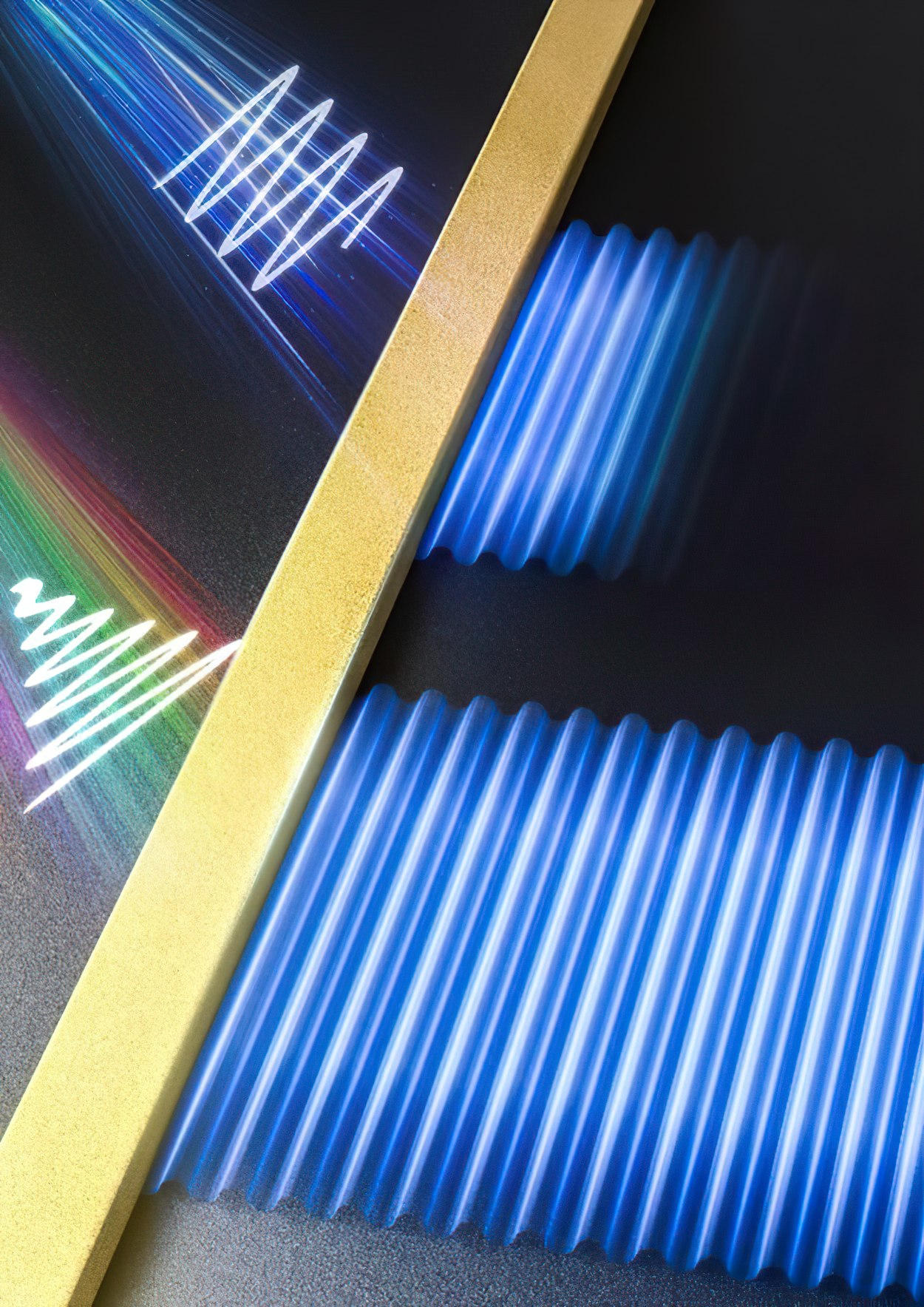
A research group, jointly led by Professor Shuang Zhang, Interim Head of the Physics Department at The University of Hong Kong (HKU), and Professor Qing Dai of the National Center for Nanoscience and Technology in China, has presented a solution to a common problem in the realm of nanophotonics – the study of light at an extremely small scale.
Their findings, recently published in the prestigious academic journal Nature Materials, propose a synthetic complex frequency wave (CFW) approach to address optical loss in polariton propagation. These findings offer practical solutions such as more efficient light-based devices for faster and more compact data storage and processing in devices such as computer chips and data storage devices, and improved accuracy in sensors, imaging techniques, and security systems.
Surface plasmon polaritons and phonon polaritons offer advantages such as efficient energy storage, local field enhancement, and high sensitivities, benefitting from their ability to confine light at small scales. However, their practical applications are hindered by the issue of ohmic loss, which causes energy dissipation when interacting with natural materials.
Over the past three decades, this limitation has impeded progress in nanophotonics for sensing, superimaging, and nanophotonic circuits. Overcoming ohmic loss would significantly enhance device performance, enabling advancement in sensing technology, high-resolution imaging, and advanced nanophotonic circuits.
Professor Shuang Zhang, corresponding author of the paper, explained the research focus, ‘To address the optical loss challenge in key applications, we have put forward a practical solution. By employing a novel synthetic complex wave excitation, we can achieve virtual gain and counteract the intrinsic loss of the polariton system. To validate this approach, we applied it to the phonon polariton propagation system and observed a significant improvement in polariton propagation.’
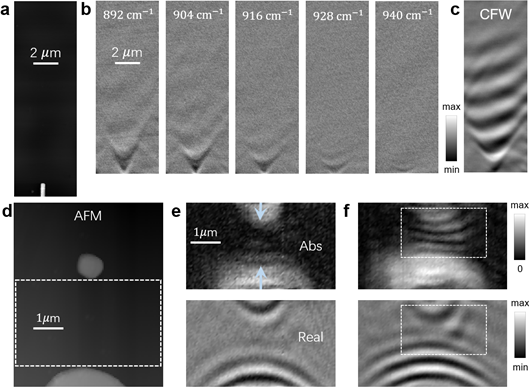
‘We demonstrated our approach by conducting experiments using phonon polariton material, such as hBN and MoO3, in the optical frequency range. As expected, we obtained nearly lossless propagation distance consistent with our theoretical predictions,’ added Dr Fuxin Guan, the paper’s first author and a Postdoctoral Fellow at the Department of Physics at HKU.
Multi-frequency approach to overcome optical loss
In this research, the team developed a novel multiple-frequency approach to address energy loss in polariton propagation. They used a special type of wave called ‘complex frequency waves’ to achieve virtual gain and compensate for the loss in an optical system. While a regular wave maintains a constant amplitude or intensity over time, a complex frequency wave exhibits both oscillation and amplification simultaneously. This characteristic allows for a more comprehensive representation of wave behavior and enables compensation for energy loss.

While frequency is commonly perceived as a real number, it can also have an imaginary part. This imaginary part tells us how the wave either gets stronger or weaker over time. Waves with a complex frequency featuring a negative (positive) imaginary part decay (amplify) over time. However, directly carrying our measurement under the excitation of complex frequency waves in optics is challenging because it requires complex time-gated measurements. To overcome this, the researchers employed the Fourier Transformation mathematical tool to break down a truncated complex frequency wave (CFW) into multiple components with individual frequencies.
Just like when you are cooking and need a specific ingredient that is hard to find, the researchers used a similar idea. They broke down the complex frequency waves into simpler components, like using substitute ingredients in a recipe. Each component represented a different aspect of the wave. It is like creating a delicious dish by using substitute ingredients to get the desired flavor. By measuring these components at different frequencies and combining the data, they reconstructed the behavior of the system illuminated by the complex frequency wave. This helped them understand and compensate for the energy loss. This approach greatly simplifies the practical implementation of CFWs in different applications, including polariton propagation and superimaging. By conducting optical measurements at different real frequencies with a fixed interval, it becomes feasible to construct the optical response of the system at a complex frequency. This is achieved by mathematically combining the optical responses obtained at different real frequencies.
Professor Qing Dai, the National Center for Nanoscience and Technology and another corresponding author of the paper, stated that this work has provided a practical solution to address the long-standing issue of optical loss in nanophotonics. He highlighted the significance of the synthesized complex-frequency method, stating that it can be easily applied to various other applications like molecular sensing and nanophotonic integrated circuits. He further emphasized that ‘this method is remarkable and universally applicable, as it can also be utilized to address loss in other wave systems, including sound waves, elastic waves, and quantum waves, thereby enhancing the quality of imaging to unprecedented levels.’
Reference: “Compensating losses in polariton propagation with synthesized complex frequency excitation” by Fuxin Guan, Xiangdong Guo, Shu Zhang, Kebo Zeng, Yue Hu, Chenchen Wu, Shaobo Zhou, Yuanjiang Xiang, Xiaoxia Yang, Qing Dai and Shuang Zhang, 8 January 2024, Nature Materials.
DOI: 10.1038/s41563-023-01787-8
This work was supported by the New Cornerstone Science Foundation, the Research Grants Council of Hong Kong.
Never miss a breakthrough: Join the SciTechDaily newsletter.
Follow us on Google and Google News.
1 Comment
The Optical Loss is closely related to the physical environment of the space where it is located. The key to overcoming Optical Loss is how to avoid the interaction between light and the medium.
If researchers are interested, you can browse https://zhuanlan.zhihu.com/p/569722770.
I hope researchers are not fooled by the pseudoscientific theories of the Physical Review Letters (PRL), and hope more people dare to stand up and fight against rampant pseudoscience.
The so-called academic journals (such as Physical Review Letters, Nature, Science, etc.) firmly believe that two objects (such as two sets of cobalt-60) of high-dimensional spacetime rotating in opposite directions can be transformed into two objects that mirror each other, is a typical case of pseudoscience rampant.
If researchers are really interested in science, you can browse https://zhuanlan.zhihu.com/p/595280873.