
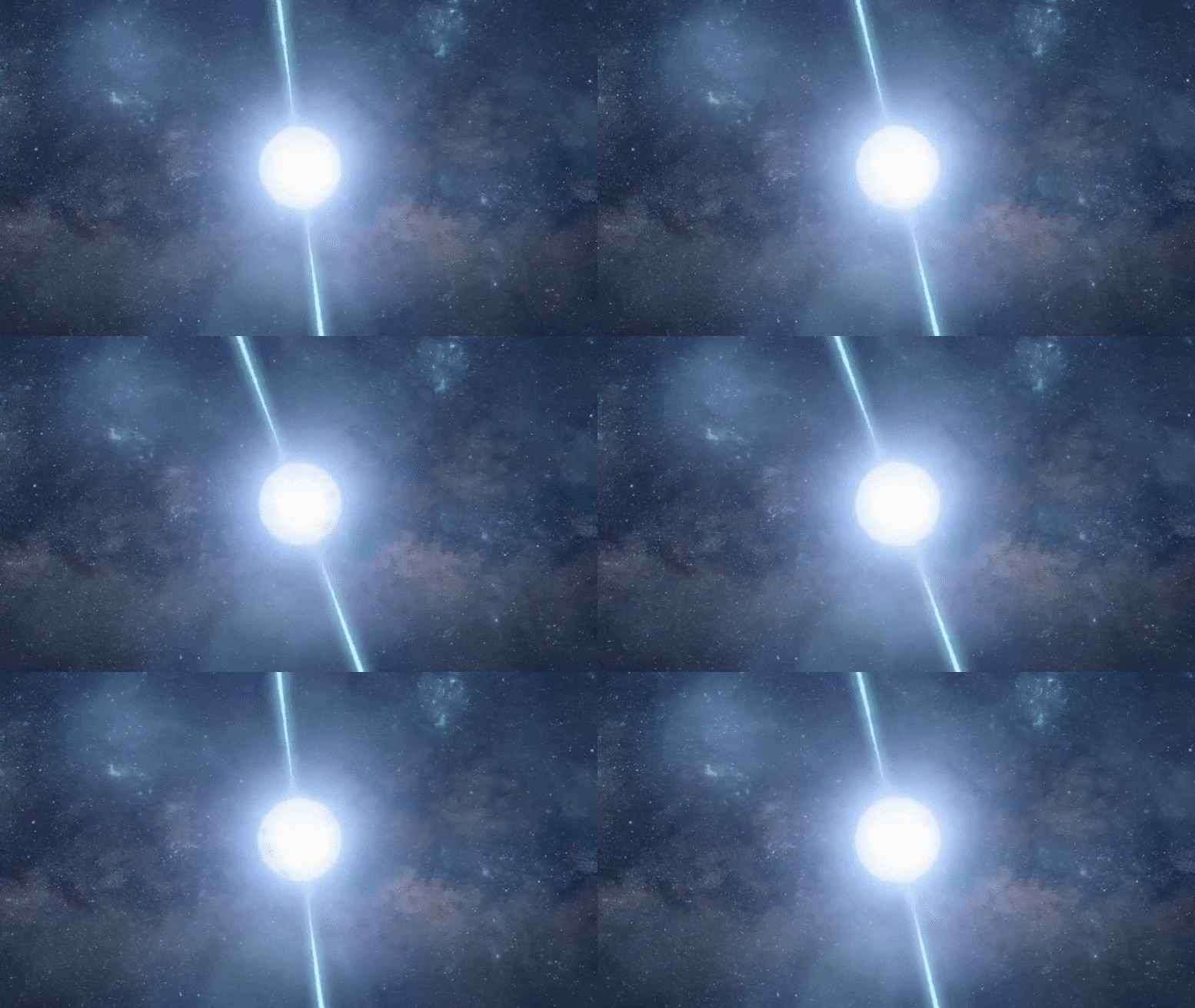
Scientists simulate a perplexing explosive process that occurs throughout the universe.
Mysterious fast radio bursts are among the most perplexing phenomena in the universe, releasing as much energy in one second as the Sun does in a year. Researchers at Princeton University, the U.S. Department of Energy’s (DOE) Princeton Plasma Physics Laboratory (PPPL), and the SLAC National Accelerator Laboratory have now simulated and proposed a cost-effective experiment to produce and observe the early stages of this process in a way that was previously thought to be impossible with today’s technology.
Celestial bodies such as neutrons, or collapsed, stars dubbed magnetars (magnet + star) enclosed in strong magnetic fields are responsible for the remarkable bursts in space. According to quantum electrodynamic (QED) theory, these fields are so intense that they transform the vacuum in space into an exotic plasma made of matter and anti-matter in the form of pairs of negatively charged electrons and positively charged positrons. Emissions from these pairs are thought to be responsible for the powerful fast radio bursts.
Pair Plasma
The matter-antimatter plasma, called “pair plasma,” stands in contrast to the usual plasma that fuels fusion reactions and makes up 99% of the visible universe. This plasma consists of matter only in the form of electrons and vastly higher-mass atomic nuclei, or ions. The electron-positron plasmas are comprised of equal mass but oppositely charged particles that are subject to annihilation and creation. Such plasmas can exhibit quite different collective behavior.
“Our laboratory simulation is a small-scale analog of a magnetar environment,” said physicist Kenan Qu of the Princeton Department of Astrophysical Sciences. “This allows us to analyze QED pair plasmas,” said Qu, the first author of a recent study showcased in Physics of Plasmas as a science highlight, and also the first author of a paper in Physical Review Letters that the present paper expands on.
“Rather than simulating a strong magnetic field, we use a strong laser,” Qu said. “It converts energy into pair plasma through what are called QED cascades. The pair plasma then shifts the laser pulse to a higher frequency,” he said. “The exciting result demonstrates the prospects for creating and observing QED pair plasma in laboratories and enabling experiments to verify theories about fast radio bursts.”
Laboratory-produced pair plasmas have previously been created, noted physicist Nat Fisch, a professor of astrophysical sciences at Princeton University and associate director for academic affairs at PPPL who serves as the principal investigator for this research. “And we think we know what laws govern their collective behavior,” Fisch said. “But until we actually produce a pair plasma in the laboratory that exhibits collective phenomena that we can probe, we cannot be absolutely sure of that.
Collective Behavior
“The problem is that collective behavior in pair plasmas is notoriously hard to observe,” he added. “Thus, a major step for us was to think of this as a joint production-observation problem, recognizing that a great method of observation relaxes the conditions on what must be produced and in turn leads us to a more practicable user facility.”
The unique simulation the paper proposes creates high-density QED pair plasma by colliding the laser with a dense electron beam traveling near the speed of light. This approach is cost-efficient when compared with the commonly proposed method of colliding ultra-strong lasers to produce the QED cascades. The approach also slows the movement of plasma particles, thereby allowing stronger collective effects.
“No lasers are strong enough to achieve this today and building them could cost billions of dollars,” Qu said. “Our approach strongly supports using an electron beam accelerator and a moderately strong laser to achieve QED pair plasma. The implication of our study is that supporting this approach could save a lot of money.”
Currently underway are preparations for testing the simulation with a new round of laser and electron experiments at SLAC. “In a sense what we are doing here is the starting point of the cascade that produces radio bursts,” said Sebastian Meuren, a SLAC researcher and former postdoctoral visiting fellow at Princeton University who coauthored the two papers with Qu and Fisch.
Evolving Experiment
“If we could observe something like a radio burst in the laboratory that would be extremely exciting,” Meuren said. “But the first part is just to observe the scattering of the electron beams and once we do that we’ll improve the laser intensity to get to higher densities to actually see the electron-positron pairs. The idea is that our experiment will evolve over the next two years or so.”
The overall goal of this research is understanding how bodies like magnetars create pair plasma and what new physics associated with fast radio bursts are brought about, Qu said. “These are the central questions we are interested in.”
This joint work was supported by National Nuclear Security Agency (NNSA) grants awarded to Princeton University through the Department of Astrophysical Sciences and by DOE grants awarded to Stanford University.
Reference: “Collective plasma effects of electron–positron pairs in beam-driven QED cascades” by Kenan Qu, Sebastian Meuren and Nathaniel J. Fisch, 21 April 2022, Physics of Plasmas.
DOI: 10.1063/5.0078969
Never miss a breakthrough: Join the SciTechDaily newsletter.
Follow us on Google and Google News.