
Close Menu
    Facebook X (Twitter) Instagram
    SciTechDaily
    • Biology
    • Chemistry
    • Earth
    • Health
    • Physics
    • Science
    • Space
    • Technology
    Facebook X (Twitter) Pinterest YouTube RSS
    SciTechDaily
    Home»Biology»VPS13 Proteins Role in Neurological Disorders, Including Parkinson’s
    Biology

    VPS13 Proteins Role in Neurological Disorders, Including Parkinson’s

    By Bill Hathaway, Yale UniversityAugust 9, 2018No Comments2 Mins Read
    Facebook Twitter Pinterest Telegram LinkedIn WhatsApp Email Reddit
    Share
    Facebook Twitter LinkedIn Pinterest Telegram Email Reddit
    Gene Mutations and Neurological Diseases
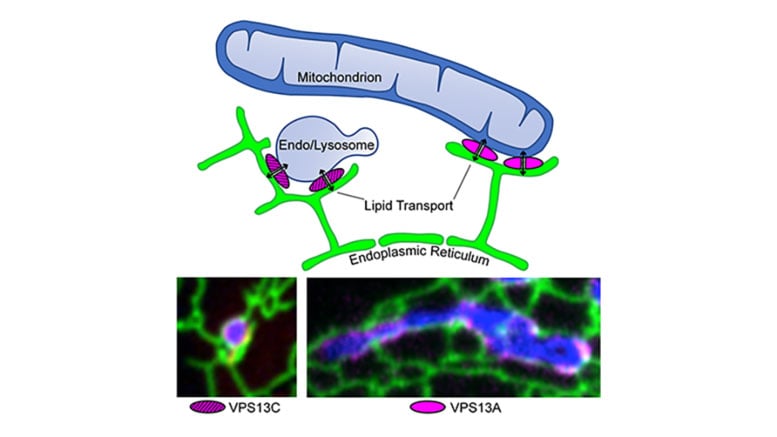
    VPS13 family members mediate lipid transfer between organelles at membrane contact sites. Bottom left: fluorescence image shows the localization of VPS13C (magenta) at contacts between the ER (green) and a lysosome (blue). Bottom right: fluorescence image showing the localization of VPS13A (magenta) at contacts between the ER (green) and a mitochondrion (blue).

    Several gene mutations have been linked to Parkinson’s disease, but exactly how and where some of them cause their damage has been unclear. A new Yale study, published in The Journal of Cell Biology, shows that one of the genes whose mutations are responsible for a familial form of Parkinson’s encodes a protein that controls the transfer of lipids between membranes of cell organelles.

    The labs of Yale’s Pietro De Camilli and Karin Reinisch investigated the role of VPS13 proteins whose dysfunction play a role in a variety of neurological disorders, including Parkinson’s. They found that VPS13 proteins can extract lipids from cellular membranes, harbor them in a waterproof cavity, and transfer them to adjacent membranes. VPS13 family members are localized at sites within the cell where organelles are in close proximity to each other — so-called contact sites — and function as tethers between them making lipid transfer more efficient.

    VPS13 family members operate at different sites within the cell and are associated with different neurological disorders. VPS13C, the protein associated with Parkinson’s disease, acts at contacts between the endoplasmic reticulum (the organelle where most lipids are synthesized) and endosomes/lysosomes (the organelles where most cell components are degraded). Another, VPS13A, is associated with a Huntington’s-like syndrome (Chorea-Acanthocytosis) and acts at contacts between the endoplasmic reticulum and mitochondria, the energy centers of the cell.

    As other Parkinson’s disease genes also encode proteins of the endo-lysosomal system, the new insight may help identify shared cellular mechanisms in Parkinson’s disease resulting from mutations in different genes and thus help design new therapies for this condition, the authors say. Nikit Kumar and Marianna Leonzino of Yale are the first authors of the study.

    Reference: “VPS13A and VPS13C are lipid transport proteins differentially localized at ER contact sites” by Marianna Leonzino, William Hancock-Cerutti, Florian A. Horenkamp, PeiQi Li, Joshua A. Lees, Heather Wheeler, Karin M. Reinisch and Pietro De Camilli, 8 August 2018, Journal of Cell Biology.
    DOI: 10.1083/jcb.201807019

    Never miss a breakthrough: Join the SciTechDaily newsletter.
    Follow us on Google and Google News.

    Disease Genetics Medicine Yale University
    Share. Facebook Twitter Pinterest LinkedIn Email Reddit

    Related Articles

    Yale Research Provides New Clues to How Cancer Cells Spread

    New Yale Study Points to a Possible Treatment for a Rare Vascular Disease

    Yale Scientists Recode Organisms to Resist Viral Contamination

    New Approach Identifies Genetic Markers Linked to Complex Diseases

    Yale Study Shows Topical Ruxolitinib Grows Hair

    Yale Researchers Identify RNA That Controls Cholesterol

    Study Reveals Non-Inherited Mutations Account for Many Heart Defects

    Study Shows that Genetics Play an Important Role in Anti-Tobacco Policies

    Stem Cells Regenerate Tissue in an Uninjured Mammal

    Leave A Reply Cancel Reply

    • Facebook
    • Twitter
    • Pinterest
    • YouTube

    Don't Miss a Discovery

    Subscribe for the Latest in Science & Tech!

    Trending News

    Scientists Discover How Coffee Impacts Memory, Mood, and Gut Health

    Why Did the Neanderthals Disappear? Scientists Reveal Humans Had a Hidden Advantage

    Physicists Propose Strange Experiment Where Time Goes Quantum

    Magnesium Magic: New Drug Melts Fat Even on a High-Fat, High-Sugar Diet

    Weight-Loss Drugs Like Ozempic May Come With an Unexpected Cost

    Mezcal “Worm” in a Bottle Mystery: DNA Testing Reveals a Surprise

    New Research Reveals That Your Morning Coffee Activates an Ancient Longevity Switch

    This Is What Makes You Irresistible to Mosquitoes

    Follow SciTechDaily
    • Facebook
    • Twitter
    • YouTube
    • Pinterest
    • Newsletter
    • RSS
    SciTech News
    • Biology News
    • Chemistry News
    • Earth News
    • Health News
    • Physics News
    • Science News
    • Space News
    • Technology News
    Recent Posts
    • Harvard Scientists Reveal Secret Structure Behind How You Smell
    • Scientists Just Discovered the Hidden Trick That Keeps Your Cells Alive
    • This Simple Movement Could Be Secretly Cleaning Your Brain
    • Male Birth Control Breakthrough: Scientists Find Way To Turn Sperm Production Off and Back On
    • A Common Vitamin Could Hold the Key to Treating Fatty Liver Disease
    Copyright © 1998 - 2026 SciTechDaily. All Rights Reserved.
    • Science News
    • About
    • Contact
    • Editorial Board
    • Privacy Policy
    • Terms of Use

    Type above and press Enter to search. Press Esc to cancel.