
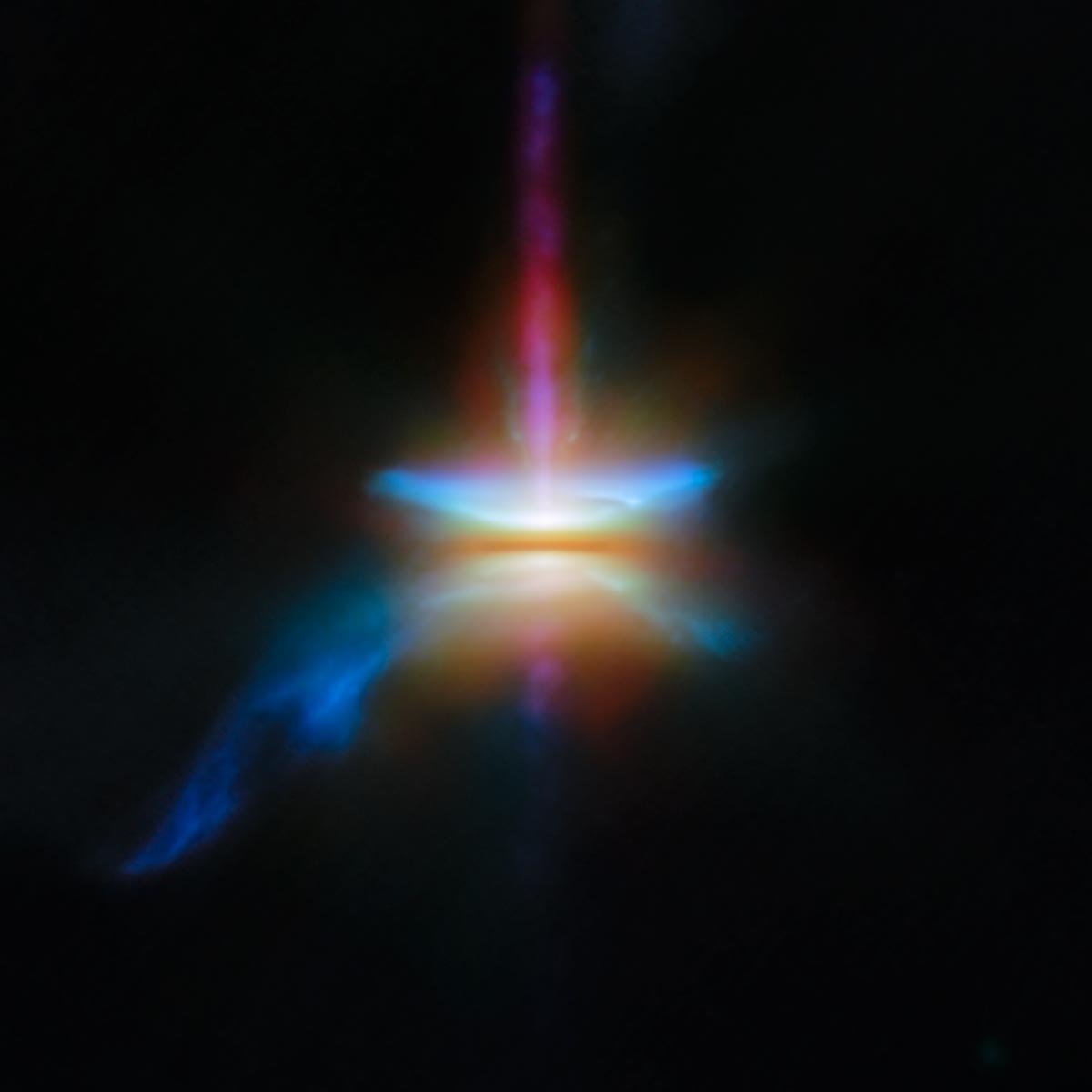
HH 30, a fascinating Herbig-Haro object, serves as a cosmic laboratory for studying star formation and planetary evolution. This celestial wonder features a striking edge-on protoplanetary disc, concealing a young star that fuels a narrow, high-velocity jet of gas.
Observations from Webb, Hubble, and ALMA have unveiled how dust behaves in this dynamic environment, revealing a crucial step in planet formation: the migration and settling of dust grains into a dense layer. These findings highlight HH 30 as an active and ever-changing system, where immense forces sculpt the building blocks of future worlds.
Illuminating Young Stars with Herbig-Haro Objects
Herbig-Haro objects are small nebulae found in regions where stars are forming. They mark areas where gas from young stars is ejected and heated by shockwaves, causing it to glow. HH 30 is a striking example, where the outflowing gas forms a narrow jet. The young star powering this jet is hidden behind a protoplanetary disc, which appears edge-on and is illuminated by the star itself.
HH 30 is particularly important to astronomers. Its disc is considered the prototype of an edge-on disc, largely due to its early discovery by the Hubble Space Telescope. Viewing discs from this angle provides a unique opportunity to study how dust grains move and settle over time.

Investigating HH 30 with Cutting-Edge Telescopes
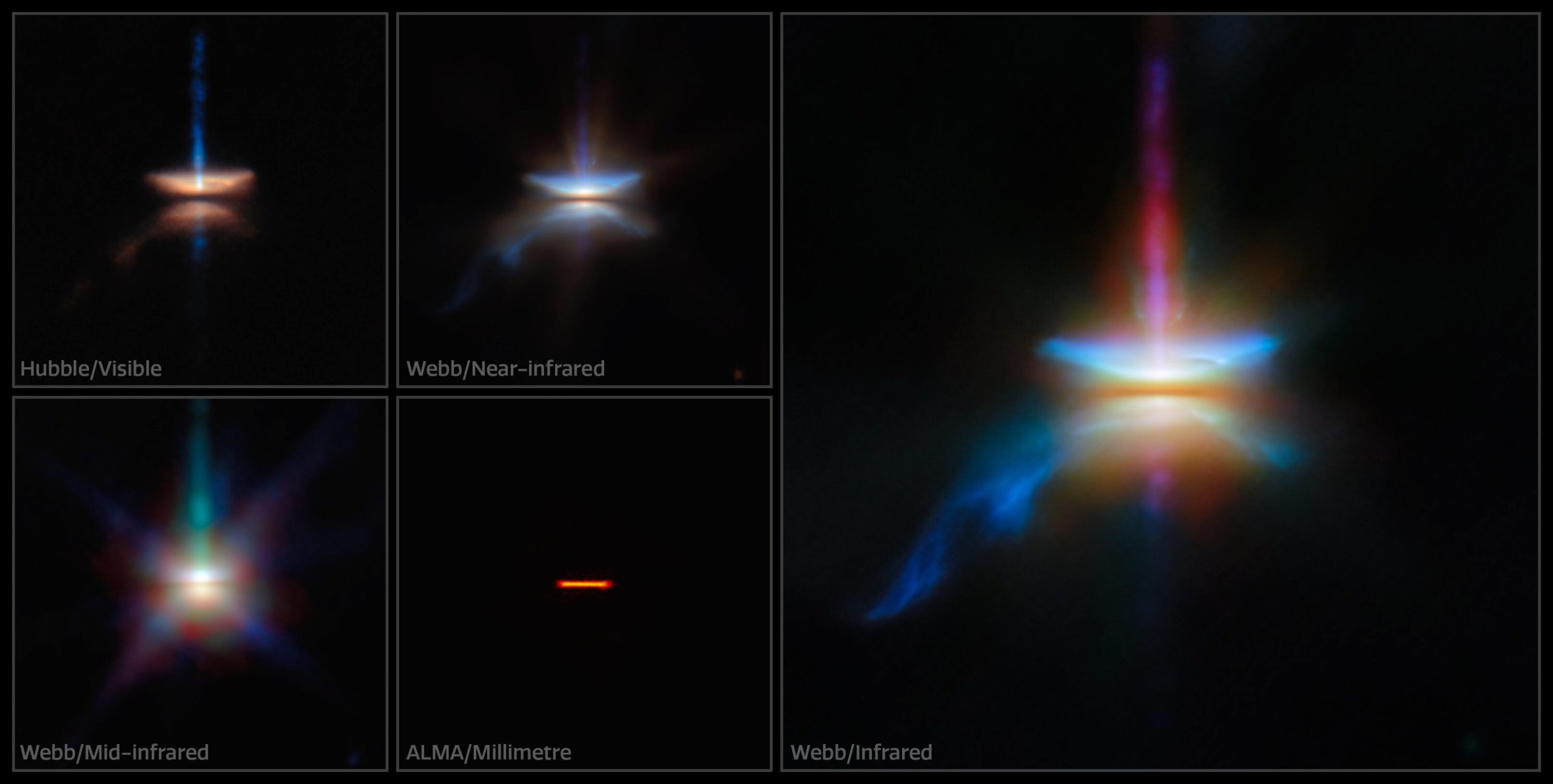
To explore HH 30 in greater detail, an international team of astronomers used the Webb Space Telescope. By combining Webb’s observations with data from Hubble and the Atacama Large Millimeter/submillimeter Array (ALMA), they were able to analyze the system across multiple wavelengths, revealing new insights into its structure and composition.
The long-wavelength data from ALMA trace the location of millimeter-sized dust grains, which are found in a narrow region in the central plane of the disc. The shorter-wavelength infrared data from Webb reveals the distribution of smaller dust grains. These grains are only one-millionth of a meter across – about the size of a single bacterium. While the large dust grains are concentrated in the densest parts of the disc, the small grains are much more widespread.
Tracking Dust Migration and Planet Formation
These Webb observations were taken as part of the Webb GO program #2562 (PI F. Ménard, K. Stapelfeldt), which aims to understand how dust evolves in edge-on discs like HH 30. Combined with the keen radio-wavelength eyes of ALMA, these observations show that large dust grains must migrate within the disc and settle in a thin layer. The creation of a narrow, dense layer of dust is an important stage in the process of planet formation. In this dense region, dust grains clump together to form pebbles and eventually planets themselves.
Revealing the Dynamic Structures of HH 30
In addition to the behavior of dust grains, the Webb, Hubble, and ALMA images reveal several distinct structures that are nested within one another. A high-velocity jet of gas emerges at a 90-degree angle from the narrow central disc. The narrow jet is surrounded by a wider, cone-shaped outflow. Enclosing the conical outflow is a wide nebula that reflects the light from the young star that is embedded within the disc. Together, these data reveal HH 30 to be a dynamic place, where tiny dust grains and massive jets alike play a role in the formation of new planets.
Reference: “JWST Imaging of Edge-on Protoplanetary Disks. IV. Mid-infrared Dust Scattering in the HH 30 Disk” by Ryo Tazaki, François Ménard, Gaspard Duchêne, Marion Villenave, Álvaro Ribas, Karl R. Stapelfeldt, Marshall D. Perrin, Christophe Pinte, Schuyler G. Wolff, Deborah L. Padgett, Jie Ma, Laurine Martinien and Maxime Roumesy, 3 February 2025, The Astrophysical Journal.
DOI: 10.3847/1538-4357/ad9c6f
About the Webb Space Telescope
The James Webb Space Telescope (Webb) is the largest and most powerful telescope ever launched into space, designed to revolutionize our understanding of the universe. As part of an international collaboration between NASA, ESA (European Space Agency), and CSA (Canadian Space Agency), Webb was launched aboard an Ariane 5 rocket, with ESA overseeing its launch service and vehicle adaptations.
Webb is equipped with cutting-edge instruments, including the Near-Infrared Spectrograph (NIRSpec), provided by ESA, and the Mid-Infrared Instrument (MIRI), which was jointly developed by the MIRI European Consortium, NASA’s Jet Propulsion Laboratory (JPL), and the University of Arizona. With its ability to observe infrared light in unprecedented detail, Webb is unlocking new insights into the formation of stars, planets, and galaxies, pushing the boundaries of astronomical discovery.
Never miss a breakthrough: Join the SciTechDaily newsletter.
Follow us on Google and Google News.
1 Comment
An international team of astronomers used the Webb Space Telescope track Dust Migration and Planet Formation.
VERY GOOD!
Please ask the researchers to think:
What are the spacetime background of the Dust Migration and Planet Formation?
As the background of various material interactions and movements, space exhibits inviscid, bsolutely Incompressible, and isotropic physical characteristics. It can form various forms of spacetime vortices through topological phase transitions. Therefore, vortex phenomena are ubiquitous in cosmic space, from vortices of quantum particles and living cells to tornados and black holes.
If the researchers are truly interested in space, please read: The Application of Inviscid and Absolutely Incompressible Spaces in Engineering Simulation (https://scitechdaily.com/microscope-spacecrafts-most-precise-test-of-key-component-of-the-theory-of-general-relativity/#comment-870077).