
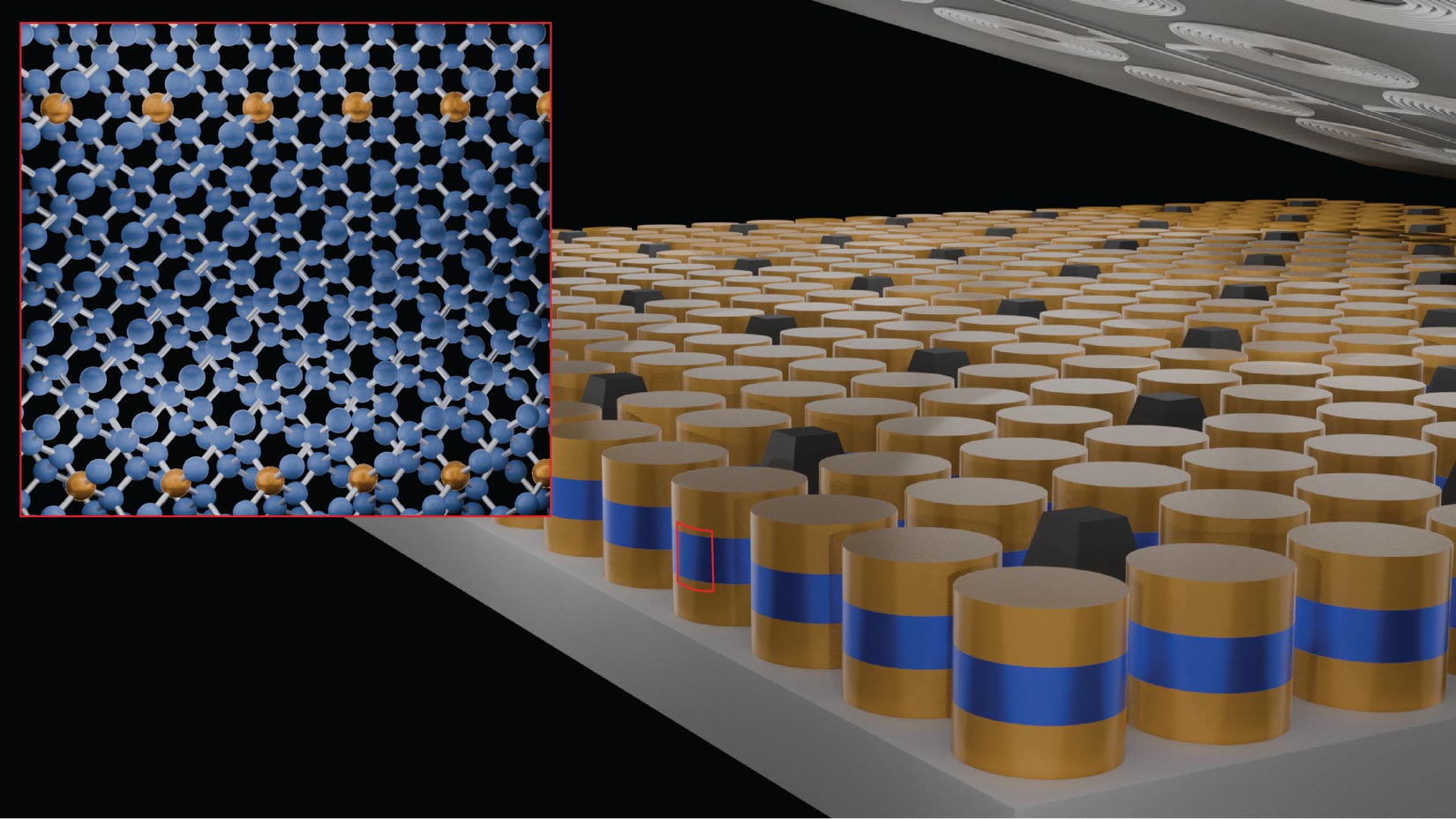
Researchers have turned germanium, a common semiconductor, into a superconductor through precise atomic engineering. The advance could revolutionize future electronics and quantum circuits by eliminating energy loss.
For years, researchers have sought to design semiconductor materials that can also act as superconductors, thereby dramatically improving the performance and efficiency of technologies such as computer chips and solar cells. Combining the two properties could open the door to faster, energy-saving devices and help power next-generation quantum systems.
Turning this vision into reality has proven difficult. Materials such as silicon and germanium, the foundation of today’s electronics, have resisted efforts to achieve superconductivity because maintaining the precise atomic structure required for seamless electron movement is exceptionally challenging.
A team of international scientists has now taken a major step forward. In a recent Nature Nanotechnology study, they report creating a version of germanium that behaves as a superconductor. The material can carry electric current without any resistance, allowing electricity to circulate endlessly with no energy loss. This breakthrough could pave the way for faster, more efficient electronics that consume far less power.
Revolutionary Potential for Quantum and Consumer Tech
“Establishing superconductivity in germanium, which is already widely used in computer chips and fiber optics, can potentially revolutionize scores of consumer products and industrial technologies,” says New York University physicist Javad Shabani, director of NYU’s Center of Quantum Information Physics and the university’s newly established Quantum Institute, one of the paper’s authors.
“These materials could underpin future quantum circuits, sensors, and low-power cryogenic electronics, all of which need clean interfaces between superconducting and semiconducting regions,” adds Peter Jacobson, a physicist at the University of Queensland and one of the paper’s authors. “Germanium is already a workhorse material for advanced semiconductor technologies, so by showing it can also become superconducting under controlled growth conditions there’s now potential for scalable, foundry-ready quantum devices.”
Why Germanium and Silicon Are So Important
Germanium and silicon are both group IV elements with diamond-like crystal structures, placing their electronic properties between those of metals and insulators. This balance makes them ideal for manufacturing durable, versatile devices. To make such materials superconducting, scientists must modify their atomic arrangement to boost the number of conducting electrons. These electrons then pair up and move freely through the crystal without resistance, a process that has been notoriously difficult to achieve and stabilize at the atomic level.
The Gallium Doping Challenge
In the Nature Nanotechnology work, the scientists created germanium films that were heavily infused with a softer element, gallium, which is also commonly used in electronics. This long-established process, known generically as ‘doping,’ alters a semiconductor’s electrical properties—but at high levels of gallium, typically the material becomes unstable, leading to a breakdown of the crystal and no superconductivity.
However, in the newly reported results, the scientists demonstrate an advanced new X-ray technique that forces gallium atoms to replace germanium atoms within the crystal at higher-than-normal levels. This process slightly deforms the shape of the crystal, but nonetheless keeps a stable structure that can conduct electricity with zero resistance at 3.5 Kelvin—or approximately -453 degrees Fahrenheit—thereby becoming superconducting.
Precision Engineering Through Molecular Beam Epitaxy
“Rather than ion implantation, molecular beam epitaxy was used to precisely incorporate gallium atoms into the germanium’s crystal lattice,” notes Julian Steele, a physicist at the University of Queensland and one of the paper’s authors. “Using epitaxy—growing thin crystal layers—means we can finally achieve the structural precision needed to understand and control how superconductivity emerges in these materials.”
“This works because group IV elements don’t naturally superconduct under normal conditions, but modifying their crystal structure enables the formation of electron pairings that allow superconductivity,” observes Shabani.
Reference: “Superconductivity in substitutional Ga-hyperdoped Ge epitaxial thin films” by Julian A. Steele, Patrick J. Strohbeen, Carla Verdi, Ardeshir Baktash, Alisa Danilenko, Yi-Hsun Chen, Jechiel van Dijk, Frederik H. Knudsen, Axel Leblanc, David Perconte, Lianzhou Wang, Eugene Demler, Salva Salmani-Rezaie, Peter Jacobson and Javad Shabani, 30 October 2025, Nature Nanotechnology.
DOI: 10.1038/s41565-025-02042-8
The research, which also included researchers from ETH Zurich and the Ohio State University, was supported, in part, by the US Air Force’s Office of Scientific Research (FA9550-21-1-0338).
Never miss a breakthrough: Join the SciTechDaily newsletter.
Follow us on Google and Google News.
1 Comment
thank you