
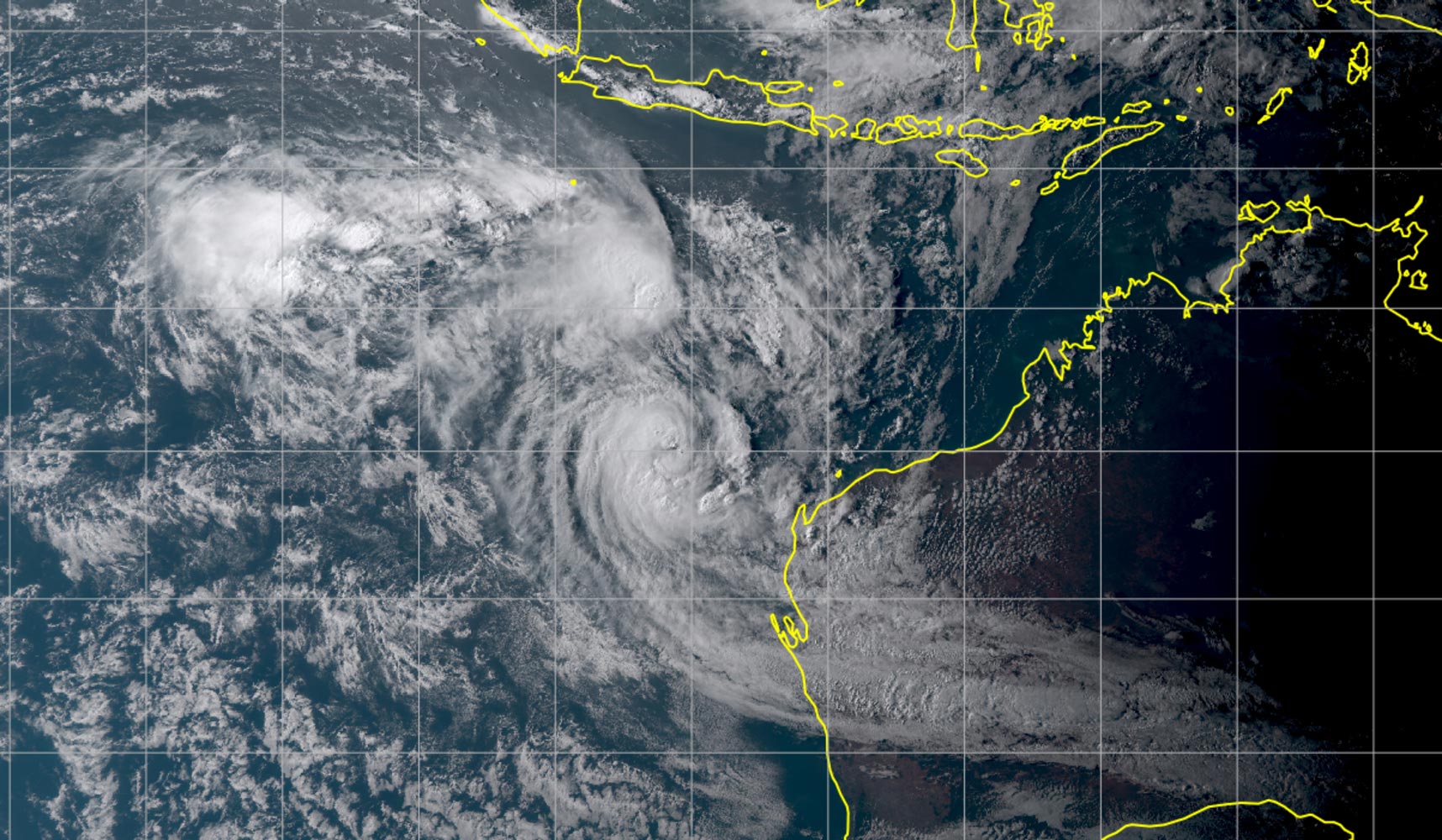
Provided by the Japanese Space Agency (JAXA), JAXA P-Tree System
A case study examines a unique phenomenon in the Indian Ocean.
Tropical cyclones (TCs) not only stir the atmosphere by whipping up air masses, but also churn the ocean waters along their paths. When two cyclones collide and merge, the interactions between the atmosphere and the ocean can become significantly more intense, according to a study by Prof. Dr. Oliver Wurl and Dr. Jens Meyerjürgens of the University of Oldenburg, published in Tellus A: Dynamic Meteorology and Oceanography.
The researchers investigated the 2021 encounter between two relatively weak tropical cyclones in the Indian Ocean, TC Seroja and TC Odette. Their analysis revealed effects typically associated with much stronger cyclones. The study highlights that as global warming continues to increase the frequency and intensity of tropical cyclones, such interactions—marked by extreme exchanges between air and sea—could occur more often in the future.
The two tropical cyclones Seroja and Odette came together north-west of Australia in April 2021. To investigate the effects of this unusual rendezvous on the ocean, Wurl and Meyerjürgens combined satellite data and measurements obtained from ARGO floats and autonomous drifters with numerical modeling. These sources provided the researchers with information about factors such as salinity and water temperatures between the sea surface and depths of up to 2,000 meters as well as data about upward and downward (vertical) flow velocities. In addition to these data, they analyzed upward and downward (vertical) flow velocities using data from numerical models.
Previously unobserved interactions with the ocean underneath
The encounter between the two cyclones lasted for around a week. On 6 April they came within approximately 1,600 kilometres of one another. “Seroja, first of all, stalled the smaller cyclone Odette and then merged with it three days later,” reports Wurl, who heads the research group Processes and Sensing of Marine Interfaces at the University of Oldenburg’s Institute for Chemistry and Biology of the Marine Environment in Wilhelmshaven. After the two cyclones merged, TC Seroja abruptly changed course by 90 degrees on 9 April. “This chain of events not only influenced weather patterns but also triggered a previously unobserved interaction with the ocean underneath,” Wurl explains.
The analysis showed that sea-surface temperatures dropped by three degrees Celsius as an after-effect of the merging of the cyclones and that deep, cold water masses were churned upwards towards the surface from a depth of 200 meters in a process known as “upwelling”. The cooling effect was “exceptionally high” in relation to the cyclones’ intensity, the researchers observed. The highest wind speeds of around 130 kilometers per hour were reached on 11 April, after the merging of the cyclones, and corresponded to Category 1 on the Hurricane Scale. The observed cooling and the depth of the upwelling, on the other hand, were of a scale observed in Category 4 or 5 hurricanes.
Wurl and Meyerjürgens were particularly surprised by the strength of the upwelling: there were periods when the deep-water masses rose to the sea surface at a speed of up to 30 meters per day. By comparison, the typical upward velocity of the ocean is only between one and five meters per day. In this specific case, a downward velocity of the ocean was observed shortly before the cyclones merged. “Thanks to satellite technology and autonomous deep-sea ARGO floats, we were able to demonstrate how the rotation of the cyclones transports cold water from the depths of the ocean to the surface,” says marine scientist Meyerjürgens.
Influences on climate worldwide
Although encounters between tropical cyclones during their one to two-week lifespan have been rare to date, according to climate models the number and intensity of tropical cyclones is likely to increase as a result of global warming – and by extension also the likelihood of full-blown hurricane-force cyclones colliding. This could result in “the most extreme interactions between the ocean and the atmosphere”, the authors of the paper write. The fact that the merging of two cyclones can lead to an abrupt change of course also makes it more difficult to predict how they will behave afterward.
Wurl also points to another important consequence: “As a result of the interactions of a cyclone with the ocean and the upwelling of cold, deep water, the ocean absorbs additional heat from the air and then transports it to higher latitudes – a crucial process that influences the climate worldwide,”. In addition, cyclones also convert thermal energy into mechanical energy which they then transport to higher latitudes as they progress. The two scientists will be taking part in an expedition with the research vessel METEOR in the Mediterranean and subtropical Atlantic next year, during which they plan to further investigate these interactions and the connection with extreme weather events.
Reference: “Intense Cooling of the Upper Ocean with the Merging of Tropical Cyclones: A Case Study in the Southeastern Indian Ocean” by Oliver Wurl and Jens Meyerjürgens, 6 December 2024, Tellus A: Dynamic Meteorology and Oceanography.
DOI: 10.16993/tellusa.4083
Never miss a breakthrough: Join the SciTechDaily newsletter.
Follow us on Google and Google News.