
Close Menu
    Facebook X (Twitter) Instagram
    SciTechDaily
    • Biology
    • Chemistry
    • Earth
    • Health
    • Physics
    • Science
    • Space
    • Technology
    Facebook X (Twitter) Pinterest YouTube RSS
    SciTechDaily
    Home»Health»When Did the First COVID-19 Case Arise? New Analysis With Surprising Findings
    Health

    When Did the First COVID-19 Case Arise? New Analysis With Surprising Findings

    By PLOSJune 28, 20211 Comment3 Mins Read
    Facebook Twitter Pinterest Telegram LinkedIn WhatsApp Email Reddit
    Share
    Facebook Twitter LinkedIn Pinterest Telegram Email Reddit
    Global Spread COVID-19
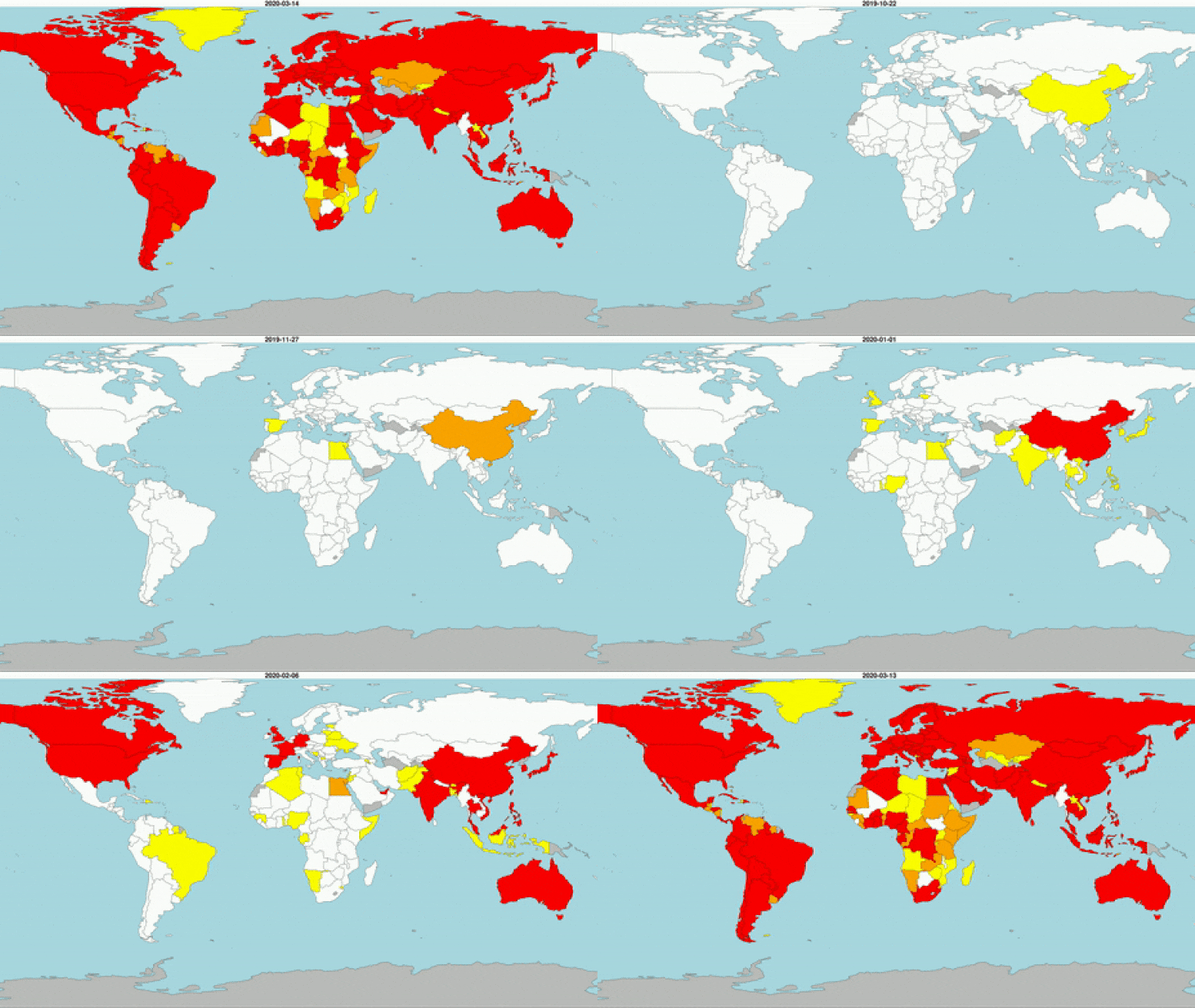
    Image presents global COVID-19 spread across countries over time. Countries marked in yellow–upper bound of a 95% confidence interval of the estimated origin date includes particular date (i.e., probability of the country already experiencing first case is above 5%); countries marked in orange–estimated origin date already occurred by that date (i.e. origin dating indicates that the COVID-19 is already spreading in the country); countries marked in red–first reported case already occurred by that date; countries marked in grey–insufficient data for origin dating. Map layers were created using the R package rworldmap, Version 1.3-6 (http://cran.r-project.org/web/packages/rworldmap). Credit: Roberts DL et al., 2021, PLOS Pathogens, CC-BY 4.0

    Novel analysis suggests much earlier, more rapid spread of COVID-19 than confirmed cases imply.

    Using methods from conservation science, a new analysis suggests that the first case of COVID-19 arose between early October and mid-November, 2019 in China, with the most likely date of origin being November 17. David Roberts of the University of Kent, U.K., and colleagues present these findings in the open-access journal PLOS Pathogens.

    The origins of the ongoing COVID-19 pandemic remain unclear. The first officially identified case occurred in early December 2019. However, mounting evidence suggests that the original case may have emerged even earlier.

    To help clarify the timing of the onset of the pandemic, Roberts and colleagues repurposed a mathematical model originally developed by conservation scientists to determine the date of extinction of a species, based on recorded sightings of the species. For this analysis, they reversed the method to determine the date when COVID-19 most likely originated, according to when some of the earliest known cases occurred in 203 countries.

    Likely Origin Date: November 17, 2019

    The analysis suggests that the first case occurred in China between early October and mid-November of 2019. The first case most likely arose on November 17, and the disease spread globally by January 2020. These findings support growing evidence that the pandemic arose sooner and grew more rapidly than officially accepted.

    The analysis also identified when COVID-19 is likely to have spread to the first five countries outside of China, as well as other continents. For instance, it estimates that the first case outside of China occurred in Japan on January 3, 2020, the first case in Europe occurred in Spain on January 12, 2020, and the first case in North America occurred in the United States on January 16, 2020.

    The researchers note that their novel method could be applied to better understand the spread of other infectious diseases in the future. Meanwhile, better knowledge of the origins of COVID-19 could improve understanding of its continued spread.

    Roberts adds, “The method we used was originally developed by me and a colleague to date extinctions, however, here we use it to date the origination and spread of COVID-19. This novel application within the field of epidemiology offers a new opportunity to understand the emergence and spread of diseases as it only requires a small amount of data.”

    Reference: “Dating first cases of COVID-19” by David L. Roberts, Jeremy S. Rossman and Ivan Jarić, 24 June 2021, PLOS Pathogens.
    DOI: 10.1371/journal.ppat.1009620

    Funding: I.J. was funded by J. E. Purkyně Fellowship of the Czech Academy of Sciences. DLR and JSR received no specific funding for this work. The funders had no role in study design, data collection and analysis, decision to publish, or preparation of the manuscript.

    Never miss a breakthrough: Join the SciTechDaily newsletter.
    Follow us on Google and Google News.

    Algorithm COVID-19 Infectious Diseases Mathematics PLOS Popular
    Share. Facebook Twitter Pinterest LinkedIn Email Reddit

    Related Articles

    CDC Failure: Internal Investigation Finds Design Errors and Contamination in First Batch of COVID-19 Tests

    Several FDA-Approved Drugs Could Be Repurposed To Treat People Infected With COVID-19

    Scientists Model “True Prevalence” of COVID-19 in the United States Throughout Pandemic

    New Research Finds Most People Are Naturally Armed Against the COVID-19 Coronavirus

    Free Online App Calculates Risk of COVID-19 Transmission in Indoor Spaces

    Testing Shows COVID-19 Lingered Longer Than Reported in Wuhan, China

    Cutting COVID-19 Infectious Period – Even by Just 1 Day – Could Prevent Millions of Cases

    New Strategy Identifies Existing Drug That Inhibits COVID-19 Virus – Outperforms Remdesivir

    New Research Shows COVID-19 Herd Immunity Could Be Achieved With Fewer People Being Infected

    1 Comment

    1. Michael Fouhy on June 28, 2021 4:11 pm

      The graphic explains New Zealand’s lack of covid

      Reply
    Leave A Reply Cancel Reply

    • Facebook
    • Twitter
    • Pinterest
    • YouTube

    Don't Miss a Discovery

    Subscribe for the Latest in Science & Tech!

    Trending News

    Your Blood Pressure Reading Could Be Wrong Because of One Simple Mistake

    Astronomers Stunned by Ancient Galaxy With No Spin

    Physicists May Be on the Verge of Discovering “New Physics” at CERN

    Scientists Solve 320-Million-Year Mystery of Reptile Skin Armor

    Scientists Say This Daily Walking Habit May Be the Secret to Keeping Weight Off After Dieting

    New Therapy Rewires the Brain To Restore Joy in Depression Patients

    Giant Squid Detected off Western Australia in Stunning Deep-Sea Discovery

    Popular Sugar-Free Sweetener Linked to Liver Disease, Study Warns

    Follow SciTechDaily
    • Facebook
    • Twitter
    • YouTube
    • Pinterest
    • Newsletter
    • RSS
    SciTech News
    • Biology News
    • Chemistry News
    • Earth News
    • Health News
    • Physics News
    • Science News
    • Space News
    • Technology News
    Recent Posts
    • The Hidden Types of Dementia Most People Have Never Heard Of
    • Scientists Discover Why Alcohol Prevents the Liver From Healing, Even After You Quit
    • Scientists Solve a 60-Year-Old Fat Cell Mystery — and It Changes What We Know About Obesity
    • A Crucial Atlantic Current Is Weakening and Weather Could Change Worldwide
    • Scientists Stunned As Volcano Removes Methane From the Air
    Copyright © 1998 - 2026 SciTechDaily. All Rights Reserved.
    • Science News
    • About
    • Contact
    • Editorial Board
    • Privacy Policy
    • Terms of Use

    Type above and press Enter to search. Press Esc to cancel.