
Scripps scientists show that ribose may have been nature’s preferred sugar for building RNA, offering new insight into how life’s molecular foundations may have formed before biology began.
Today, cells rely on enzymes to assemble complex molecules like RNA and DNA. But billions of years ago, before life and enzymes existed, how did these vital molecules come together? And why were certain molecules chosen as life’s foundations while others were not? Scientists at Scripps Research have uncovered new clues that begin to answer these fundamental questions.
In a study recently published in the journal Angewandte Chemie, the researchers explored how ribose might have emerged as the key sugar in the early development of RNA. Their experiments showed that ribose attaches to phosphate (another crucial component of RNA) faster and more efficiently than similar sugars. This natural advantage may have influenced why ribose became a central building block in the chemistry that led to life.
“This gives credence to the idea that this type of prebiotic chemistry could have produced the building blocks of RNA, which then could have led to entities which exhibit lifelike properties,” says corresponding author Ramanarayanan Krishnamurthy, professor of chemistry at Scripps Research.
What Are Nucleotides, and Why Focus on Ribose?
Nucleotides, the building blocks of RNA and DNA, consist of a five-carbon sugar molecule (ribose or deoxyribose) that is bound to a phosphate group and a nitrogen-based base (the part of the molecule that encodes information, e.g., A, C, G or U). Krishnamurthy’s research aims to understand how these complex molecules could have arisen on primordial Earth. Specifically, this study focused on phosphorylation, the step within nucleotide-building where ribose connects to the phosphate group.
“Phosphorylation is one of the basic chemistries of life; it’s essential for structure, function, and metabolism,” says Krishnamurthy. “We wanted to know, could phosphorylation also play a fundamental role in the primordial process that got all of these things started?”
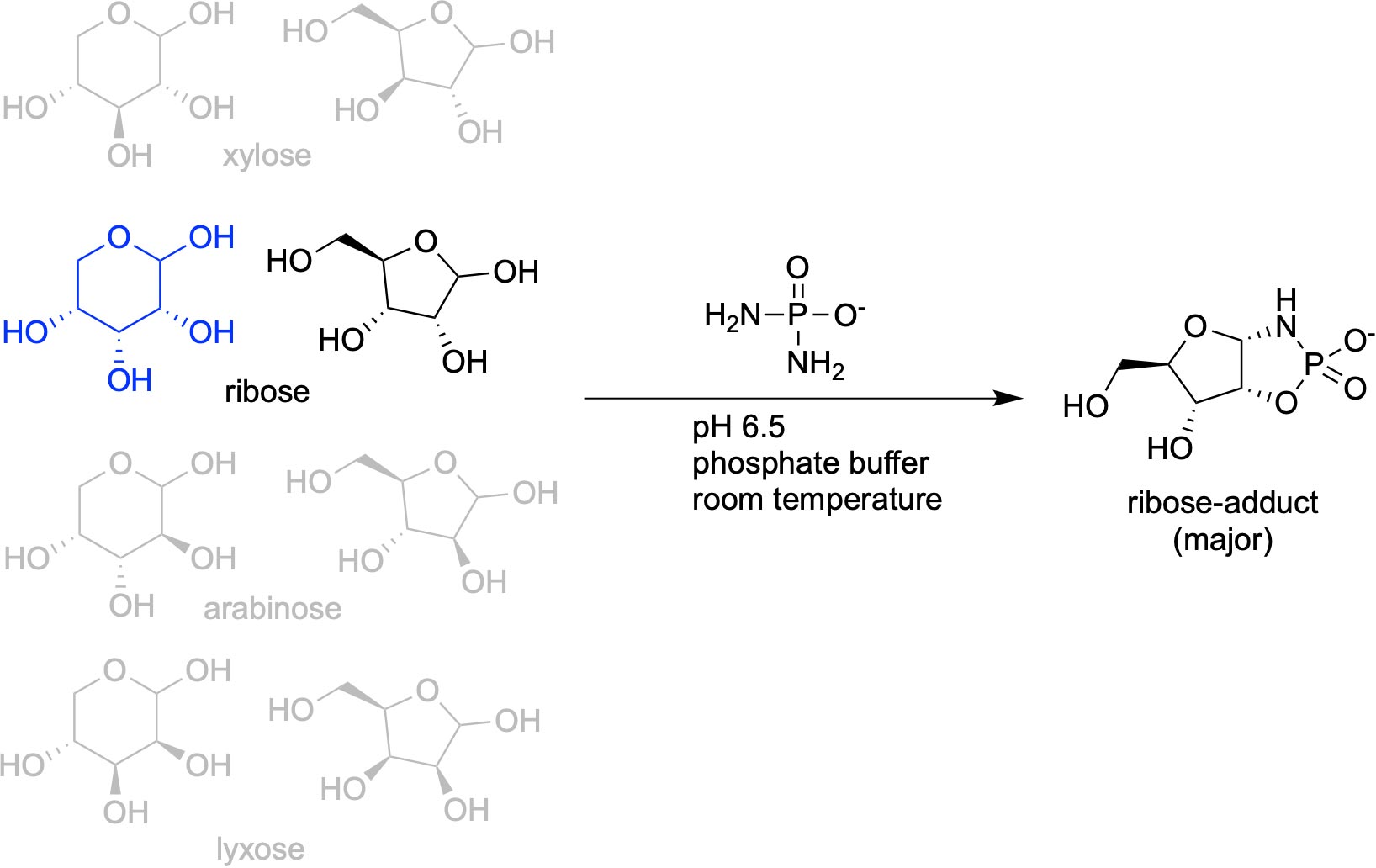
From previous work, the team knew that ribose could become phosphorylated when combined with a phosphate-donating molecule called diamidophosphate (DAP). In this study, they wanted to know whether other, similar sugars could also undergo this reaction, or whether there is something special about ribose.
Testing Ribose Against Its Peers
To test this, the researchers used controlled chemical reactions to investigate how quickly and effectively ribose is phosphorylated by DAP compared to three other sugar molecules with the same chemical makeup but a different shape (arabinose, lyxose, and xylose). Then, they used an analytical technique called nuclear magnetic resonance (NMR) spectroscopy to characterize the molecules produced by each reaction.
They showed that although DAP was able to phosphorylate all four sugars, it phosphorylated ribose at a much faster rate. Additionally, the reaction with ribose resulted exclusively in ring-shaped structures with five corners (e.g., 5-member rings), whereas the other sugars formed a combination of 5- and 6-member rings.
“This really showed us that there is a difference between ribose and the three other sugars,” says Krishnamurthy. “Ribose not only reacts faster than the other sugars, it’s also more selective for the five-member ring form, which happens to be the form that we see in RNA and DNA today.”
When they added DAP to a solution containing equal amounts of the four different sugars, it preferentially phosphorylated ribose. And whereas the other three sugars got “stuck” at an intermediate point in the reaction, a large proportion of the ribose molecules were converted into a form that could likely react with a nuclear base to form a nucleotide.
“What we got was a 2-in-1: We showed that ribose is selectively phosphorylated from a mixture of sugars, and we also showed that this selective process produces a molecule with a form that is conducive for making RNA,” says Krishnamurthy. “That was a bonus. We did not anticipate that the reaction would pause at the stage advantageous for producing nucleotides.”
Caution and Next Steps
The researchers caution that, even if these reactions can all occur abiotically, it doesn’t mean that they are the reactions that necessarily resulted in life.
“Studying these types of chemistries helps us understand what sort of processes might have led to the molecules that constitute life today, but we are not making the claim that this selection is what led to RNA and DNA, because that’s quite a leap,” says Krishnamurthy. “There are a lot of other things that need to happen before you get to RNA, but this is a good start.”
In future research, the team plans to test whether this chemical reaction can occur inside primitive cellular structures called “protocells.”
“The next question is, can ribose be selectively enriched within a protocell, and can it further react to make nucleotides within a protocell?” says Krishnamurthy. “If we can make that happen, it might produce enough tension to force the protocell to grow and divide — which is exactly what underpins how we grow.”
Reference: “Selection of Ribofuranose-Isomer Among Pentoses by Phosphorylation with Diamidophosphate” by Harold A. Cruz and Ramanarayanan Krishnamurthy, 27 June 2025, Angewandte Chemie International Edition.
DOI: 10.1002/anie.202509810
The work was supported by the NASA Astrobiology Exobiology grant (80NSSC22K0509).
Never miss a breakthrough: Join the SciTechDaily newsletter.
Follow us on Google and Google News.