
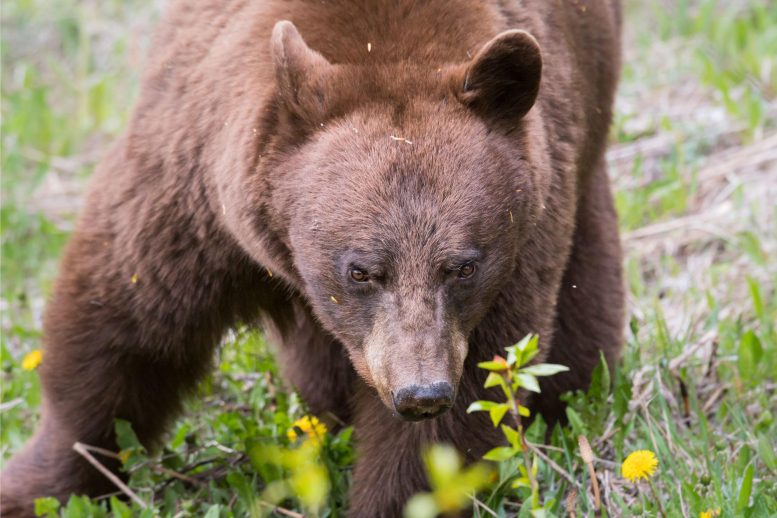
A team of researchers from HudsonAlpha, the University of Memphis, and the University of Pennsylvania have uncovered the underlying cause of the cinnamon-colored coat in certain black bears.
Names can be deceiving, as is the case with bears. In Yellowstone National Park, black bears are more common than the brown-hued grizzly bear, and in the Pacific Northwest coastal regions, the term “brown bear” typically refers to a grizzly bear. However, not all brown bears are grizzly bears.
Contrary to their name, American black bears (Ursus americanus) can come in a variety of colors, such as brown (also known as cinnamon), blond, or bluish-grey. Some bears even have coats that are a combination of different colors. Distinguishing a cinnamon-colored Ursus americanus from its brown (grizzly) Ursus arctos cousin can be challenging as the differences in body shape and size can be subtle. One theory for the cinnamon coloration in Ursus americanus is that it serves as camouflage or a defense mechanism by mimicking the appearance of a grizzly bear.
Now, researchers at HudsonAlpha, the University of Memphis, and the University of Pennsylvania, have discovered what causes the cinnamon color, which sheds some light on this color confusion.
Gene Variant Responsible for Cinnamon Morph Black Bear
Emily Puckett, Ph.D., an Assistant Professor of Biological Sciences at the University of Memphis, has devoted her career to learning more about the evolution and genetics of bears. With help from partners in state, provincial, and federal wildlife agencies, she collected hundreds of DNA and hair samples from North American bears. She teamed up with Greg Barsh, MD, Ph.D., Faculty Investigator at HudsonAlpha, and animal pigmentation expert to figure out why black bears aren’t always black.
In mammals, pigment is produced by skin cells called melanocytes. There are two types of melanin: eumelanin is black or brown, and pheomelanin is red or yellow. It is widely accepted that genetic variation in melanin biosynthesis gives rise to differences in hair, eye, and skin color. By studying photos of bears and chemically analyzing their corresponding hair samples, the team determined that cinnamon-colored black bears have reduced amounts of eumelanin, just like grizzly bears.
Genome sequence analysis of nearly 200 bears uncovered different missense mutations in the gene Tyrosinase-related protein 1 (TYRP1): cinnamon-colored black bears have a mutation called TYRP1R153C, while most (but not all) grizzly bears have a mutation called TYRP1R114C. The TYRP1 gene produces an enzyme within melanocytes that helps produce eumelanin, so it makes sense that the cinnamon and grizzly bears have less eumelanin. Furthermore, functional studies carried out by Mickey Marks, Ph.D., Professor of Pathology at the University of Pennsylvania, and his lab, determined that the TYRP1R153C and TYRP1R114C mutations interfere with melanin synthesis and distribution.
“When we looked at other species, we were surprised to find the TYRP1R153C variant responsible for cinnamon U. americanus is identical to one previously described as a cause of oculocutaneous albinism (OCA3) in humans,” says Barsh. OCA3 is characterized by reddish skin and hair and frequent visual abnormalities and is most common in people of African or Puerto Rican ancestry. But according to Puckett, bears with TYRP1 mutations have normal skin and can see just fine.
When and Where Did the Cinnamon Morph Arise?
The TYRP1R153C variant was primarily found in the southwest United States, at lower frequencies moving northward to Southeast Alaska and the Yukon Territory. TYRP1R153C was associated with the cinnamon color in black bears and the chocolate and light brown colors, meaning it accounts for almost all of the color diversity among U. americanus.
The researchers used their data to learn more about the TYRP1R153C mutation. One hypothesis is that it may have started in grizzly bears and then was transferred to black bears, but demographic analysis indicated that was not the case. Instead, the TYRP1R153C mutation arose spontaneously about 9,360 years ago in black bears living in the western United States, then spread as the bears moved across their current geographic range.
“Based on its wide range today, the TYRP1R153C mutation that arose in black bears over 9,000 years ago probably gave an advantage to the cinnamon bears,” says Puckett. “We used genetic modeling and simulations to predict the selective forces acting on the cinnamon morph. But our predictions ruled out the grizzly mimicry hypothesis as well as another hypothesis having to do with thermoregulation.”
As to why the coat color variant arose in the first place, the team presents a new hypothesis: crypsis. Crypsis refers to the ability of an animal to conceal itself and blend into the environment. Generally, crypsis is found in prey species and ambush predators who color match within their environments. Here, the researchers suggest crypsis as a broader adaptive mechanism for large-bodied species.
“These results illustrate how genetic variation in melanin biosynthesis can underlie iconic phenotypes and inform our understanding of color variation and recent evolution in large carnivores,” says Barsh.
Reference: “Genetic architecture and evolution of color variation in American black bears” by Emily E. Puckett, Isis S. Davis, Dawn C. Harper, Kazumasa Wakamatsu, Gopal Battu, Jerrold L. Belant, Dean E. Beyer, Colin Carpenter, Anthony P. Crupi, Maria Davidson, Christopher S. DePerno, Nicholas Forman, Nicholas L. Fowler, David L. Garshelis, Nicholas Gould, Kerry Gunther, Mark Haroldson, Shosuke Ito, David Kocka, Carl Lackey and Gregory S. Barsh, 16 December 2022, Current Biology.
DOI: 10.1016/j.cub.2022.11.042
Never miss a breakthrough: Join the SciTechDaily newsletter.
Follow us on Google and Google News.